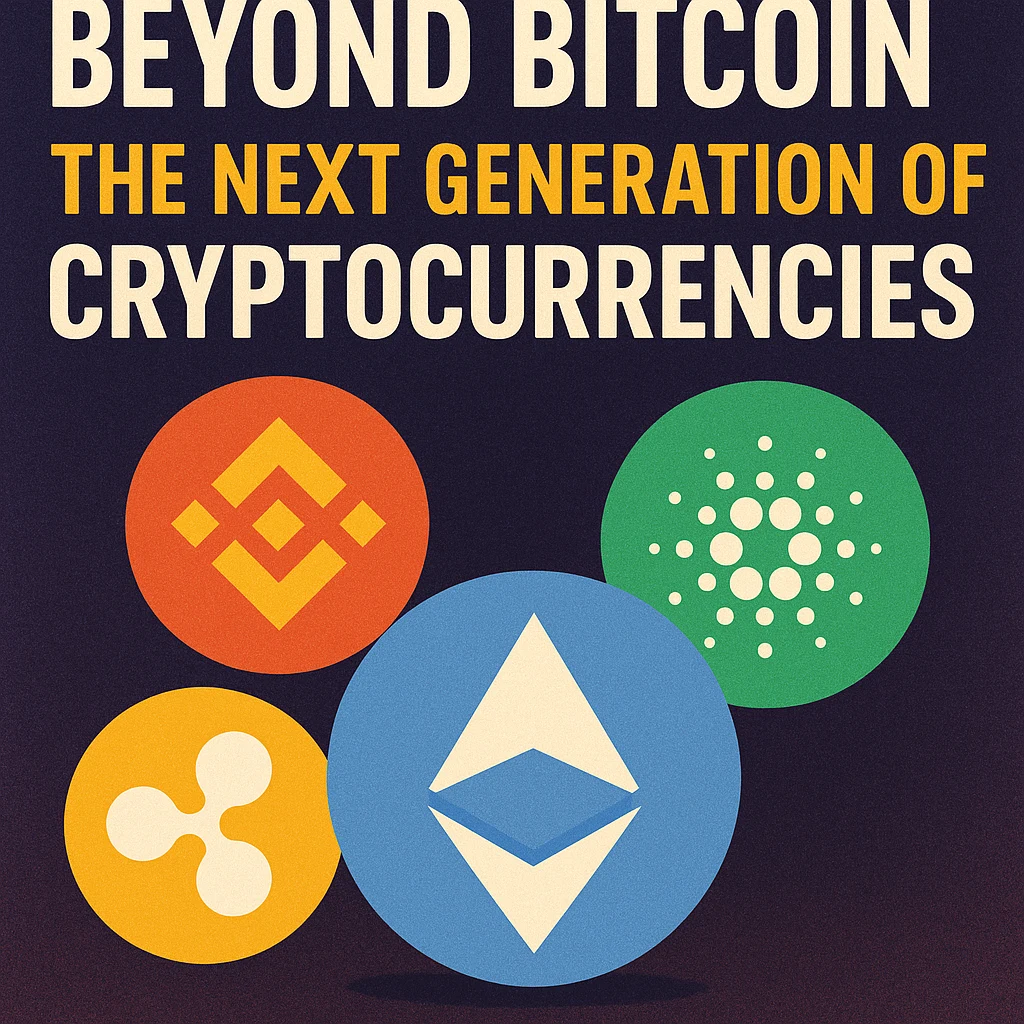
When Bitcoin initially surfaced in 2009, it was more than simply a novel kind of currency; it was a novel concept pertaining to technology, freedom, and trust. People were able to exchange money globally for the first time without depending on governments or banks. It presented decentralization, a revolutionary idea that fundamentally altered our understanding of financial institutions.
Even while Bitcoin was groundbreaking, it wasn't flawless. The blockchain of Bitcoin could only handle a few transactions every second. Its design was purposefully straightforward, emphasizing scarcity and protection over adaptability.
In the present day, the cryptocurrency scene has grown well beyond what Bitcoin first envisioned. Thousands of next-generation cryptocurrencies have surfaced, all of which seek to address Bitcoin's shortcomings, broaden its applications, and investigate the possibilities of fusing technology, finance, and human ingenuity.
The future of cryptocurrency is about a new digital economy, not merely digital gold.
1. Bitcoin’s Legacy: The Foundation of a Revolution
We must first comprehend what made Bitcoin revolutionary in order to comprehend what followed. A significant barrier to digital money, double-spending, was resolved by Bitcoin. Prior to Bitcoin, there was no method to guarantee that digital currency could not be replicated or used again without being verified by a central authority.
Bitcoin accomplished what no one else could: a decentralized, secure, peer-to-peer financial system with blockchain technology and a proof-of-work consensus process.
But its success also revealed its weaknesses. Bitcoin is:
-
Slow: 7 transactions per second, as opposed to Visa's 24,000.
-
Energy-intensive: Large amounts of electricity and processing power are needed for mining.
-
Limited in function: It is not intended for sophisticated applications or smart contracts.
The next generation of cryptocurrencies emerged as a result of these restrictions, which allowed for innovation.
2. The Rise of Ethereum: From Digital Gold to Digital Infrastructure
Ethereum is the second generation of cryptocurrency, if Bitcoin was the first. Ethereum, which was founded in 2015 by Vitalik Buterin, proposed a ground-breaking idea: smart contracts, which are self-executing agreements that are directly inscribed into the blockchain.
As a result, blockchain became a platform for decentralized applications (dApps) rather than a transaction ledger. Users could now engage with software that operated independently on the blockchain, generating everything from games to lending platforms, rather than merely exchanging money.
Ethereum’s contributions include:
-
Programmable money: Ethereum allows developers to build organizations, apps, and tokens.
-
DeFi (Decentralized Finance): Middlemen were removed from lending and trading through platforms like Uniswap and Aave.
-
NFTs (Non-Fungible Tokens): distinctive digital assets that transformed ownership, gaming, and the arts.
One of the main complaints about cryptocurrency was addressed with Ethereum's proof-of-stake upgrade (Ethereum 2.0), which also cut energy consumption by almost 99%.
Ethereum increased the capabilities of blockchain technology rather than taking the role of Bitcoin.
3. The Third Generation: Solving Scalability and Sustainability
Although Ethereum advanced blockchain technology, it also has problems with scalability, high transaction costs, and poor speeds. As a result, the third generation of cryptocurrencies emerged, designed to improve blockchain's accessibility, sustainability, and efficiency.
Cardano (ADA): The Academic Approach
Charles Hoskinson, a co-founder of Ethereum, developed Cardano using peer-reviewed research. It makes use of an efficient and scalable proof-of-stake method called Ouroboros.
Cardano seeks to integrate practical application with rigorous academic ideas, particularly in the areas of education, identity, and government in developing nations.
Polkadot (DOT): The Internet of Blockchains
Polkadot sees a multi-chain future in which seamless communication between several blockchains is possible. Because of its interoperability, data and value can be shared between Ethereum, Bitcoin, and other chains.
Because of its parachain architecture, developers can build customized blockchains that link to the main network, providing flexibility and security.
Avalanche (AVAX): High-Speed Consensus
With the potential to execute thousands of transactions per second, Avalanche prioritizes speed and scalability. It is perfect for decentralized banking and enterprise-level applications because of its special consensus method, which delivers almost instantaneous finality.
Algorand (ALGO): Sustainability Meets Speed
Algorand was created to solve the "blockchain trilemma," which involves striking a balance between security, scalability, and decentralization. It is one of the greenest cryptocurrency platforms due to its small energy impact and speedy transactions.
Each of these initiatives signifies a new phase in the development of blockchain technology—an endeavor to make decentralized systems quick, environmentally friendly, and accessible worldwide.
4. DeFi and Web3: A New Financial Ecosystem
Decentralized Finance (DeFi) is one of the most revolutionary uses of next-generation cryptocurrencies. Without the use of traditional banks, DeFi platforms enable users to trade, lend, borrow, and earn interest.
Users trust code rather than institutions. Everyone can audit the transparent smart contracts that power everything.
However, the shift is not limited to the financial sector. With the help of tokens and blockchain networks, the idea of Web3—a decentralized internet controlled by its users—is beginning to take shape.
-
DAOs (Decentralized Autonomous Organizations): communities that use blockchain-based voting to make decisions as a group.
-
Play-to-Earn Games: Through platforms like The Sandbox and Axie Infinity, people may profit from their internet engagement.
-
Social Tokens: In order to interact with followers and create communities, creators might issue their own currency.
These developments are advancing cryptocurrency beyond money and toward a decentralized digital civilization.
5. Stablecoins and CBDCs: Bridging Crypto and Traditional Finance
Stablecoins seek to combine the efficiency of blockchain technology with the stability of fiat money, whereas Bitcoin and altcoins are unstable.
Examples include:
-
USDT (Tether) and USDC (USD Coin) — based on the US dollar.
-
DAI — smart contract-driven decentralized stablecoin.
Stablecoins facilitate instantaneous payments, remittances, and settlements by acting as links between blockchain technology and conventional finance.
Central Bank Digital Currencies (CBDCs), or state-issued digital currency, are one way that governments are venturing into the blockchain arena. Blockchain ideas can be used to formal monetary systems, as demonstrated by China's Digital Yuan and Europe's Digital Euro.
Despite being centralized, CBDCs support the same fundamental notion as Bitcoin: money will be digital, programmable, and instantaneous in the future.
6. Privacy Coins and the Fight for Financial Freedom
Privacy is becoming a major worry as blockchain becomes more widely used. Every transaction on the majority of blockchains, such as Ethereum and Bitcoin, can be tracked.
Zcash (ZEC) and Monero (XMR), two next-generation privacy coins, have a distinct strategy. They conceal transaction details while preserving security by using sophisticated encryption, such as zero-knowledge proofs.
These initiatives bring up a crucial issue: is transparency possible without monitoring? Privacy coins serve as a reminder that decentralization was always intended to safeguard individual freedom rather than only financial efficiency as governments tighten their laws on cryptocurrencies.
7. The Role of Layer-2 Solutions
Blockchains must expand without compromising decentralization as demand rises. In order to manage more transactions effectively, Layer-2 solutions—technologies built on top of current blockchains—are introduced.
-
Lightning Network (for Bitcoin): allows for quick and inexpensive Bitcoin transactions.
-
Polygon (for Ethereum): increases Ethereum's capacity through quicker and less expensive transactions.
-
Optimism and Arbitrum: To combine transactions off-chain and save down on fees and congestion, use "rollups."
These technologies guarantee that blockchains maintain their decentralized nature while remaining useable for millions of users as they expand.
8. The Environmental Turn: Green Cryptocurrencies
The impact of Bitcoin on the environment is one of the main objections. With energy-efficient consensus mechanisms, next-generation cryptocurrencies are directly tackling this issue.
-
Proof-of-Stake (PoS): It uses a much less energy than proof-of-work and is utilized by Ethereum, Cardano, Solana, and other systems.
-
Proof-of-History (PoH): Solana uses it to keep the network synchronized and fast.
-
Delegated Proof-of-Stake (DPoS): Consensus-based community governance is introduced by EOS and TRON.
These examples show how blockchain can develop responsibly while preserving security and decentralization and in line with global environmental objectives.
9. The Next Frontier: AI, IoT, and Quantum Resistance
The next wave of cryptocurrencies will focus more on integration than just money. Blockchain will interact with quantum computing, artificial intelligence (AI), and the Internet of Things (IoT) as technology develops.
-
AI-powered blockchains similar to Fetch. AI is creating self-governing economic agents that engage in independent trade and interaction.
-
IoT-focused cryptocurrencies such as Helium and IOTA want to make machine-to-machine payments possible in smart cities.
-
Quantum-resistant cryptography is being created to defend blockchains against potential attacks by quantum computers in the future.
These developments will guarantee blockchain's applicability in a world growing more intelligent and connected.
10. The Road Ahead: What Comes After Bitcoin
The foundation—the initial spark that started the decentralized revolution—will always be Bitcoin. However, the next wave of cryptocurrencies is laying the groundwork for everything that will exist in the future, including communication, identification, art, governance, and finance.
Here’s what the next decade might bring:
-
Mainstream adoption: Crypto became a natural part of everyday life.
-
Global interoperability: a network of linked blockchains that works similarly to the internet.
-
Tokenized economies: All assets, including stocks and homes, are on the chain.
-
Digital self-sovereignty: People are in charge of their money, identities, and data.
We are transitioning from a world where money was regulated and scarce to one where value is shared by everybody and trust is decentralized.
Conclusion: The Evolution Has Just Begun
A new era of innovation lies beyond Bitcoin, where blockchains are about connections rather than just cash. Every new cryptocurrency advances quicker, smarter, and more inclusive systems by building on the lessons learned from previous ones.
The next generation—Ethereum, Cardano, Solana, Polkadot, and others—is shaping the future of digital trust and international banking, but Bitcoin initiated the change.
Not only will money be decentralized in the future, but it will also be intelligent, cooperative, and infinite. In this future, every creation, contract, and transaction bears not only value but also the network's collective trust.