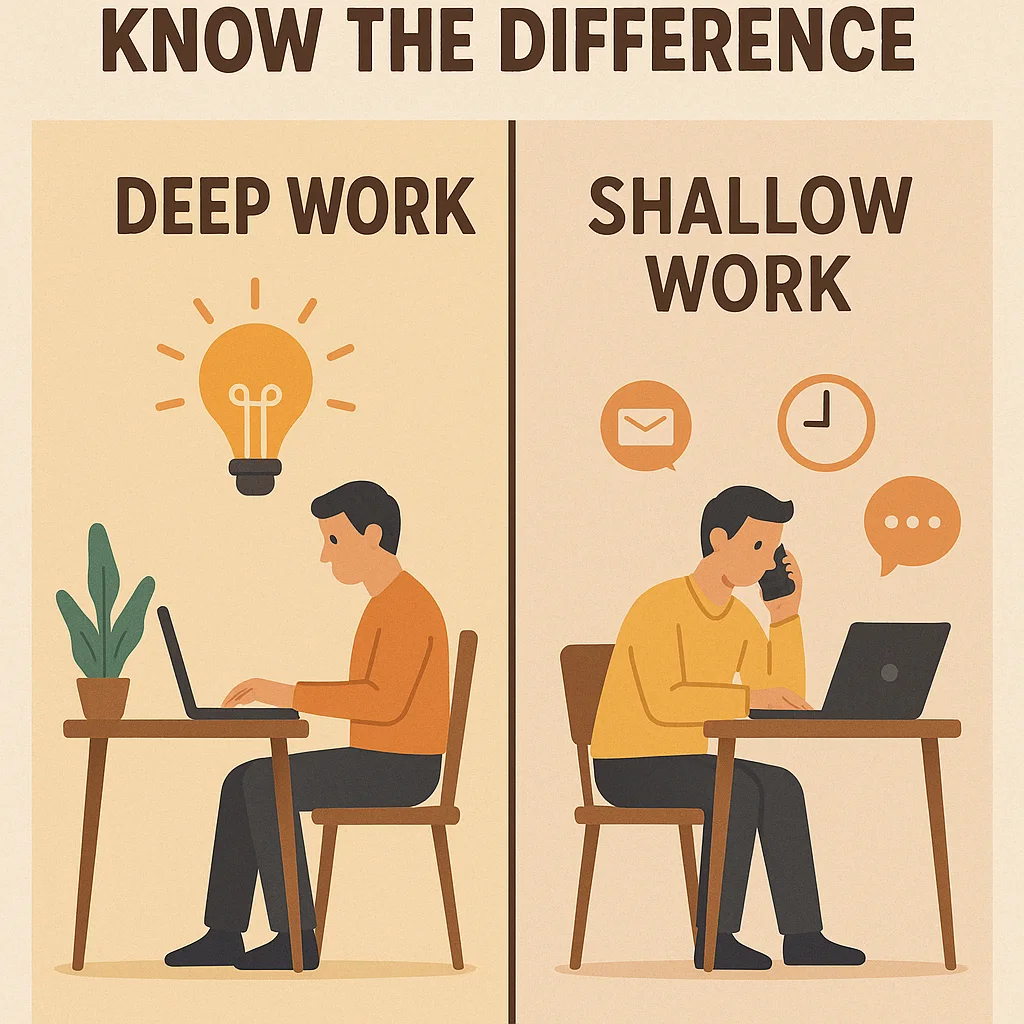
Deep focus is becoming a rare and valuable skill in today's hyperconnected world, where distractions are just a click away. Few of us are working on projects that actually make a difference, even though many of us spend the day responding to emails, going to meetings, and reading through messages.
Understanding the distinction between deep and shallow work is crucial for success in the contemporary knowledge economy. After you do, you'll have the clarity to prioritize your most important tasks, take back your time, and generate more significant outcomes.
What Is Deep Work?
Coined by productivity expert Cal Newport in his bestselling book Deep Work, the term refers to:
“Professional activities performed in a state of distraction-free concentration that push your cognitive capabilities to their limit.”
Characteristics of Deep Work:
-
Requires full focus and zero distractions
-
Engages high-level cognitive functions
-
Leads to learning, growth, or the creation of something valuable
-
Difficult to replicate and often irreplaceable
-
Examples: Writing a book, designing a product, coding, making art, researching, and solving complicated problems
Why Deep Work Matters
Deep work is where true value is created. It’s what allows you to:
-
Master difficult skills
-
Produce work that is original and meaningful
-
Stand out in a noisy world
-
Build a sustainable, fulfilling career
According to Newport, "The deep work hypothesis: The ability to perform deep work is becoming increasingly rare at exactly the same time it is becoming increasingly valuable."
What Is Shallow Work?
Shallow work refers to tasks that are:
-
Non-cognitively demanding
-
Often performed while distracted
-
Logistically necessary but low in value
-
Easy to replicate and delegate
-
Examples: Managing schedules, responding to emails, checking social media, attending status update meetings, and performing simple data entry
Even though short-term work may seem productive at the time, it frequently makes little long-term progress.
Why Most People Are Stuck in Shallow Work
The modern workplace is optimized for shallow work:
-
Open office spaces encourage interruptions
-
Notifications constantly hijack attention
-
Instant messaging promotes responsiveness over reflection
-
“Busyness” is celebrated more than results
Without intentional effort, shallow work expands to fill the entire day.
The Hidden Cost of Shallow Work
1. It Reduces Creative Output
Even though you might think you're working hard, doing mediocre work doesn't push your creativity or challenge your thinking.
2. It Leads to Burnout
Continuous context switching and multitasking are mentally taxing but rarely fulfilling.
3. It Stunts Professional Growth
Your skills won't get better with shallow work. You might eventually find yourself trapped in a never-ending cycle of busyness without progress.
4. It Undermines Your Competitive Edge
Those who can master complex work—thinkers, builders, and creators—will always have more clout in a global market than those who only keep things running smoothly.
How to Prioritize Deep Work in Your Life
✅ 1. Time Blocking
Dedicate specific chunks of time in your calendar for deep work. During these blocks:
-
Turn off notifications
-
Close unnecessary tabs and tools
-
Let others know you’re unavailable
Even just 2–4 hours of focused deep work daily can outperform a whole day of multitasking.
✅ 2. Create a Deep Work Ritual
Develop a deep work routine. Decide on a regular time and place for it, like before the world wakes up every morning.
Consider:
-
Where will you work?
-
How will you minimize distractions?
-
What materials do you need?
-
How will you measure success?
✅ 3. Limit Shallow Work to Designated Times
Don’t let shallow work hijack your day. Batch these tasks:
-
Set specific time blocks to check email or messages
-
Avoid starting your day with shallow work
-
Use tools like autoresponders or scheduling assistants
The less reactive you are, the more proactive you can become.
✅ 4. Practice the “Shutdown Ritual”
Review your accomplishments at the end of the day and make plans for the deep work block the following day. This enhances evening relaxation and clears the mind.
✅ 5. Train Your Focus Muscle
The more you use your focus, the stronger it becomes. Increase the length of your deep work sessions gradually by starting with shorter ones (30 to 45 minutes).
Avoid multitasking during this period. No switching tabs, no phone checks. Build your ability to sit with a single problem.
Combining Both Work Types: Finding the Balance
Shallow work isn’t evil—it’s often necessary. The key is balance.
Consider your day as a meal. The main course is deep work, which is nourishing, fulfilling, and necessary. While it's important, shallow work isn't the main attraction.
Aim for a 70/30 or 60/40 split between deep and shallow work. Protect your deep work time fiercely and streamline your shallow work with automation, delegation, or elimination.
Real-World Examples of Deep Work Success
🎨 Creators & Writers
In order to concentrate deeply, J.K. Rowling secluded herself in a hotel to finish Harry Potter and the Deathly Hallows. She was able to create magic—literally—after gaining clarity and space through deep work.
🧠 Programmers
Proficient software developers frequently spend hours in "flow states" to create scalable systems or address important bugs—tasks that demand their full focus.
🧪 Scientists & Researchers
Innovative scientific breakthroughs don't come during a Slack meeting. They happen in prolonged sessions of deep thought, experimentation, and analysis.
Technology and Deep Work: Friend or Foe?
While tech can be a tool, it’s also the biggest barrier to deep work. Here’s how to make it work for you:
-
Use website blockers like Freedom or Cold Turkey
-
Keep your phone in another room
-
Schedule tech-free deep work hours daily
-
Turn off Slack, Teams, and email notifications during deep sessions
Remember: attention is your most valuable currency. Spend it wisely.
Conclusion: Choose Depth Over Distraction
Anyone can look busy in this day and age. However, only those who are adept at deep work will prosper in their mental, creative, and professional lives.
Shallow work keeps you busy.
Deep work makes you valuable.
You can break free from the cycle of digital noise and create work that endures by realizing the difference and purposefully planning your day around what really matters.