Introduction: The Rise of Forest Bathing
The thought of just taking a leisurely stroll through a forest may sound nearly radical in a society where screens, schedules, and constant stimulation rule. However, this method—also referred to as Shinrin-yoku or forest bathing—has become well-known throughout the world as a treatment for contemporary stress. Forest bathing, which originated in Japan in the 1980s, encourages people to use all five senses to fully immerse themselves in nature without regard to fitness objectives, goals, or electronic distractions.
A crucial question arises as forest bathing is promoted by therapists, wellness retreats, and social media influencers. Is forest bathing essentially a spiritual trend marketed for contemporary audiences, or is it a scientifically proven way to improve health? The answer is found at the intersection of human intuition, psychology, and biology.
What Exactly Is Forest Bathing?
Hiking, working out, and sightseeing are not the same as forest bathing. It is the act of being in the moment in a wooded setting, letting the senses interact with the environment organically. Walking slowly, paying attention to the bark's texture, listening to the wind and birds, observing light patterns, and taking deep breaths are all recommended..
Experience is prioritized over accomplishment. No step count, no destination, and no performance pressure are there. This deliberate slowing down stands in stark contrast to contemporary life, when self-worth is frequently determined by production.
The Scientific Foundations of Forest Bathing
How the Body Responds to Forest Environments
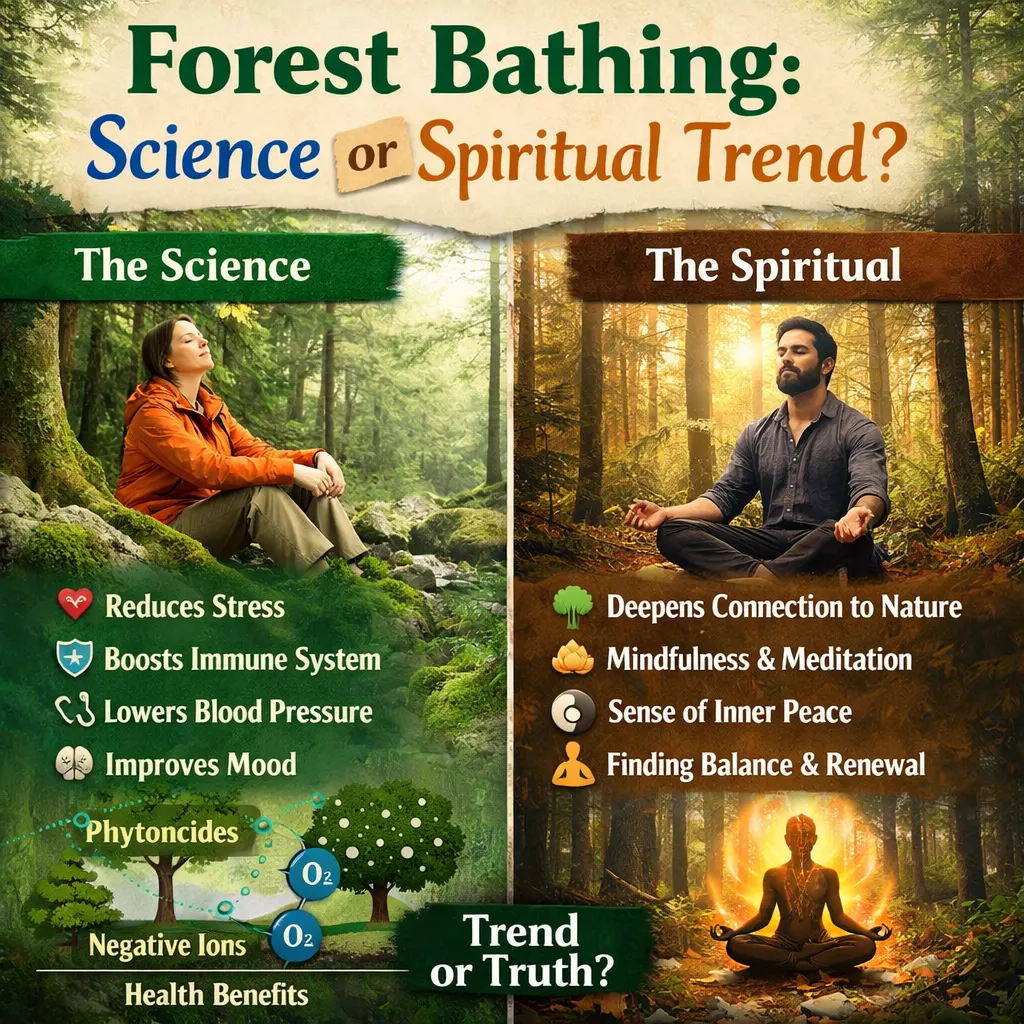
Over the past 20 years, there has been a notable increase in scientific interest in forest bathing. Its effects on stress hormones, blood pressure, heart rate, immunological response, and brain activity have all been investigated by researchers. The lowering of cortisol, the hormone linked to stress, is one of the most frequently noted benefits.
Additionally, as part of their natural defense mechanism, trees in forests release organic substances known as phytoncides. According to research, inhaling these substances may improve immune function by boosting the activity of natural killer cells, which are involved in the fight against infections and even malignant cells.
✔ Reduced cortisol levels and lower blood pressure
✔ Improved immune response through exposure to phytoncides
✔ Calmer nervous system activity and improved heart rate variability
The Brain on Nature
Additional understanding of the healing effects of forest bathing comes from neuroscience. Traffic signals, alerts, crowds, and noise all require continuous focused attention in urban settings. Mental exhaustion results from this. In contrast, forests provide what psychologists refer to as "soft fascination." Without overtaxing the brain, natural patterns softly retain attention.
Studies on brain imaging reveal that spending time in nature lowers activity in areas linked to anxiety and rumination. Rather, it stimulates regions associated with creativity and emotional control. This explains why spending time in forests frequently results in people reporting emotional comfort and mental clarity.
The Psychological Appeal of Forest Bathing
Reconnection in a Fragmented World
Humans are frequently cut off from natural rhythms by modern living. Living indoors separates us from seasonal change, digital communication replaces in-person interactions, and artificial illumination throws off circadian cycles. Reconnecting with oneself as well as with nature is possible through forest bathing.
Time feels different in forests. People become more conscious of their inner states when they are not constantly reminded of productivity. Emotions surface more clearly, thinking calm down, and sensory awareness intensifies. Forest bathing is becoming more and more suggested as a treatment for anxiety, burnout, and emotional tiredness because of this psychological transformation.
✔ Encourages mindfulness without structured meditation
✔ Reduces mental overload caused by constant digital exposure
✔ Enhances emotional awareness and self-reflection
Why Forests Feel Safer Than Cities
From an evolutionary standpoint, people have spent thousands of years evolving in their natural habitats. Greenery, flowing water, and wide spaces are all perceived by our brains as indicators of resources and safety. Because they indicate unpredictability, heavy traffic, loud noises, and artificial structures might produce low-level stress reactions.
This age-old neurological comfort is accessed by forest bathing. The body exits survival mode when it feels safe. Breathing slows, muscles relax, and the mind shifts from being protective to being more sensitive.
The Spiritual Side of Forest Bathing
Ancient Roots and Cultural Wisdom
Cultures all throughout the world understood the spiritual significance of trees long before cortisol levels were measured by science. According to indigenous traditions, trees are wise, living creatures. Forests are revered places where spirits reside in Japanese Shinto beliefs. Groves were used for ritual and healing in Celtic societies.
By promoting reverence rather than control, forest bathing reflects these customs. Participants are asked to listen to nature rather than try to conquer it. Those looking for purpose beyond financial achievement find resonance in this spiritual framing.
Is It Just a Wellness Trend?
Critics contend that forest bathing has lost its authenticity due to its commercialization into retreats, certifications, and opulent experiences. Spiritual activities run the risk of becoming fads rather than significant experiences when they are promoted without taking into account cultural context.
Commercialization does not, however, negate the fundamental practice. Forest bathing encourages humility, patience, and presence—qualities frequently linked to spiritual development—even when done in a secular manner. Belief systems are not necessary for the experience to work, yet it can inherently inspire wonder and a sense of connectedness.
✔ Promotes feelings of interconnectedness and humility
✔ Encourages reverence rather than consumption of nature
✔ Bridges ancient spiritual intuition with modern wellness needs
Forest Bathing vs Other Nature-Based Practices
The purpose of forest bathing is different from that of hiking, camping, or adventure sports. Forest bathing emphasizes attentiveness, whereas hiking concentrates on distance or physical difficulty. Forest bathing strikes a balance between inner awareness and external sensory information, whereas meditation frequently becomes internal.
It is very accessible because of this. Forest bathing is typically simpler for those who have trouble with traditional meditation because the setting naturally directs focus. The only thing to do is to observe what is already there; there is no pressure to stop thinking.
Who Benefits Most from Forest Bathing?
Forest bathing seems to be particularly beneficial for people who are dealing with long-term stress, anxiety, digital exhaustion, or creative burnout, however almost anybody can benefit. The most severe impacts are frequently reported by office workers, students, caretakers, and urban dwellers.
Children gain a great deal as well. Spending time in woods has been associated with decreased symptoms of attention difficulties, better focus, and emotional regulation. Forest bathing can promote emotional and cognitive wellness in elderly persons without causing physical hardship.
Science or Spiritual Trend: A False Divide
When science and spirituality are discussed, it is frequently assumed that they are diametrically opposed. This notion is called into question by forest bathing. The effects of forests on the body and brain are explained by science. The significance of the encounter can be explained by spirituality. Different facets of the same human reaction are described by both viewpoints.
Forest bathing is effective because people are both biological users and emotional beings at the same time, not because it is mystical or quantifiable on its own. The mind opens as the nervous system calms. Meaning comes organically when the mind is silent.
Conclusion: Why Forest Bathing Matters Today
Forest bathing is neither a fad nor a miracle remedy. It serves as a reminder of something that people have always understood but frequently overlook: the close relationship between wellbeing and the natural world. Forest bathing allows people to slow down guilt-free in a time of perpetual acceleration.
Forest bathing encourages a more compassionate relationship with time, attention, and the self, regardless of how it is approached—through science, spirituality, or just plain curiosity. It doesn't require production, performance, or belief. It merely requests your presence. And its worth becomes evident in a world that hardly ever permits that.