Introduction: The Invisible Hand Behind Our Screens
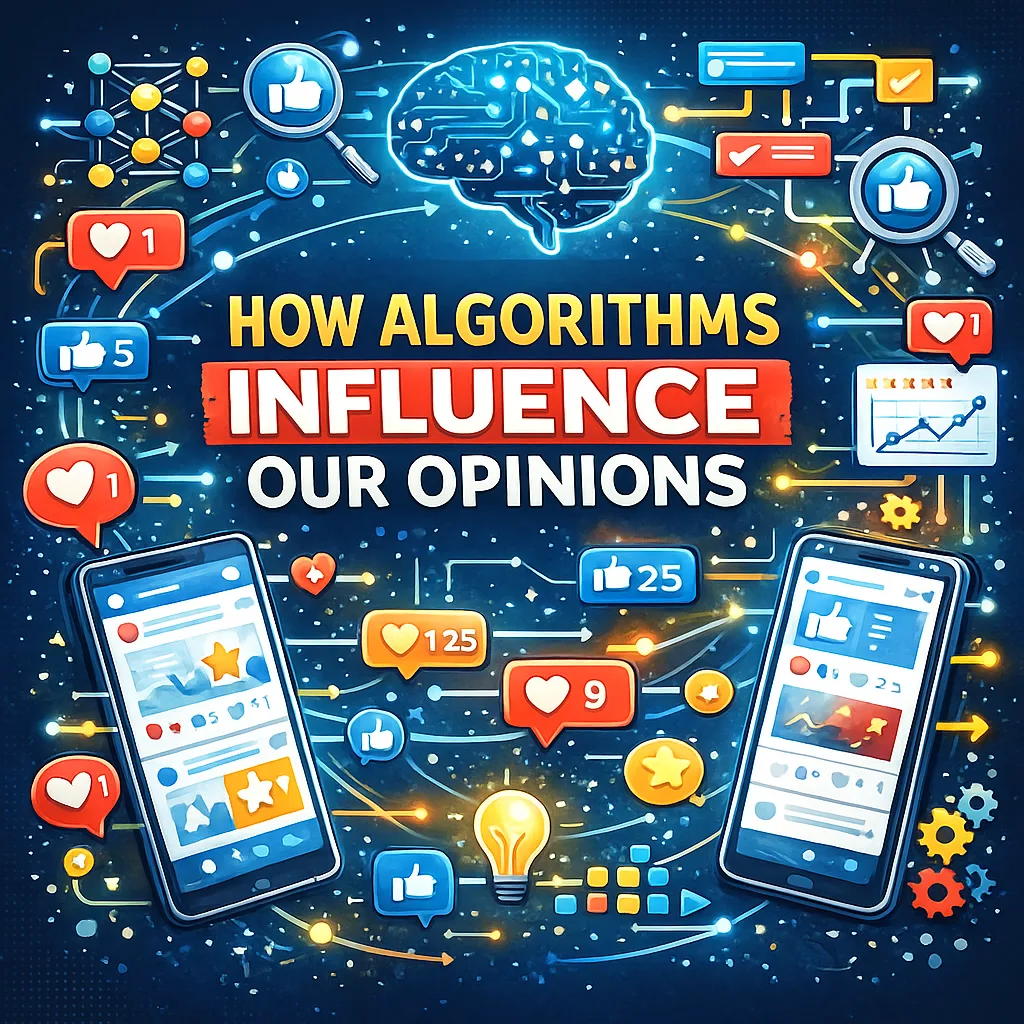
Every click, like, share, and scroll seems like a personal decision. We think we have control over what we read, watch, and interact with on the internet. However, algorithms are an unseen power that shapes every social media feed, video recommendation, news headline, and search result.
What stuff gets to us and what silently vanishes is decided by these automatic decision-making systems. Over time, they do more than just arrange data; they have an impact on our beliefs, thoughts, and even worldview.
Algorithms are no longer impartial instruments. They are now strong gatekeepers of opinion, able to promote some viewpoints while stifling others. In a world where digital platforms are progressively influencing political opinions, cultural trends, public debate, and individual identities, it is crucial to comprehend their impact.
What Are Algorithms and Why Do They Exist?
Algorithms are fundamentally collections of instructions intended to solve issues or reach conclusions. They are used to effectively categorize enormous volumes of content on digital platforms. Search engines would be useless without algorithms, social media feeds would be disorganized, and streaming services would find it difficult to suggest pertinent information.
The main objective of the majority of contemporary algorithms is engagement. Metrics like time spent, clicks, comments, and shares are used by platforms to gauge their success. The platform's profitability increases with user engagement. Algorithms are therefore tuned to provide material that is most likely to keep consumers reading, seeing, and responding.
Influence starts with this emphasis on participation. Content that elicits strong emotional reactions, such as fear, wrath, excitement, or validation, typically performs better than content that is neutral or subtle. Algorithms gradually pick up on what grabs users' attention and give it priority, gently influencing their mental and emotional landscapes.
Personalization: When the Internet Becomes “Your” Internet
Personalization is one of the most potent aspects of contemporary algorithms. In order to build comprehensive user profiles, platforms monitor activity including likes, watch time, search history, and conversations. Each person's online experience is made distinct by using these profiles to personalize content feeds.
Personalization limits exposure even if it can be practical. Content that supports users' preexisting interests and opinions is more likely to be seen. As a result, competing opinions become less prominent and similar ideas are continually reinforced, creating a feedback cycle. This can eventually create the false impression that "everyone thinks this way," despite the fact that reality is much more varied.
✔ Instead of challenging preexisting assumptions, personalized algorithms serve to reinforce them.
✔ Repeated exposure boosts credibility and perceived truth.
✔ Over time, opposing perspectives become less apparent.
This process occurs gradually and frequently goes unnoticed by consumers. Algorithmic reinforcement is often what appears to be natural preference.
Echo Chambers and Filter Bubbles
The phrases "filter bubble" and "echo chamber" refer to situations in which people are mainly exposed to information that supports their preexisting opinions. In order to create these places, algorithms are essential. Platforms lessen intellectual friction by giving priority to material that is similar to what users already interact with.
Opinions are reinforced rather than challenged in echo chambers. While disagreement feels uncommon or antagonistic, agreement becomes constant. Over time, moderate viewpoints may become more extreme due to the intensification of beliefs caused by this environment. People may view opposing viewpoints as dangers rather than as valid distinctions when they eventually come upon them.
Critical thinking is also weakened by filter bubbles. Users have less opportunities to assess arguments, examine sources, or hone beliefs when they are not frequently questioned. This can eventually result in polarization and overconfidence, both offline and online.
Algorithms and Emotional Manipulation
Algorithms are remarkably adept at figuring out what affects consumers emotionally. Emotionally charged content spreads more quickly and widely than neutral information, according to studies. Although engagement-based systems inherently prefer material that elicits a response, platforms do not always aim to manipulate emotions.
This fosters an atmosphere that rewards indignation, terror, and sensationalism. Opinions get more extreme, stories become simpler, and headlines become more dramatic. Complicated problems are broken down into emotionally appealing chunks that are simpler to understand and distribute.
As a result, emotions frequently take precedence over facts on the internet. Reasoned debate is more difficult to maintain when engagement is motivated by emotions. Algorithms simply react to quantifiable engagement; they do not differentiate between constructive manipulation and healthy enthusiasm.
The Role of Algorithms in Political Opinions
Particularly susceptible to algorithmic manipulation are political beliefs. Ideological inclinations are gradually shaped by news feeds and video platforms that frequently suggest political content based on past participation. Because extreme ideas increase engagement, users may begin with mild curiosity and gradually be exposed to them.
Direct persuasion is not necessary for this approach. Rather, it functions through exposure and repetition. Repeated exposure to identical political messaging can normalize them, giving the impression that some beliefs are popular even though they are not. Users may develop stronger ideas over time without being aware of how they were formed.
✔ Perceived legitimacy rises when political content is repeated.
✔ Neutral analysis is outperformed by emotional political posts.
✔ Extremism may inadvertently be amplified by algorithms.
This poses significant questions concerning social cohesiveness and well-informed decision-making in democracies.
Algorithmic Bias and Its Impact on Beliefs
Although algorithms are created by humans and taught on data created by humans, they are frequently thought of as objective. This implies that prejudices based on race, gender, culture, and ideology may be passed on to them. Biased data can gently influence social ideas when it is reinforced through participation.
For instance, users may unintentionally adopt skewed attitudes if particular groups are underrepresented or badly portrayed in suggested information. Stereotypes and inequality are reinforced as a result of these patterns' long-term influence on societal attitudes.
Users hardly ever criticize algorithmic judgments since they are essentially invisible. Even if the content at the top of a feed is the product of intricate and biased mechanisms working in the background, it frequently seems spontaneous or deserving.
The Illusion of Choice and Control
The appearance of autonomy is one of algorithms' most potent impacts. Users assume they have control over what they read, watch, and believe. In actuality, decisions are largely influenced by what is made available and apparent. Unrecommended content might as well be nonexistent.
This indicates that influence is subtle, but it does not imply that consumers are helpless. Algorithms influence the context in which beliefs are formed, not the opinions themselves. Exposure progressively alters perception, much like living in a room where some talks are constantly louder than others.
Reclaiming agency in digital places starts with understanding this illusion.
Can We Resist Algorithmic Influence?
It is not necessary to give up on technology in order to resist algorithmic dominance. It calls for consciousness and deliberate action. Algorithmic molding can be lessened by users who actively seek out a variety of sources, challenge emotional responses, and restrict passive scrolling.
Additionally, platforms must create processes that put informational diversity and wellbeing ahead of pure participation. In order to create healthy digital environments, transparency, user control, and ethical AI development are crucial.
✔ Awareness weakens unconscious influence
✔ Diverse information sources reduce echo chambers
✔ Intentional digital habits restore autonomy
The objective is to live more mindfully with algorithms rather than to completely eradicate them.
Conclusion: Shaping the Future of Digital Thought
These days, algorithms are a part of our mental environment. Instead of using coercion, they shape opinions via emotional connection, visibility, and repetition. They provide ease and customization, but they also inadvertently and frequently unnoticeably influence beliefs.
Algorithms already have an impact on us, so the question is not if they will. The true question is whether we recognize that impact and react to it intelligently. We can make sure that algorithms promote informed thought rather than subtly supplanting it by raising awareness, demanding ethical design, and critically interacting with digital content.
Ultimately, technology is a reflection of human values. Our ideas' future is determined not only by the algorithms that direct us but also by the consciousness with which we decide to adhere to them.