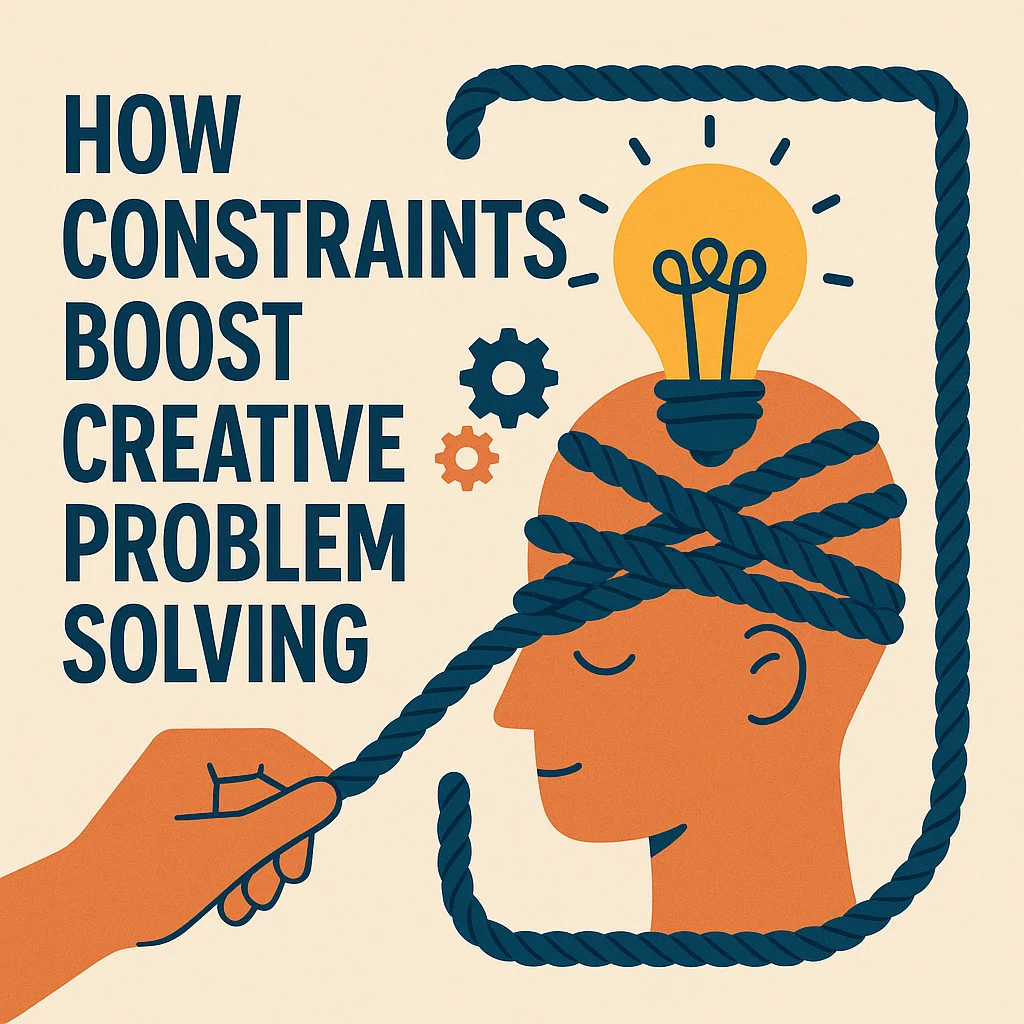
When we think of creativity, we frequently picture complete freedom and limitless possibilities. However, in practice, the most creative solutions frequently come from stringent constraints rather than limitless resources.
Constraints, such as a limited budget, time, tools, or regulations, can be strong motivators for innovative problem solving. They make the mind think differently—to innovate within limits—instead of stifling creativity.
In this blog, we’ll explore:
-
Why constraints don’t stifle but stimulate creativity
-
Real-world examples of constraint-driven innovation
-
How to apply constraints deliberately to spark better ideas
-
Practical tips to turn limitations into your superpower
Let’s uncover the paradox of creativity: why thinking “inside the box” may be the key to breakthrough ideas.
Why We Assume Constraints Are Bad for Creativity
It's a widely held belief that creativity flourishes when one is allowed to do anything. From startup culture's "think outside the box" motto to art school critiques, this concept appears everywhere.
However, having too much freedom can paralyze you. When there are countless options, decision fatigue can overwhelm the brain. It causes creative paralysis. Ironically, fewer options can spur creativity and action.
The Psychology Behind Constraints and Creativity
Research in cognitive science supports the idea that constraints fuel innovation.
People who were given fewer resources to solve a problem came up with more creative solutions than those who had plenty of resources, according to a seminal study published in the Journal of Personality and Social Psychology.
Why? Because constraints:
-
Narrow focus, forcing attention on what truly matters
-
Trigger lateral thinking, pushing the brain to find new angles
-
Provide structure, which helps organize and build ideas
-
Create urgency, speeding up decision-making
Think of it like this: when your path is blocked, you find new ways through the forest.
Famous Examples of Creativity Through Constraints
Throughout history, countless breakthroughs have been born from necessity and limitations.
1. Dr. Seuss and “Green Eggs and Ham”
Bennett Cerf, the publisher, bet Dr. Seuss that he couldn't write a book with just fifty words. Green Eggs and Ham, one of the best-selling children's books ever, is the end result. Seuss was forced by the constraint to use extreme simplicity to create rhythm, rhyme, and charm.
2. The Apollo 13 Mission
Engineers had to use only the parts that were on board to solve life-or-death problems when the oxygen tank on NASA's Apollo 13 spacecraft exploded in 1970. They saved the lives of the astronauts by making a makeshift CO2 filter out of plastic tubing, duct tape, and socks due to damaged systems and limited power.
3. Twitter’s 140-Character Limit
Twitter's 140-character limit, which has since been extended, was initially enforced as a result of SMS restrictions and compelled users to be succinct. This influenced a whole culture of micro-content, memes, and succinct communication.
4. Pixar’s “Toy Story”
Significant technical limitations, such as a lack of processing power and animation tools, were faced by the Toy Story animation team. They adopted the style, using toys as characters, where slightly stiff movements felt natural, rather than viewing these as issues. The end result was an innovative movie that ushered in a new era of animation.
The Science of “Creative Tension”
Creative tension is the gap between where you are and where you want to be. Constraints add pressure to that gap, creating a tension that demands resolution.
In psychological terms, this is linked to:
-
Divergent thinking: generating multiple ideas or possibilities
-
Cognitive dissonance: the discomfort of conflicting thoughts or goals
-
Flow state: intense focus within defined challenges
Without constraints, there's no tension. Without tension, there's no urgency to innovate.
Types of Constraints That Spark Creativity
Not all constraints are created equal. Here are some that frequently trigger creative breakthroughs:
1. Time Constraints
Deadlines and time boxes force fast prioritization. The brain works differently under a ticking clock.
Example: Hackathons, 24-hour film challenges, and time-limited design sprints often produce more exciting outcomes than open-ended projects.
2. Budget Constraints
A lack of resources encourages frugality and ingenuity.
Example: Indie filmmakers using smartphones instead of professional cameras to create award-winning films.
3. Material Constraints
Having limited tools or materials forces unconventional usage.
Example: Artists using only recycled materials to create powerful environmental statements.
4. Rules-Based Constraints
Sometimes, self-imposed rules shape new forms.
Example: The haiku’s 5-7-5 syllable structure limits language but enhances poetic depth.
5. Audience or Format Constraints
A need to communicate with a specific group or through a specific medium focuses the message.
Example: Designing an app for elderly users with low digital literacy sharpens the interface and user experience.
How to Use Constraints Deliberately
Instead of waiting for limitations to show up, you can build them into your creative process. Here’s how:
1. Set Artificial Deadlines
Don't wait for outside pressure to build. Allow yourself 30 minutes to write an idea outline or 2 hours to sketch a prototype.
2. Limit Your Tools
Don't use more than one brush, app, or font. Your mind investigates more complex variations when there are fewer options.
3. Shrink the Scope
Challenge yourself to do more with less:
-
Write a story in 100 words
-
Design a product with just 3 features
-
Make a video in one take
4. Use Constraint Prompts
Generate ideas from constraint-based exercises:
-
“Solve this problem without using money.”
-
“Design this for someone with only one hand.”
-
“Create something using only what’s in your fridge.”
5. Adopt a Constraint Mindset
Start seeing every obstacle as a creative opportunity. Instead of saying, “I can’t do this because I lack X,” ask:
“How can I do this despite lacking X—or because of it?”
Common Objections to Embracing Constraints
Even though the benefits are proven, many people still resist constraints. Let’s address common fears:
“I can’t be creative without full freedom.”
In truth, too much freedom overwhelms your brain with options. Constraints give you a clear stage to perform on.
“Constraints feel limiting, not empowering.”
We perceive boundaries as walls, which is why. Change your perspective and consider them as frames that mold the artwork rather than as shackles that confine it.
“It won’t be good enough.”
Constraint-driven work often feels imperfect. But perfection isn’t the goal—progress, originality, and momentum are.
Final Thoughts: Embrace the Box
It's not quite complete to say that you need to "think outside the box." Occasionally, the magic is created by the box itself.
Limitations serve as stepping stones to innovation rather than obstacles to creativity. They challenge us to think more clearly, let go of our comforts, and follow unexpected paths. Creative limitations, whether internal or external, can inspire some of your most potent, sophisticated, and brilliant ideas.
Therefore, instead of complaining the next time you feel constrained by resources, time, money, or structure, try creating. The smallest spaces might contain your best ideas.