Seldom does life turn out the way we see it when we are young. Many people are raised to believe that once one's identity is established, it remains largely unchanged. However, age frequently shows a different reality. Relationships, career changes, setbacks, losses, and unexpected responsibilities all gradually but significantly alter our self-perception. Identity is a dynamic process that reacts to experience rather than a static structure. Significant life changes influence the narrative we tell ourselves about ourselves, not just our daily routines.
Moving to a new city, having a child, losing a loved one, or changing occupations are examples of situations that make us face aspects of ourselves we might not have known existed. The change might occasionally seem liberating. At other times, it might be painful and confusing. We may handle these times with greater clarity and self-compassion if we comprehend how and why identity shifts throughout significant life transitions.
Understanding Identity as a Flexible System
Identity is frequently misinterpreted as a consistent collection of characteristics or a solid personality. Identity is actually a dynamic system that is molded by relationships, memory, the environment, and meaning-making, according to psychologists. As our responsibilities, attitudes, and beliefs change, so does it. Significant life transitions challenge preexisting self-definitions by acting as disruptions.
Identity Is Built Through Roles and Narratives
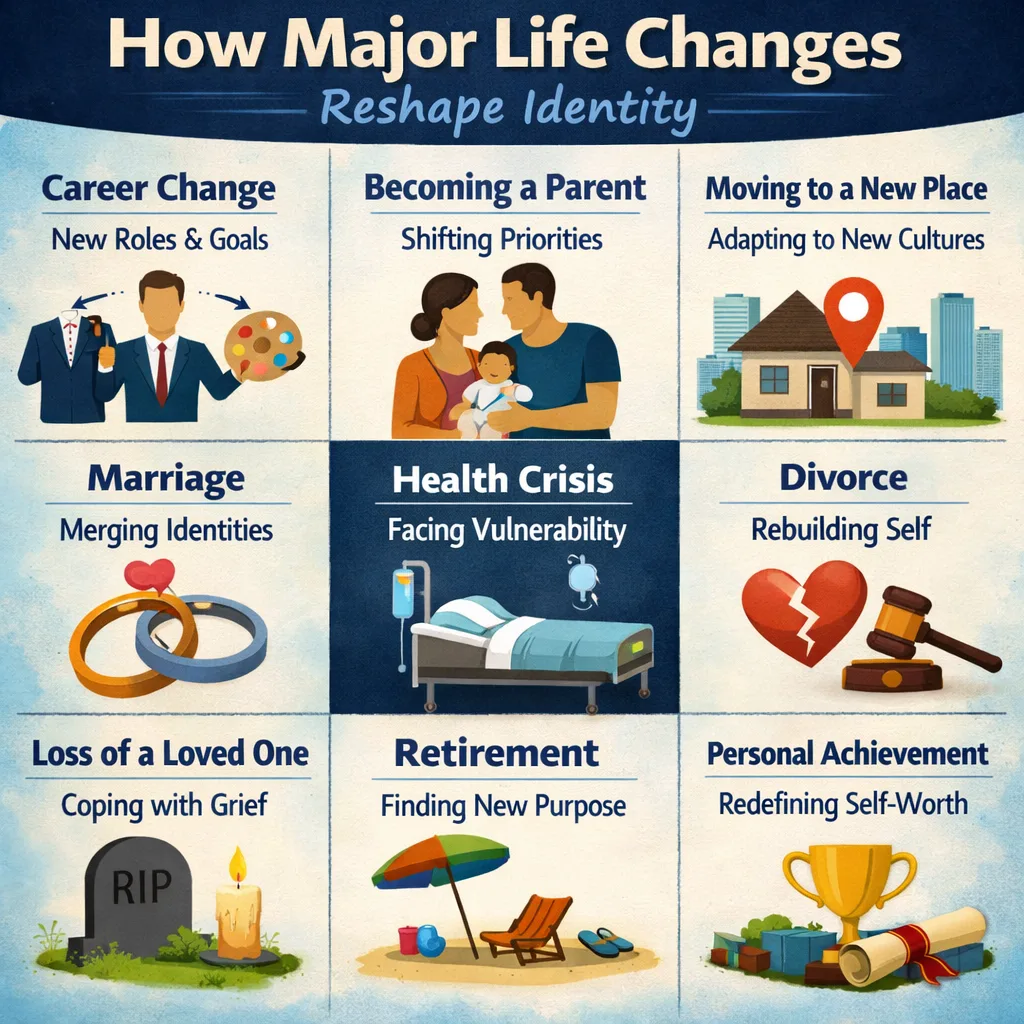
The roles we play have a big impact on who we are. Being a partner, a caretaker, a professional, or a student offers our self-definition structure. Our self-perception is reinforced on a regular basis by these roles. Identity might feel suddenly brittle when a role shifts or vanishes.
For instance, losing one's job might result in a profound sense of emptiness since it removes a fundamental component of one's identity. In a similar vein, becoming a parent brings with it a potent new role that alters emotional boundaries, priorities, and self-image.
Why Change Feels So Unsettling
Psychological doubt arises during significant transformations. Identity offers the sense of continuity that the brain seeks. The mind finds it difficult to reconcile the old and new selves when life changes upset established routines. This is why, even in cases where the change is beneficial, transitions can cause worry, grief, or perplexity.
✔ When traditional roles vanish, identity feels endangered.
✔ During times of transition, the brain fights uncertainty.
✔ Identity reconfiguration is frequently indicated by emotional pain.
Career and Purpose: When Work Redefines the Self
Since work takes up a large amount of an adult's life, changes in one's employment can have a profound impact on one's identity. Changes in one's career path, whether deliberate or unintentional, can significantly impact one's sense of worth and purpose.
Self-worth is frequently challenged by career shifts. Unconsciously, a lot of individuals confuse identity with productivity. People may doubt their ability, significance, or future when a job quits or changes abruptly. Emotional disengagement and self-doubt may result from this identity gap.
However, changing careers can also create opportunities for reinvention. Individuals may uncover hobbies they had previously suppressed or ideals that no longer fit with their former career path. Identity starts to change from being validated by others to having internal significance.
Many adults eventually discover that identities based only on work titles are brittle. People are frequently forced to redefine success beyond status or cash when they undergo significant professional shifts. A more grounded sense of self can result from this process, which can be uncomfortable but ultimately freeing.
✔ Career changes require a reassessment of one's own value.
✔ Identity may change from success on the outside to contentment on the inside.
✔ Over time, purpose becomes increasingly value-driven.
Relationships and Emotional Bonds
Relationships are one of the most potent forces that reshape identity. Our understanding of ourselves in relation to others is altered by love, attachment, separation, and loss.
Getting into a committed partnership frequently broadens one's identity. People start thinking in terms of "we" instead of "I." This change is made considerably more intense by parenthood. Emotional sensitivity rises, priorities shift, and self-definition broadens to encompass accountability for another life.
This development may be significant, but it may also seem overwhelming. Many individuals experience shame or a loss of individuality as a result of their inability to reconcile their former identities with their current positions in relationships.
Identity can break down when partnerships terminate. A hole is left behind as shared rituals, plans for the future, and emotional attachments disappear. Grief is more than just losing someone; it's also about losing the version of oneself that was there in that connection.
Deep contemplation is frequently sparked by this time. Individuals may doubt their long-term objectives, attachment styles, and ideals. Identity gradually reorganizes around new emotional limits and self-awareness.
Crisis, Trauma, and Sudden Life Shifts
While some identity changes happen suddenly, others develop gradually. Old self-concepts can be quickly destroyed by accidents, illness, migration, or unanticipated loss.
How Trauma Alters Self-Perception
The sensation of safety and control are frequently disturbed by traumatic events. People may no longer identify themselves in their mental habits or emotional responses. When the mind tries to make sense of such drastic change, identity becomes disjointed.
But trauma can also result in significant development. After surviving significant catastrophes, many people report feeling more resilient, empathetic, and clear. This emphasizes identity's capacity to change under duress, but it does not lessen pain.
Rebuilding Identity After Disruption
It takes time to rebuild. Individuals progressively incorporate the event into their life narrative, crafting a new story that incorporates both grief and resilience. Identity becomes more about who they are becoming than who they were in the past.
✔ Crisis challenges core beliefs about self and world
✔ Identity reconstruction is gradual and non-linear
✔ Meaning-making plays a key role in healing
Growth, Reflection, and the Emergence of a New Self
Not every change in identity is motivated by a catastrophe. Some come from introspection, maturing, and self-realization. Priorities naturally shift as people go through different phases of life.
Many adults eventually turn their attention from accomplishment to purpose. Authenticity and internal serenity are valued more than external approval. Identity progresses from self-proving to self-understanding.
Despite receiving fewer incentives from outside sources, older persons report more emotional stability, which is frequently explained by this shift. Instead of being socially formed, identity becomes intrinsically grounded.
The fact that identity does not have to be finalized is one of the most liberating insights of adulthood. Fear of change is lessened when one allows oneself to change. Transitions in life now feel more like chapters in a longer story than like failures.
Conclusion: Identity Is Not Lost—It Is Rewritten
Significant life changes reshape identity rather than eliminate it. Every shift calls into question established definitions and encourages the emergence of new ones. Even though the process can be difficult, confusing, or uncomfortable, it is fundamentally human. Experience, introspection, and adaptation all contribute to the development of identity.
Instead of posing the question, "Why do I no longer feel like myself?" "Who am I becoming now?" might be a more useful question. When this perspective is applied, life changes become transformations rather than threats. Adulthood is about learning to change without losing purpose, not about maintaining a fixed self.