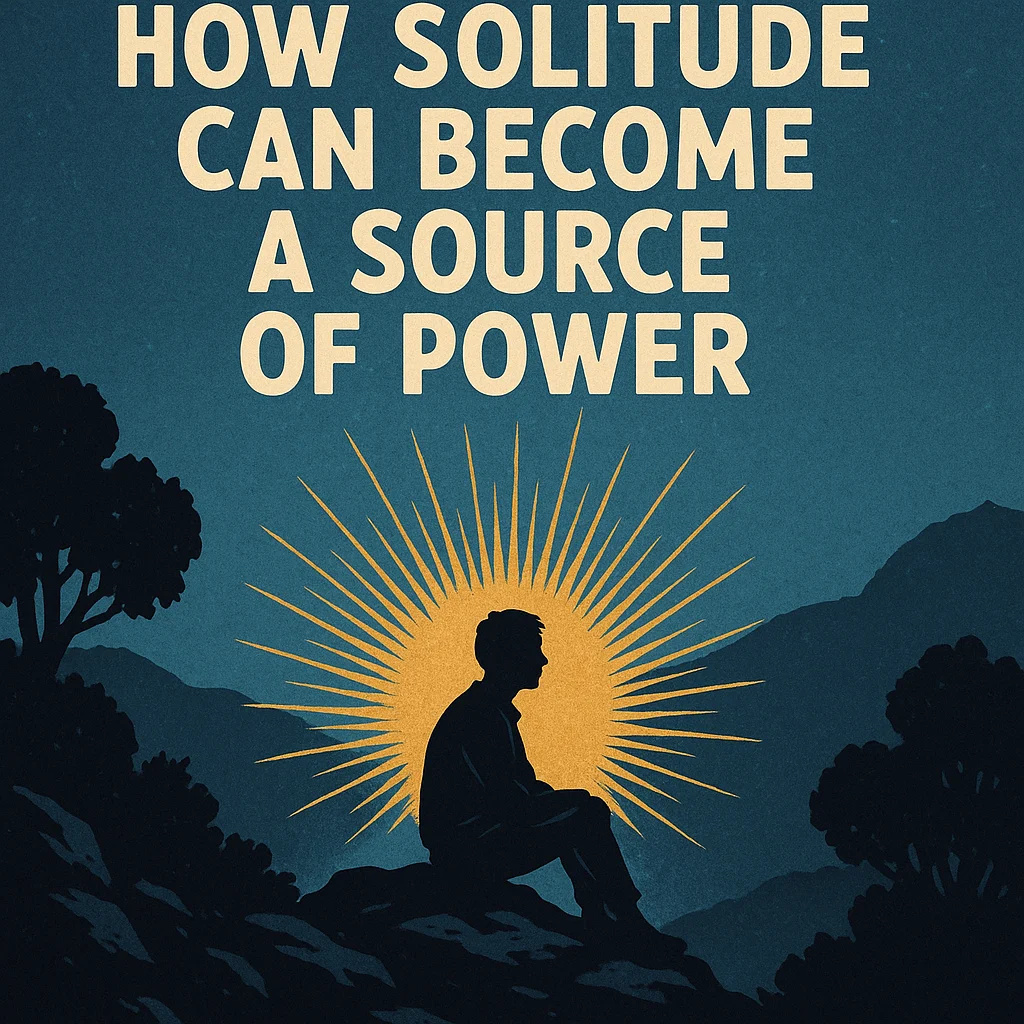
Being alone has become one of the rarest and most misinterpreted experiences in a society that is fixated on connection, noise, and constant movement. Many people fear solitude because they associate it with boredom, loneliness, or isolation. However, being alone—really, purposefully alone—is not a sign of weakness. It is a source of inner strength, a condition in which self-awareness grows, creativity awakens, and clarity sharpens.
Throughout history, great leaders, artists, and thinkers like Virginia Woolf, Albert Einstein, Marcus Aurelius, and innumerable others frequently sought solitude as a tool rather than an escape. They realized that the only way they could hear their own thoughts clearly enough to influence the world was to remain silent.
One of the most potent forms of self-mastery you can develop in this day and age of incessant distraction is learning to embrace solitude.
The Misunderstanding of Solitude
To understand the power of solitude, we must first separate it from its shadow—loneliness.
A sense of alienation and an unfulfilled need for company are the hallmarks of loneliness. Conversely, solitude is a decision. It's about being connected—to yourself—rather than being alone. Solemnity restores energy where loneliness saps it.
Being alone is frequently viewed in modern culture as a problem that needs to be solved. Our social media feeds beg for our attention, our phones buzz with notifications, and silence is awkward. We've been conditioned to associate presence with productivity and busyness with meaning.
But there is a price for this ongoing involvement. We become disconnected from our inner compass when we don't have time to ourselves. When we move from one stimulus to another without pausing to consider why, we stop being reflective and instead become reactive.
The Psychological Power of Solitude
Your thoughts change when you're by yourself. When the brain is alone, it goes into a state known as default mode network (DMN) activation, which is linked to introspection, creativity, and careful thought. At this point, patterns become apparent, intuition gets stronger, and insights surface.
Psychologists have long noted that solitude offers three profound psychological benefits:
-
Self-Reflection – Spending time by yourself enables you to remove yourself from the bustle of everyday life and clearly analyze your feelings, values, and thoughts.
-
Emotional Regulation – Greater emotional intelligence results from the ability to process emotions in solitude without outside pressure.
-
Creative Renewal – Since your mind can roam freely and unhindered when you're alone, many breakthroughs occur.
We become our own reflection when we are by ourselves. We can see where our true desires are concealed beneath distraction, where we have been living for others, and where we have been avoiding the truth.
Why the World Fears Solitude
The fear of being alone is a universal human fear. Being a member of a tribe was essential for survival for the majority of history. Being by yourself could be fatal. Even though the circumstances have changed, we still possess this innate instinct.
These days, we are afraid of being alone because we will have to confront ourselves, not because we will be attacked by untamed animals. Busyness conceals insecurity, unresolved pain, and unfulfilled desires; silence exposes these things.
For this reason, people use music, scrolling, or conversation to keep themselves stimulated all the time. These layers of noise are removed by solitude, which also compels honesty. It forces you to face your true self. Even though it can be unsettling, that is also where change starts.
Solitude as the Foundation of Self-Mastery
Solemnity is necessary for all types of mastery, be it of craft, character, or consciousness. Without removing yourself from the cacophony of others, you cannot develop wisdom, sharpen your intellect, or increase your level of focus.
Solitude builds the following pillars of self-mastery:
-
Clarity of Thought – Your own thoughts become clear once the voices of others subside. Authenticity, not influence, is the foundation of decisions made alone.
-
Emotional Independence – Being alone teaches you to value who you are rather than looking for approval. You gain the ability to stand emotionally on your own without needing approval from others.
-
Focus and Discipline – Any significant accomplishment necessitates consistent concentration. Distractions are eliminated in solitude, enabling you to intentionally direct your energy.
-
Inner Peace – By accepting silence, you learn that being calm isn't about not having noise; rather, it's about being able to stay focused in spite of it.
This was understood by the greatest leaders and intellectuals in history, ranging from spiritual mystics to stoic philosophers. They sought to withdraw into solitude in order to reenter society with strength and clarity, not because they disapproved of it.
Historical Examples of Solitude as Strength
History is rich with examples of solitude shaping greatness.
-
Marcus Aurelius,During military campaigns, the Roman emperor and Stoic philosopher wrote his meditations alone. He used introspection to keep his moral fortitude in the face of chaos.
-
Henry David Thoreau demonstrated that living alone is an active lifestyle rather than a sign of withdrawal by retreating to Walden Pond to live intentionally.
-
Buddha discovered enlightenment by themselves beneath the Bodhi tree, demonstrating that solitude can bring to light truths that no teacher can impart.
-
Nikola Tesla famously remarked, "Unbroken solitude and seclusion sharpen and keenen the mind." In isolation, originality flourishes.
Each of these figures used solitude as a laboratory for self-discovery, creativity, and purpose.
Solitude and Creativity
Quiet environments tend to foster creativity. Throughout history, artists, authors, and inventors have used solitude to clearly hear their inner voices.
The imagination expands when one is by themselves. Without interruption, ideas can float and converge. Only the pure act of creation is required; no performance or outside validation is required.
Deep creative work frequently occurs in solitude, according to psychologist Mihaly Csikszentmihalyi, who also created the concept of flow. One must be totally focused on a task in order to enter flow, which is practically impossible when distracted or overstimulated by social interactions.
Therefore, when you spend time alone, you're connecting with the creative energy that creates new worlds rather than disengaging from the outside world.
The Spiritual Dimension of Solitude
There is a deep spiritual component to solitude that goes beyond psychology and creativity. All spiritual traditions, including Buddhism, Sufism, and Christianity, acknowledge the importance of solitude for inner awakening.
The ego softens in solitude. Awe, thankfulness, and humility take precedence over the incessant din of self-importance. You start to perceive your life as a component of a greater whole.
Connecting with the divine, the natural world, or your innermost self is what spiritual solitude is all about, not being cut off from other people. The great sages and mystics realized that in the midst of incessant chatter, it is impossible to hear the whisper of truth.
Silence becomes sacred when it reveals what words cannot express.
How to Practice Empowering Solitude
Even though silent retreats and weeks spent in the wilderness can be life-changing, solitude doesn't have to mean those things. Intentional times of solitude in daily life are the first step.
Here are a few ways to cultivate solitude that strengthens rather than isolates:
-
Start small. Start each day with 10 to 15 minutes of undisturbed time, free from distractions like music or phones. Take a seat quietly and observe your thoughts.
-
Take solitude walks. Walking by yourself without headphones helps you re-establish a connection with your thoughts and environment.
-
Journal daily. Writing by yourself aids in goal clarification, emotional organization, and comprehension of thought patterns.
-
Disconnect regularly. Set aside time each week to avoid using technology. Allow silence to take the place of continual stimulation.
-
Seek “quiet spaces” in nature. Beaches, mountains, and forests all naturally slow down the mind and encourage introspection.
-
Turn solitude into ritual. Include it in your daily routine as a sacred period for recharging and realigning.
The objective is to strike a balance between reflection and connection, not to distance oneself from others. Because it grounds you in your own presence before sharing it with others, solitude strengthens relationships.
The Paradox of Solitude: Alone but Connected
The most potent paradox about solitude is that it strengthens bonds with others. You get better at understanding other people when you take the time to understand yourself. Relationships become authentic exchanges of energy when you are at ease in your own company, rather than being about filling a void.
Being alone fosters presence, patience, and empathy. It turns the fear of loneliness into the freedom of wholeness.
In solitude, you realize that connection doesn’t start with others—it starts with yourself.
Conclusion: Turning Silence Into Strength
In a world that never stops talking, solitude is an act of rebellion—and an act of power.
Selecting solitude means choosing self-mastery over reliance, depth over distraction, and clarity over noise. It's a method that turns insecurity into strength, uncertainty into insight, and fear into calm.
Loneliness cannot control a person who is at ease being by themselves. They are independent, rooted in reality, and self-sufficient.
Thus, make time for solitude—not as a means of escape, but as a means of reconnection. You will rediscover the silent voice that leads you down your most authentic path in that area. Because the ultimate power comes from knowing yourself well enough to walk peacefully by yourself, not from other people.