One of the most enduring issues facing developing countries today is poverty. Millions of individuals lack access to social mobility, economic opportunities, and basic amenities. Even while conventional development methods have advanced, technology is currently changing the game. From digital education to telemedicine, from mobile banking to renewable energy, technology is changing communities throughout the developing world and opening up new avenues for escaping poverty.
This blog will discuss how technology lowers poverty in developing countries, how it enhances health, education, and economic opportunities, what obstacles still exist, and what the future holds for tech-driven development.
Understanding Poverty in Emerging Nations
Lack of money is not the only aspect of poverty. It is a complicated condition characterized by restricted access to infrastructure, economic opportunity, clean water, healthcare, and education. Additional issues that emerging countries frequently deal with include political unpredictability, fast population increase, and inadequate infrastructure.
Aid and top-down initiatives, which can be sluggish, constrained in scope, or unsustainable, are frequently the focus of traditional efforts to reduce poverty. On the other hand, technology can offer scalable, affordable, and effective solutions that enable people and communities to escape poverty.
Technology and Financial Inclusion
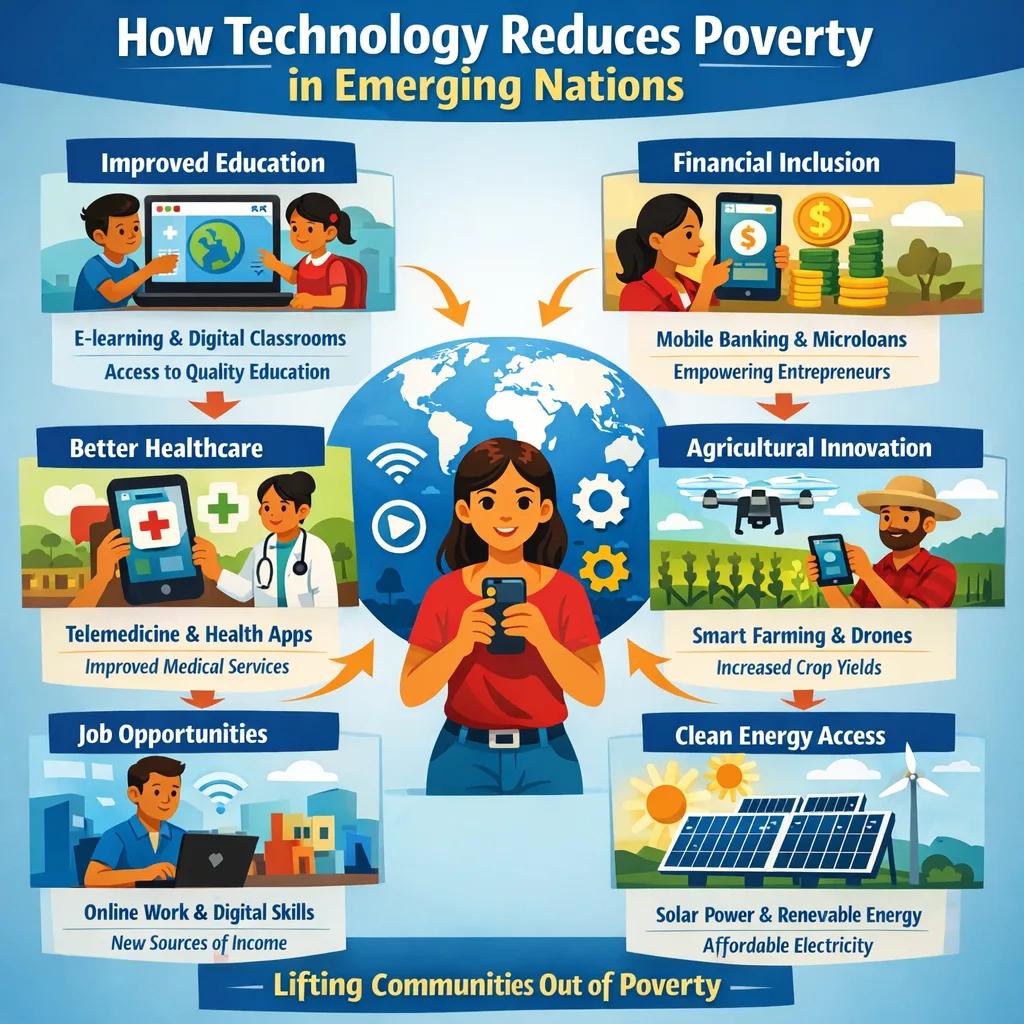
Enhancing financial inclusion is one of the most effective ways technology lowers poverty. It is challenging for millions of people in developing countries to save, borrow, or invest because they lack access to traditional banks.
Digital wallets and mobile banking platforms have completely changed how people manage their finances. For instance, people can use a smartphone to receive payments, save money, pay bills, and even apply for microloans thanks to mobile money services. For those who were previously shut out of the financial system, this results in economic independence.
-
Increased savings: People can develop financial resilience and safely store money thanks to mobile platforms.
-
Access to microloans: Small loans help entrepreneurs and farmers invest in their businesses or agriculture.
-
Improved transaction efficiency: By eliminating the need for currency, digital payments save time and money on transactions.
Financial inclusion empowers individuals to invest in education, start businesses, and support their families, effectively breaking the cycle of poverty.
Technology in Agriculture
Many emerging economies rely heavily on agriculture, but conventional farming methods frequently result in low productivity and climate change vulnerability. Precision farming, mobile apps for farmers, and market information access are just a few examples of how technology is revolutionizing agriculture.
-
Precision farming: Farmers can manage water resources, maximize agricultural yields, and cut expenses with the aid of sensors, GPS, and data analytics.
-
Market access: Mobile systems help farmers make better decisions by giving them access to real-time information regarding supply, demand, and prices.
-
Climate resilience: Farmers can save crops from harsh disasters by using weather forecasts and early warning systems.
Technology helps farmers secure revenue, feed communities, and lessen rural poverty by boosting production and profitability.
Education and Skill Development Through Technology
One of the most important methods to escape poverty is through education. Geographical location, a lack of infrastructure, and a teacher shortage restrict access to high-quality education in many developing countries. By offering digital learning options, technology overcomes these obstacles.
-
E-learning platforms: Children and adults can learn at any time and from any location with the help of educational applications, virtual classrooms, and online courses.
-
Digital literacy: Digital skill training increases employability by preparing people to engage in the contemporary workforce.
-
Teacher support: Teachers can enhance the quality of education by using technology to give them resources, lesson plans, and training.
Long-term poverty is reduced when people have access to education through technology, which enables them to start enterprises, obtain higher-paying employment, and engage in the knowledge economy.
Healthcare Access and Telemedicine
Another crucial area where technology lowers poverty is healthcare. Rural communities in many developing countries struggle with a shortage of medical professionals, facilities, and necessary medications. Digital health technologies and telemedicine are helping to close this gap.
-
Remote consultations: By using cellphones to consult with doctors, patients can cut down on waiting periods and travel expenses.
-
Health monitoring apps: Chronic illnesses, immunizations, and health issues can all be tracked with wearable technology and smartphone apps.
-
Data-driven interventions: Governments and non-governmental organizations can plan initiatives, monitor outbreaks, and enhance healthcare delivery thanks to technology.
In addition to being more productive and able to work continuously, healthier populations also lessen the financial burden of disease, which helps to reduce poverty.
Entrepreneurship and Digital Platforms
In developing countries, technology is creating new avenues for entrepreneurship. Social media, e-commerce platforms, and digital marketplaces enable small enterprises to reach clients worldwide and generate new revenue sources.
-
E-commerce for small businesses: Local farmers, shopkeepers, and craftspeople can sell goods outside of their local areas.
-
Gig economy opportunities: Digital platforms provide marginalized groups with service-based jobs, ride-sharing, and freelance work.
-
Access to knowledge and mentorship: Online forums and educational materials support entrepreneurs' skill development, business management, and innovation.
By supporting entrepreneurship, technology empowers individuals to create wealth, generate jobs, and strengthen local economies.
Infrastructure and Renewable Energy Solutions
In many developing countries, economic progress is hampered by limited access to infrastructure and electricity. Power is becoming more accessible in remote regions thanks to technology, especially renewable energy alternatives.
-
Solar-powered microgrids: Reliable energy is available for homes, businesses, and schools in communities without conventional electrical systems.
-
Water purification technologies: Safe drinking water is produced via inexpensive filtration and purification methods, enhancing both productivity and health.
-
Connectivity and internet access: Education, e-commerce, financial inclusion, and social connectivity are all made possible by internet access.
Reliable infrastructure promotes company operations, enhances living conditions, and fosters an atmosphere that is conducive to economic growth.
Challenges in Implementing Technology for Poverty Reduction
Despite its potential, technology adoption in emerging nations faces several challenges.
-
Digital divide: Unequal access to devices, internet, and electricity limits technology’s reach.
-
Affordability: High costs of devices and services can exclude the poorest populations.
-
Skills gap: Many individuals lack the technical skills to effectively use technology.
-
Cultural and language barriers: Technology solutions must be adapted to local contexts.
-
Infrastructure constraints: Weak internet connectivity, unreliable power, and poor logistics hinder adoption.
Addressing these challenges requires coordinated efforts from governments, NGOs, private sector, and international organizations.
The Future of Technology in Poverty Reduction
Technology-driven poverty reduction has a bright future. Artificial intelligence, blockchain, the Internet of Things, and mobile platforms are examples of emerging technologies that will continue to change how people access resources, healthcare, education, and finance.
-
AI-powered solutions can predict crop yields, optimize healthcare delivery, and improve government services.
-
Blockchain technology can provide secure identity verification, transparent aid distribution, and access to financial services.
-
IoT devices can monitor environmental conditions, water supply, and infrastructure efficiency.
Inclusive, sustainable, and context-specific technology solutions that strengthen communities rather than foster reliance are the key to success.
Conclusion
Although it is one of the most effective instruments accessible to developing countries, technology is hardly a panacea for reducing poverty. Technology fosters economic empowerment, social mobility, and sustainable development by enhancing financial inclusion, agriculture, education, healthcare, entrepreneurship, and infrastructure.
Communities that adopt technological solutions can raise living standards, create robust economies, and end the cycle of poverty. To make sure that technology is available, reasonably priced, and tailored to local needs, governments, businesses, and individuals must collaborate.
Poverty becomes not only tolerable but also solved when technology reaches those who need it most. Innovation has the power to change lives, communities, and entire countries, demonstrating that everyone can achieve opportunity and wealth in the digital era.