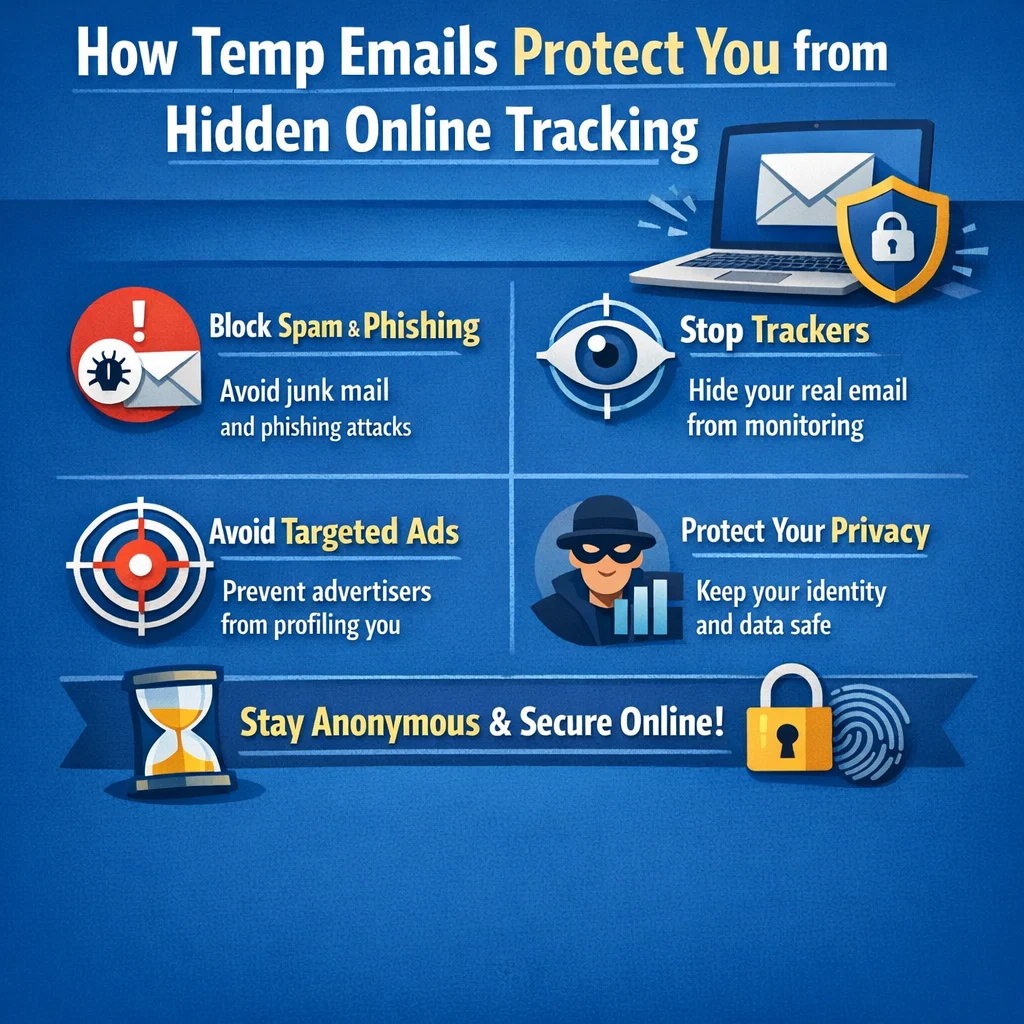
In the digital world of today, privacy is frequently sacrificed for convenience. You are usually prompted for your email address the first time you register for a webinar, download an eBook, join up for a website, or create a new app account. Despite its seemingly innocuous nature, your email serves as more than just a means of communication. One of the most effective ways to monitor your online activity is through this identification.
2026 has seen a rise in the sophistication of covert internet monitoring. Businesses gather, examine, and profit from user data to target advertisements, forecast behavior, and sway consumer choices. In this context, temporary email services, sometimes referred to as disposable email or temp mail, are emerging as a crucial instrument for safeguarding online privacy.
Users can receive short-term communications and verification messages using temporary email accounts without disclosing their primary inbox. Data profiling and hidden tracking can be greatly decreased with this easy fix.
Why Your Email Address Is a Tracking Tool
The majority of consumers associate tracking with browser history and cookies. Email addresses are a significant tracking mechanism, but cookies are also crucial. Your email address is frequently connected to your surfing habits, past purchases, and device information when you give it to a website.
Companies use email addresses to:
✔ Build detailed consumer profiles
✔ Connect activity across multiple devices
✔ Retarget ads based on browsing habits
✔ Share data with third-party marketing partners
An email address serves as a reliable digital identity because it is distinct and durable. Your email address enables businesses to reconnect your behavior even if you delete cookies or change devices.
Temporary emails interrupt this process by preventing long-term identification.
Breaking the Data Collection Chain
Linking several data points together is usually how hidden tracking operates. When you use your primary email address to sign up for a discount code, for instance, the website may include tracking pixels in the emails you receive. Whether you click a link, open an email, or return to the website can all be tracked by these pixels.
Over time, this builds a behavioral map of your interests and habits.
Temporary email addresses break this chain in several ways:
✔ They prevent long-term association with your primary inbox
✔ They limit follow-up marketing campaigns
✔ They reduce cross-platform data sharing
✔ They expire automatically, cutting off extended tracking
Because temp emails are short-lived, companies cannot easily build continuous profiles tied to your real identity.
Protecting Against Email Tracking Pixels
Marketing emails contain invisible graphics called email tracking pixels. The pixel loads from the sender's server when you open an email, alerting them that you have read it. Marketers can use this to gauge engagement and improve their advertising tactics.
While some users may not mind this tracking, others prefer to limit how much data companies collect about their habits.
For one-time registrations, using a temporary email minimizes exposure to these tracking pixels. Even if tracking does take place, it is not linked to your regular account and stays separate within the disposable mailbox.
This simple separation protects your main email from being integrated into broader tracking networks.
Reducing Targeted Advertising
Personal information is crucial to targeted advertisements. Advertisers can generate comprehensive interest profiles when your email is connected to a variety of platforms, including newsletters, applications, streaming services, and shopping websites. Advertising networks frequently exchange these profiles.
When someone subscribes to a fitness newsletter, for instance, advertisements for gym memberships, apparel, and supplements may show up on other websites. This occurs because data is matched and synced across platforms using your email.
This synchronization is diminished by temporary emails. Advertisers are less able to link your interests to your principal digital identity when you utilize a disposable address for non-essential registrations.
Benefits of reducing tracking-linked advertising include:
✔ Fewer highly personalized ads
✔ Less data aggregation across services
✔ Greater separation between browsing and identity
✔ Reduced long-term profiling
While advertising will not disappear entirely, the depth of personal tracking decreases significantly.
Shielding Against Data Breaches
Data breaches are becoming more frequent. Every now and again, even well-known businesses experience security lapses that expose millions of email addresses and related user data. After being leaked, this data may spread on dark web marketplaces and be exploited for identity theft or phishing.
A layer of protection is offered by temporary emails. Your primary inbox is safe even if a throwaway address is compromised. The impact is negligible because the temporary address is not connected to any personal data or important accounts.
This approach creates a buffer zone between your real digital identity and less secure platforms.
Maintaining Anonymity During Exploration
Today's internet promotes experimentation. Regularly, users sign up for trial subscriptions, online communities, AI tools, and educational platforms. But not all platforms necessitate ongoing participation.
With temporary email services, you can freely browse without revealing your true identity on any website. This adaptability allows access to online resources while promoting privacy-conscious browsing.
For instance, utilizing a disposable email keeps your primary inbox from being included to long-term marketing lists when you wish to temporarily test a service or get a free guide.
This keeps your digital footprint lighter and more manageable.
Supporting a Privacy-First Mindset
Privacy awareness is higher than ever in 2026. Companies are still improving tracking systems despite governments enforcing more stringent data protection laws. More and more users are assuming personal responsibility for protecting their data.
Temporary email services fit into a broader digital hygiene strategy that includes:
✔ Using strong and unique passwords
✔ Enabling two-factor authentication
✔ Limiting oversharing on social media
✔ Reviewing privacy settings regularly
While temp mail is a useful addition, it cannot take the place of thorough security procedures. It gives consumers the ability to decide how and where their contact details are shared.
Responsible Use of Temporary Emails
Temporary emails have significant privacy benefits, but they should be used sparingly. Critical work accounts, government platforms, healthcare portals, and banking should all be connected to secure, long-term email addresses.
Temporary email is best suited for:
✔ One-time downloads
✔ Trial subscriptions
✔ Public Wi-Fi registrations
✔ Non-critical account sign-ups
Understanding the appropriate context ensures both privacy and reliability.
The Future of Email and Online Privacy
Email will continue to be a key element of online identity as digital ecosystems become more integrated. Meanwhile, tracking technology will keep developing. Because of this, proactive privacy protections are becoming more and more crucial.
A straightforward yet effective safeguard against covert internet tracking is offered by temporary email providers. You can recover more control over your online appearance and lessen long-term data exposure by keeping your primary email and your informal online activities separate.
In an era where personal data has become currency, protecting your email address means protecting your identity.
Conclusion
Online tracking that is hidden frequently runs in the background without being noticed. Businesses utilize behavioral profiling, data sharing agreements, tracking pixels, and email IDs to create comprehensive images of users' online lives.
This procedure is disrupted by temporary email services. They sever the connection between short-term registrations and ongoing identity monitoring. They prevent data breaches, limit targeted advertising, and lessen spam in your primary inbox.
Temporary emails drastically cut down on exposure, but no technology can completely remove tracking. Using disposable email accounts is an easy and convenient solution to improve internet security in 2026, when privacy is both valuable and vulnerable.