How the Internet of Senses Will Change Human Experience
Imagine being able to taste the food you're considering ordering, smell the leather of a new jacket, and feel the texture of the clothing as you browse your favorite online store. It sounds like science fiction, doesn't it? It won't be for long.
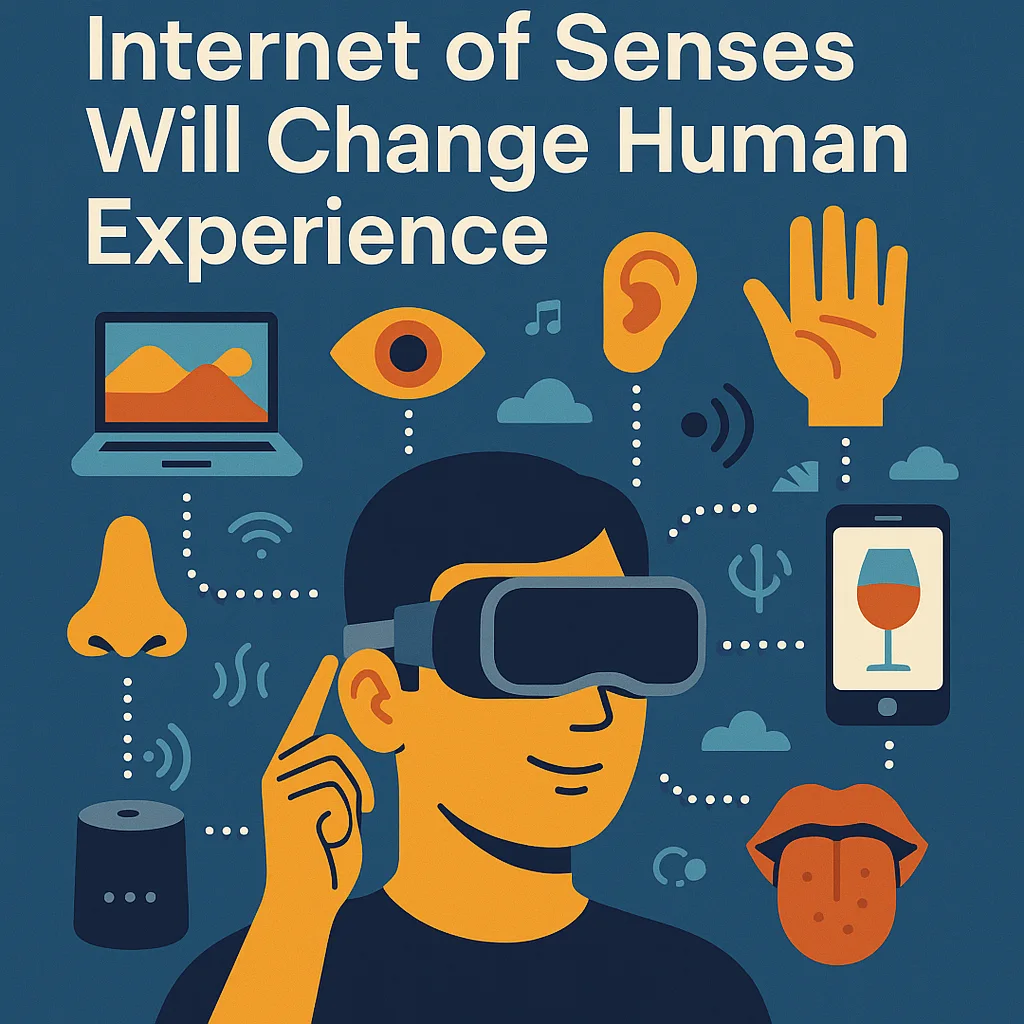
The Internet of Senses, a concept that seeks to include all five human senses into our online interactions, is ushering in a new era of digital progress. The Internet of Senses (IoS) seeks to link our senses to technology in order to create experiences that seem really human in a digital world, much like the Internet of Things (IoT) connected devices.
This shift will alter not only how we use the internet but also how we view reality.
What Is the Internet of Senses?
The next phase of digital connectivity is known as the "Internet of Senses," in which technologies such as artificial intelligence, virtual reality (VR), augmented reality (AR), 5G, and haptic feedback collaborate to mimic human senses via the internet, including touch, taste, smell, sight, and hearing.
In simple terms, it means we’ll soon be able to feel, taste, and smell digital experiences, not just see and hear them.
Ericsson's "10 Hot Consumer Trends 2030" research, which projected that by the end of this decade, digital experiences will become multisensory and seamlessly mix the real and virtual worlds, popularized the term.
Our complete sensory system will serve as an interface for communication in this next era of the internet, rather than just screens and music.
The Building Blocks of the Internet of Senses
We must examine the technologies that enable the Internet of Senses in order to comprehend how it functions:
1. 5G and Beyond
Transmitting enormous volumes of sensory data in real time requires high-speed, low-latency networks. The aroma of virtual coffee or the tactile sensations of a handshake must feel instantaneous.
2. Artificial Intelligence (AI)
AI will duplicate and analyze sensory inputs. It will acquire human perceptions of feelings, such as how warm is "warm" and how rough is "rough," and then digitally replicate those experiences.
3. Virtual and Augmented Reality (VR & AR)
Visual and aural environments are already simulated by VR and AR. They will grow to incorporate taste, smell, and touch with IoS, resulting in completely immersive experiences.
4. Haptic Technology
Haptic devices mimic touch through pressure and vibrations. Digital contact and real touch will be nearly identical thanks to the upcoming generation of haptic suits, gloves, and implants.
5. Neural Interfaces
True sensory integration with technology could be achieved through brain-computer interfaces (BCIs), such as those being developed by Neuralink, which would enable direct sensory input and output between the brain and machinery.
These technologies work together to create a world that allows us to digitize, transmit, and exchange our sensory experiences.
How the Internet of Senses Will Transform Everyday Life
The Internet of Senses will change human experience in almost every area of life, not only improve technology.
1. Communication Will Feel Real Again
We can currently communicate visually and vocally through video conversations, but the Internet of Senses will give digital communication more emotional depth. Imagine using a haptic suit that replicates touch to embrace a loved one across countries, or using scent sensors to convey them to their current location.
Emotional barriers will no longer be caused by distance. You'll feel close to each other when interacting virtually.
2. Education Will Become Fully Immersive
Reading and watching will no longer be the only ways to learn. Students might taste cuisines from various cultures, smell chemicals in a virtual lab, and feel the texture of antique relics.
Students may be able to experience living in ancient civilizations through history classes. Haptic gloves, which mimic the resistance and feel of real tissue, could be used by medical students to perform surgery.
The Internet of Senses has the potential to accelerate learning through immersion and transform education into a completely embodied experience.
3. Healthcare Will Reach New Dimensions
Video consultations will not be the only development in telemedicine. One day, medical professionals may use sensory gadgets to detect infection symptoms or remotely sense a patient's pulse.
For patients suffering from injuries, virtual rehabilitation programs could replicate real-world feelings. Sensory settings, such as virtual nature with authentic scents and winds, could be used in mental health therapies to lessen anxiety or tension.
This technology could bring care and comfort to patients anywhere in the world.
4. Retail and E-commerce Will Engage All Senses
There will be a revolution in online buying. Before making a purchase, you will be able to taste food samples, touch fabrics, and smell perfumes from the comfort of your own home.
Brands will compete on multisensory storytelling in addition to price and imagery. The ease of internet shopping will be combined with the depth of in-person experiences to create a fully immersive shopping experience.
5. Entertainment Will Transcend the Screen
Gaming, music, and movies won't be limited to just visuals and sounds. You’ll feel the rumbling of explosives in a film, breathe the ocean air in a beach scene, or taste success in a digital environment.
Particularly, gaming will change as gamers use smart gadgets to feel textures, landscapes, and even the weather. It will be a whole new kind of immersion.
6. Work and Collaboration Will Become Sensory Experiences
Coworkers will be able to engage as if they were physically there in virtual workstations, which will develop into sensory experiences. In a virtual café meeting, you might smell the aroma of coffee or shake hands with a client using haptic gloves.
A fully sensory form of remote work will be possible when the distinction between real offices and virtual cooperation becomes more hazy.
The Psychological Impact of the Internet of Senses
Not only will the Internet of Senses change how we see the world, but it will also change how we feel about it.
People are sensory-driven creatures. Smell, taste, and touch have a much stronger emotional and memory connection than sight or hearing. Virtual encounters could feel emotionally real and even transformative if these senses can be digitally simulated.
But this brings up important psychological issues. How will our brains differentiate between digital and physical feelings if virtual encounters seem real? Could we develop a synthetic pleasure addiction?
The Internet of Senses will alter how we perceive reality and authenticity, much as social media changed how we perceive connection.
There is a great deal of potential for empathy and shared experience, but there is also a great deal of opportunity for manipulation or sensory overload. Regulators and designers must use caution to ensure that technology complements real human connection rather than replacing it.
The Ethical and Privacy Challenges Ahead
When your senses become data, privacy takes on a new meaning.
The Internet of Senses will gather extremely private data about you, including how you feel, react, and even smell, in addition to what you look at or click on. Theoretically, tech corporations may examine your emotional reactions to advertisements, settings, or individuals.
This creates opportunities for behavioral targeting and manipulation that go well beyond existing advertising approaches.
Ethical questions arise:
-
Who owns your sensory data?
-
Can companies simulate emotions to influence decisions?
-
How do we protect mental and emotional privacy?
To maintain the privacy, security, and consent of sensory data, governments and organizations will need to establish new frameworks for digital rights.
The Road to the Internet of Senses
While the vision is ambitious, we’re already seeing early signs of this transformation:
-
Meta’s haptic gloves simulate touch in VR environments.
-
Feelreal VR masks allow users to experience scents and temperatures.
-
Sony’s haptic controllers for PlayStation create nuanced tactile feedback.
-
Researchers at the National University of Singapore have developed “taste interfaces” that electrically stimulate taste buds.
Even if these are tiny milestones, taken as a whole, they suggest that digital sensations will eventually become commonplace. Experts estimate that sensory online experiences may become as widespread as video conversations by 2035.
Beyond Technology: Redefining What It Means to Be Human
The Internet of Senses is about the development of human perception, not merely innovation.
Throughout history, every leap in communication technology has brought us closer together:
-
Writing extended our memory.
-
Telephones extended our voices.
-
The internet extended our reach.
-
The Internet of Senses will extend our very bodies into the digital realm.
No matter how far apart we are, we will be able to communicate our emotions, sentiments, and sensations. Global human empathy may increase as a result, or a hyperreal world where simulation takes the place of experience may be created.
Either way, humanity is about to witness something truly remarkable: the flawless fusion of technology and the senses.
Conclusion: The Dawn of Sensory Internet
One of the biggest changes in human history is the Internet of Senses. It will change not just our intellectual but also our emotional and physical ways of working, playing, connecting, and communicating.
We’re moving toward a world where the internet is not something we look at—it’s something we feel.
The lines separating digital and real life will blur, resulting in experiences that are richer than anything we have ever experienced. However, we must keep in mind that technology should enhance humanity rather than replace it as we embrace this sensory revolution.
By giving the digital world a human heartbeat, the Internet of Senses has the potential to permanently alter what it means to live in a connected age.