Introduction: A Plastic Revolution
Swiping a card—or tapping a phone—has become second nature in today's world. The credit card, which was once merely a convenient tool, has become one of the most powerful forces influencing consumer behavior, economies, and even cultural attitudes toward wealth and responsibility. It has revolutionized how people view money, make purchases, and manage debt.
But credit cards did more than just make payments easier; they also altered human psychology, making it harder to distinguish between need and want, ownership and obligation, and desire and affordability. In order to comprehend today's consumer society, with its never-ending shopping, subscription services, and "buy now, pay later" mentality, we must first understand how credit cards came to redefine money itself.
From Charge Plates to Plastic: The Origins of Credit
The early 20th century is when the credit card first appeared. Charge plates and charge coins, which are metal tokens or cards that let regular customers make credit purchases and pay their bills at the end of the month, were distributed by department stores and oil companies prior to the invention of plastic.
These early credit options were store-specific, though. Only one store was compatible with each card. Businessman Frank McNamara made history in 1950 when he introduced the Diners Club Card, the first credit card that was accepted at all restaurants.
Legend has it After losing his wallet at a restaurant, McNamara had the notion. Members of the Diners Club were able to charge meals at participating restaurants and then pay a single bill. The idea of multi-merchant credit emerged after thousands of people joined in less than a year.
Then, in 1958, Bank of America created BankAmericard, which was the real spark. The BankAmericard permitted customers to carry a balance, or borrow money from the bank, in contrast to charge cards, which required monthly return in full. As history would demonstrate, this invention turned the credit card from a convenience into a financial tool and, as a result, a psychological catalyst for new spending habits.
The Birth of the Borrowing Consumer
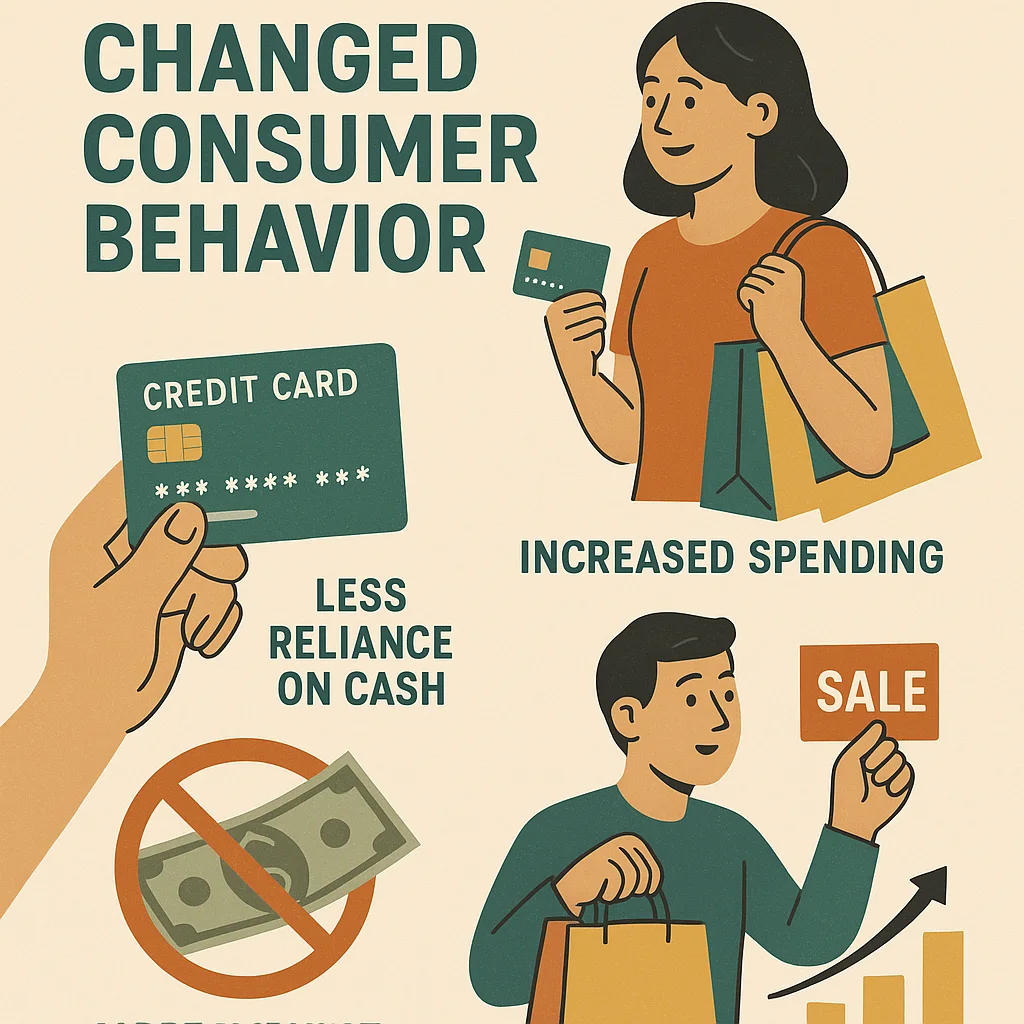
Spending was mostly limited by physical money prior to credit cards. People had to live within their means, or at least feel the actual depletion of their funds, because they had to pay with cash or checks. That relationship was drastically altered by the introduction of the credit card.
Money became abstract all of a sudden. All you needed was a commitment to pay later; you no longer needed actual cash in your wallet. A tsunami of consumer freedom—and temptation—was unleashed by this change. The "credit card premium"—the tendency for people to spend more when using credit than when purchasing with cash—was quickly observed by economists and psychologists.
This is corroborated by behavioral economics research, which shows that paying with cash causes the brain's pain receptors to fire, resulting in a feeling of loss. Conversely, credit cards lessen this emotional strain by separating the act of purchasing from the act of paying. Essentially, the card made it possible for consumers to enjoy immediately while delaying the inconvenience of spending money.
This new dynamic increased consumption in addition to making life easier. Mass consumerism grew in the 1960s and 1970s thanks to advertising and easy access to credit. Shopping evolved from a need to a way of expressing oneself and one's identity.
Credit as Empowerment — and Trap
Credit cards were first seen as a sign of advancement. They made goods, travel, and experiences that were previously only available to the wealthy accessible to those without substantial funds. Credit evolved into a type of financial inclusion that allowed more people to engage in contemporary economic life.
However, empowerment had a cost. Debt became commonplace along with credit. The idea of "living beyond one's means" became less stigmatized as the psychological gap between earning and spending widened. Personal debt had emerged as a defining characteristic of Western economies by the 1980s, particularly in the US.
This increased reliance was exploited by banks and credit card corporations. They found that clients who held balances—referred to as "revolvers"—were far more profitable than those who made complete payments. Then came aggressive marketing campaigns that offered cheap introductory rates, reward schemes that gamified spending, and "pre-approved" cards.
As a result, credit cards developed into a two-edged sword: a means of long-term debt and a doorway to financial independence. Millions of people were able to obtain credit, but many also were trapped in cycles of interest payments, late penalties, and worries about their credit scores.
The Psychology of Plastic Money
We must comprehend the psychological change that credit cards brought about in order to understand how they changed consumer behavior. This change is supported by several important mechanisms:
-
Temporal Discounting:
People typically put immediate benefits ahead of long-term expenses. By providing rapid satisfaction while postponing payment, credit cards take advantage of this inclination. The implicit maxim of consumer culture is "I'll deal with it later." -
Mental Accounting:
Credit card purchases are frequently viewed as "future money" and treated differently from cash purchases. Underestimating costs and overpaying are the results of this mental accounting. -
Social Signaling:
Credit cards were prestige symbols in their early years. A gold or platinum card was a sign of financial sophistication and reliability. Elite card tiers still have status, which fuels customer ambition. -
The Illusion of Control:
A false sense of security is produced by credit limitations. A high limit is frequently seen as an indication of financial capacity rather than possible danger. Larger purchases and riskier behavior are encouraged by this delusion. -
Reward Systems:
Spending is turned into a game via cashback and point systems, which encourage customers to make more purchases. This transforms spending into a kind of achievement on a psychological level.
Together, these factors transformed credit cards from financial instruments into behavioral accelerators, quietly altering people's perceptions of success, affordability, and responsibility.
The Retail Revolution: Shopping Without Borders
Not only did credit cards transform people, but they also changed entire industries. Easy credit led to more sales, as retailers soon discovered. Stores started creating marketing plans centered on impulsive purchases and postponed payments as a result.
Global transactions became easy with the introduction of electronic payment networks like Visa and MasterCard in the 1970s. Without this infrastructure, e-commerce, internet purchasing, and international travel would not have been possible. Consumption became international as the world economy grew more interconnected.
Credit cards became facilitators of lifestyle aspirations in the late 20th century as malls proliferated and advertising became more sophisticated. Having a card was a ticket to modernity, not just a convenience.
The groundwork was established by the time the internet was introduced. Because consumers could pay instantaneously without using cash, online shopping behemoths like Amazon and eBay thrived. Digital credit was necessary for digital commerce, and the psychological gap between "click" and "cost" grew.
Debt as a Way of Life
Debt became commonplace as a result of the widespread use of credit cards. Student debt, auto loans, and home loans all increased as consumer credit became more commonplace. "Buy now, pay later" replaced the notion of saving first and purchasing later.
The typical American household had thousands of dollars in rolling debt and multiple credit cards by the 2000s. Many customers were caught in high-interest cycles because financial education frequently lagged behind this trend.
The darkest aspects of this society came to light during the 2008 financial crisis. Despite having its origins in the housing market, the crisis was a reflection of a larger issue: an economy based on borrowed funds. Risky banking practices were influenced by the same attitudes that drove consumer spending.
However, credit card usage swiftly recovered even after the crisis. Caution was outweighed by habit and convenience. These days, "buy now, pay later" apps, contactless payments, and digital wallets are just the next development of the same idea: spend now, settle later.
The Modern Consumer: Freedom, Convenience, and Surveillance
Credit cards have evolved into data engines in the twenty-first century. Each swipe creates a digital trail that informs algorithms that provide customized offers and targeted advertising. Consumer behavior now becomes a product in and of itself, rather than merely affecting their financial situation.
Fintech developments that further separate money from physical reality include virtual cards and credit lines backed by cryptocurrencies. Societies are moving further toward digital capitalism as the psychological gap between payment and consumption continues to widen.
Convenience against control is still the fundamental trade-off, though. Instant access and worldwide flexibility are provided by credit cards, but they also necessitate ongoing attention to detail. The ability to purchase anything is accompanied by the need to oversee everything.
Conclusion: The Credit Card’s Legacy
The development of the credit card changed how people interacted with money in addition to revolutionizing payment methods. Convenience became a fundamental aspect of contemporary life, debt became a way of life, and spending became an experience.
Credit cards enabled international travel, democratized access to goods and services, and facilitated the growth of e-commerce. However, they also encouraged excessive spending, normalized reliance on debt, and made it harder to distinguish between borrowing and riches.
Ultimately, the tale of the credit card is the story of modern consumption itself: a blend of freedom and restraint, empowerment and temptation. As technology continues to evolve—with digital wallets, crypto payments, and biometric transactions—the lessons of the credit card era remain crucial.
Because while the tools may change, one truth endures: how we pay shapes how we live.