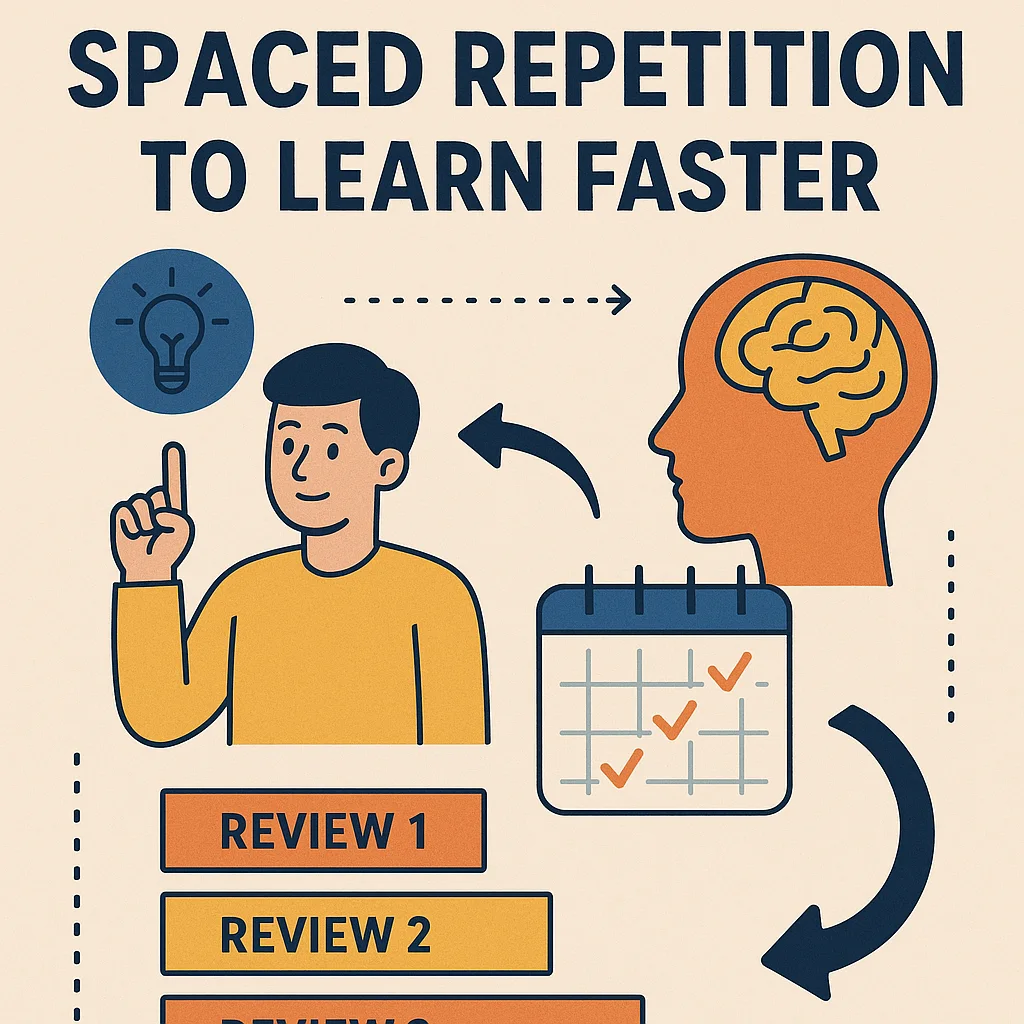
Learning more quickly and retaining more information has become a competitive advantage in an era of information overload. Learning how to learn is just as important as learning what you learn, regardless of whether you're a professional, student, or lifelong learner. Here comes spaced repetition, a potent, scientifically supported method that makes use of the way the brain functions to improve memory.
However, repetition with gaps is only one aspect of spaced repetition. When applied properly, this memory science-based system can significantly cut down on study time while improving long-term retention.
In this blog, we’ll break down:
-
What spaced repetition is
-
Why it works (the science)
-
How to implement it
-
The best tools and apps
-
Tips to make it part of your routine
What Is Spaced Repetition?
A learning strategy called spaced repetition entails going over material more frequently over time, right before you start to forget it. It uses the forgetting curve to time your reviews in the best possible way, unlike cramming or rote memorization.
A Simple Example:
You're learning vocabulary in French. Today, tomorrow, three days later, and a week later, you go over the word "bonjour" once more. The interval increases with each successful recall.
This technique greatly improves retention by reinforcing your memory when it is about to fade.
The Science Behind Spaced Repetition
Cognitive psychology and neuroscience are the foundations of spaced repetition. Its efficacy is explained by two fundamental ideas:
1. The Forgetting Curve
The forgetting curve, which was put forth by German psychologist Hermann Ebbinghaus, illustrates how easily we forget new information in the absence of reinforcement.
-
Within 24 hours, we forget nearly 50–70% of what we learn.
-
After a week, we might remember less than 10%.
By going over the content at specific intervals, spaced repetition breaks this curve and improves your brain's memory.
2. The Spacing Effect
According to the spacing effect, information is more likely to be retained when study sessions are spread out over time as opposed to being jam-packed into one sitting. Research continuously demonstrates that spaced learning results in:
-
Longer-lasting memory
-
Greater comprehension
-
Improved problem-solving
Why Spaced Repetition Helps You Learn Faster
Here’s how spaced repetition beats traditional study methods:
✅ Efficiency
Because you are reinforcing knowledge right before you forget it, you spend less time relearning.
✅ Deeper Retention
The brain more firmly embeds the information when you actively use your memory by recalling it and increasing the intervals.
✅ Less Cramming
Spaced repetition improves performance by distributing the learning process over days and weeks rather than cramming right before exams or presentations.
✅ Reduced Cognitive Load
You're regularly going over small portions of material rather than overloading your brain with it all at once.
How to Implement Spaced Repetition (Step-by-Step)
1. Choose What You Want to Learn
Start with information that needs to be deeply understood or memorized:
-
Vocabulary
-
Formulas
-
Historical facts
-
Concepts or definitions
-
Medical/technical terminology
-
Programming syntax
2. Break It Into Flashcards
The basis of spaced repetition is provided by flashcards because they:
-
Engage active recall
-
Are easy to categorize and schedule
-
Let you measure performance over time
Use tools like:
-
Anki (most popular)
-
Quizlet
-
Brainscape
-
RemNote
-
SuperMemo
Flashcards should follow best practices:
-
One question per card
-
Use simple language
-
Include images or mnemonics where helpful
-
Avoid clumping too much info into a single card
Example:
Front: What is the capital of Portugal?
Back: Lisbon
3. Use an Algorithm (Don’t Just Guess the Schedule)
Algorithms are used by apps like Anki and SuperMemo to measure your memory of each card, and they then automatically schedule your next review according to difficulty.
The idea is simple:
-
If you get a card right easily → review it later
-
If you struggle or forget → review it sooner
This indicates that you are concentrating on your areas of weakness rather than wasting time on what you already know.
4. Review Daily (But Briefly)
Long study sessions are not necessary for spaced repetition. Actually, 10 to 30 minutes a day is sufficient to achieve noticeable results.
The key is consistency. Make reviewing your cards a habit, like brushing your teeth:
-
In the morning with coffee
-
During commute (with mobile apps)
-
After work or before bed
Set a daily review goal in your app (e.g., 30 new cards, 50 reviews) and stick to it.
5. Combine With Other Learning Techniques
Spaced repetition works best when paired with:
-
Active recall (retrieving info from memory)
-
Interleaving (mixing topics or subjects)
-
Elaboration (explaining concepts in your own words)
-
Teaching others (the Feynman technique)
Don't merely memorize terms when studying anatomy; instead, sketch the parts, label them, or test a friend. Information sticks deeper the more ways it is encoded.
Real-World Applications
🎓 Students
Do well on tests without cramming. Learn dates, formulas, and vocabulary more quickly and efficiently.
🌐 Language Learners
Using daily card reviews, expand your vocabulary over time. Spaced repetition is used by apps like Duolingo, but you have more control with tools like Anki.
💼 Professionals
To stay sharp and remember complex information, doctors, lawyers, engineers, and developers use spaced repetition.
📖 Lifelong Learners
Spaced repetition makes things stick, whether you're learning a new skill, reading nonfiction, or studying philosophy.
Common Mistakes to Avoid
-
Cramming with spaced repetition: Reviewing all cards in one sitting defeats the purpose.
-
Overloading new cards: Start small; don’t add 200 new cards at once.
-
Skipping reviews: Missing scheduled reviews weakens memory and breaks the spacing cycle.
-
Poor card quality: Badly written or vague cards lead to frustration.
Remember: spaced repetition is not magic. It’s a method. It works if you work it.
Final Thoughts
One of the best time-saving learning techniques ever found is spaced repetition. You can build long-lasting memories rather than cramming by reviewing information at the appropriate intervals, which is in line with how your brain naturally functions.
Use spaced repetition right now if you're serious about learning more quickly, remembering more, and wasting less time. Over time, even ten minutes a day can produce amazing results.