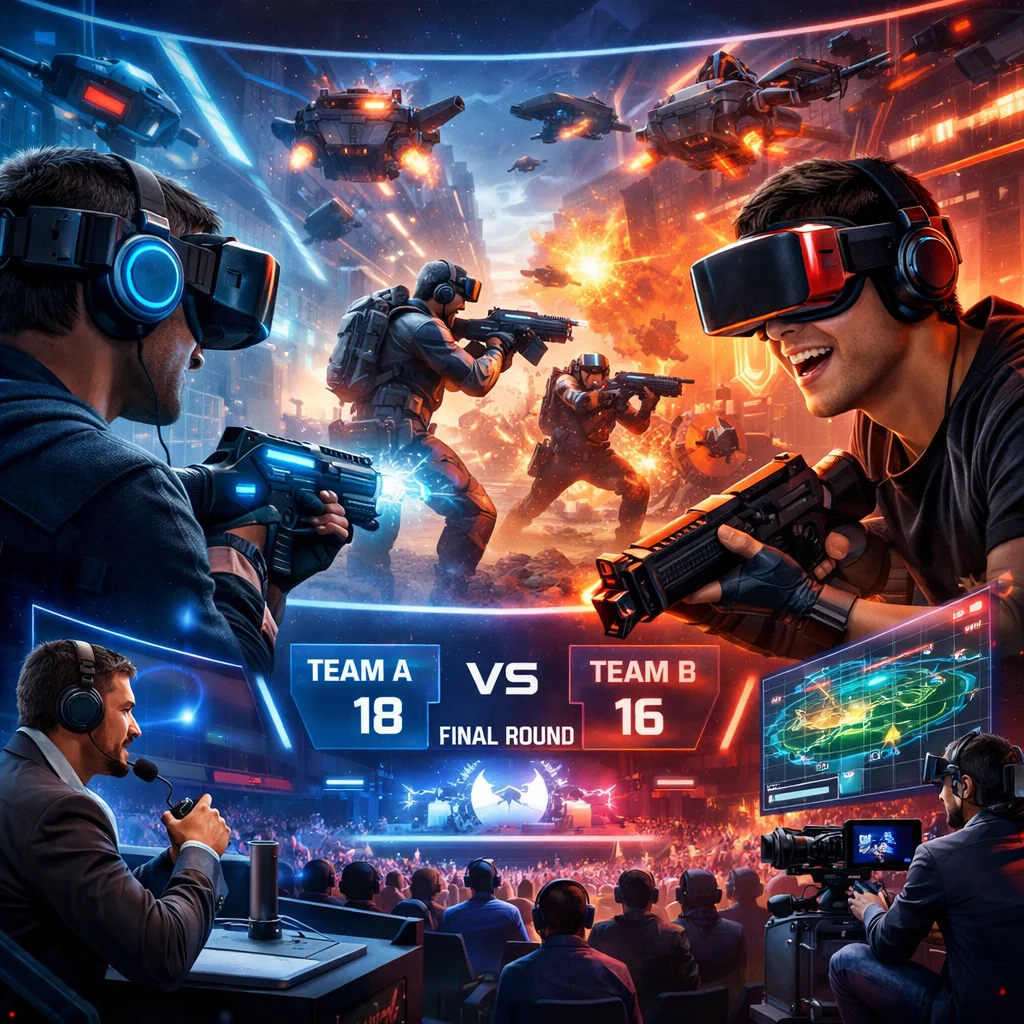
Over the past ten years, competitive gaming—also referred to as esports—has expanded into a sizable international market. Millions of athletes participate in professional competitions, and billions of spectators watch online. The esports ecosystem has been shaped by games like Dota 2, League of Legends, and Counter-Strike 2, which have produced professional teams, competitive leagues, and worldwide competitions.
However, virtual reality (VR) may be the next significant technical development in gaming. Players can engage with games in ways that go well beyond conventional keyboard, mouse, or controller gameplay thanks to virtual reality (VR) technology.
Millions of players worldwide now have access to immersive gaming experiences thanks to the introduction of VR devices like Meta Quest 3 and PlayStation VR2 from companies like Meta Platforms and Sony.
As VR technology develops, it has the potential to change competitive gaming by generating new esports, improving player performance, and changing how spectators watch competitions.
The Evolution of Competitive Gaming
Simple multiplayer competitions where players faced off against one another in arcades or online matches were the first examples of competitive gaming. Esports were able to develop into a professional sector throughout time thanks to advancements in streaming platforms, gaming hardware, and internet access.
By enabling fans to watch competitions live from any location in the world, streaming services like Twitch and YouTube have significantly contributed to the growth of esports viewership.
The majority of esports contests still use conventional gaming interfaces like keyboards, controllers, and monitors despite its expansion. The entirely new level of involvement that virtual reality offers has the potential to fundamentally alter competitive gaming.
What Makes Virtual Reality Different
Players may physically move, look around, and interact with virtual worlds as if they were inside them thanks to virtual reality's immersive surroundings. VR headsets allow users to control their actions by tracking their body and head motions.
✔ Fully immersive 3D environments
✔ Motion-based controls and gestures
✔ Real-time spatial interaction
✔ Enhanced player presence in digital worlds
These features can make gaming feel more realistic and engaging compared to traditional screen-based gameplay.
Creating New Types of Esports
Virtual reality could lead to the creation of whole new esports competition categories. Players could physically evade attacks, aim weapons, and interact with items in the game world rather than just pushing keys or moving a mouse.
Physical movement may already be included into competitive gameplay in VR esports games like Beat Saber and Echo VR.
✔ VR combat and shooting competitions
✔ Physical sports simulations in virtual arenas
✔ Team-based strategy games with full immersion
✔ VR racing or extreme sports competitions
By integrating real-world physical movements into gaming events, these new forms may make it harder to distinguish between regular sports and esports.
Enhancing Player Skill and Performance
Beyond conventional gaming talents, virtual reality provides new skill dimensions. To succeed, players need to integrate spatial awareness, physical coordination, and strategic thinking.
✔ Quick reflexes and reaction speed
✔ Physical agility and movement control
✔ Strong spatial awareness
✔ Strategic teamwork and communication
VR esports may become more similar to regular sporting events due to this combination of mental and physical abilities.
Professional VR players may also need specialized training programs similar to athletes in traditional sports.
Transforming the Spectator Experience
The way spectators view tournaments may be another significant effect of virtual reality on competitive gaming. Fans of esports now watch competitions on screens via live broadcasts or streaming services.
Fans may be able to enter the game scene as spectators using virtual reality, providing them with an entirely immersive viewing experience.
✔ Fans can watch matches from inside the virtual arena
✔ 360-degree perspectives during gameplay
✔ Interactive spectator experiences
✔ Personalized viewing angles and replays
Imagine standing inside the virtual stadium and watching a competitive game from the viewpoint of a player.
This immersive viewing experience could revolutionize how esports events are broadcast and consumed.
Building New Esports Arenas
The hosting of esports competitions might also be altered by virtual reality. Future competitions may take place in virtual reality arenas, where players wander around and compete in interactive surroundings, rather than conventional arenas with big screens.
These stadiums could create hybrid tournaments that integrate technology and sports by fusing digital surroundings with real infrastructure.
✔ Motion-tracking systems for players
✔ Large physical play areas for movement
✔ Real-time spectator interaction
✔ Mixed reality broadcasting systems
Such environments could make esports competitions more dynamic and visually exciting for audiences.
Challenges Facing VR Esports
Despite its potential, virtual reality still faces several challenges before it can fully transform competitive gaming.
✔ High cost of VR hardware
✔ Limited availability of competitive VR games
✔ Motion sickness issues for some players
✔ Physical space requirements for gameplay
To overcome these obstacles and make VR gaming more accessible to players and tournament organizers, technological advancements will be required.
As VR hardware becomes more affordable and powerful, these barriers may gradually disappear.
The Role of Technology Companies
Big IT firms are making significant investments in the study and creation of virtual reality. VR headsets, motion tracking devices, and immersive software are all being improved by companies like Sony and Meta Platforms.
These advancements will play a crucial role in determining how quickly VR esports can grow.
Additionally, new gameplay mechanisms created especially for VR environments are being tested by game creators. Competitive VR gaming may grow to be a significant part of the esports market as these advancements continue.
The Future of VR in Competitive Gaming
VR esports has immense long-term potential. Competitive gaming may become more immersive, interactive, and physically demanding than it has ever been as technology advances.
✔ Global VR esports leagues and tournaments
✔ Integration with augmented reality technologies
✔ Mixed reality competitions combining physical and digital elements
✔ Advanced spectator experiences for global audiences
These advancements have the potential to completely transform the esports market and open up new avenues for players, teams, and spectators.
Conclusion
One of the most fascinating new developments in game technology is virtual reality. VR has the ability to significantly change competitive gaming by enabling physical engagement with game worlds and producing immersive digital settings.
The competitive gaming environment has been established by classic esports games like League of Legends and Dota 2, but virtual reality (VR) has the potential to bring new forms that take esports to new heights.
VR has the potential to completely change how players compete and spectators enjoy esports events, from immersive spectator experiences to physically demanding gameplay.
Even if there are still issues like expensive hardware and technological constraints, the future of VR esports appears bright thanks to further innovation from businesses like Sony and Meta Platforms.
Virtual reality has the potential to be one of the most revolutionary factors in the development of competitive gaming as technology advances.