Introduction: The Hidden Danger in a Simple Number
Your phone number seems innocuous. Without hesitation, you offer it to websites, apps, delivery services, bank forms, job applications, and occasionally even complete strangers. It's simple to forget that a phone number serves as more than just a means of communication; it's a digital passport, a universal identification, and one of the simplest ways for hackers to gain access to your personal information.
Your phone number is linked to your identity on hundreds of platforms in the connected world of today. It is frequently used as a verification technique, login backup, and recovery option for everything from financial apps to social media accounts. However, it was never intended to be safe.
The issue is straightforward: phone numbers are easily obtained, easily guessed, and almost impossible to keep hidden. However, disclosing your number can have a variety of negative effects, from bothersome spam calls to serious identity theft. This blog explains why your phone number is your weakest security link and offers self-defense tips.
The Phone Number’s Original Purpose: Communication, Not Security
Phone numbers were never meant to be used as identity keys when they were first created. They were only intended to be used for making calls. That's all. Online banking, cloud accounts linked to a number, and two-factor authentication were nonexistent.
However, businesses eventually started utilizing phone numbers as a practical means of authentication. At first, the reasoning made sense. Everybody was usually carrying their phones. SMS was widely used. The network was under the hands of carriers. It looked safer than email at first.
Convenience, however, had a price. While cybercrime changed, the security model did not. Due to its outdated, disjointed, and easily exploitable infrastructure, SMS emerged as one of the most vulnerable ways of verification as technology developed.
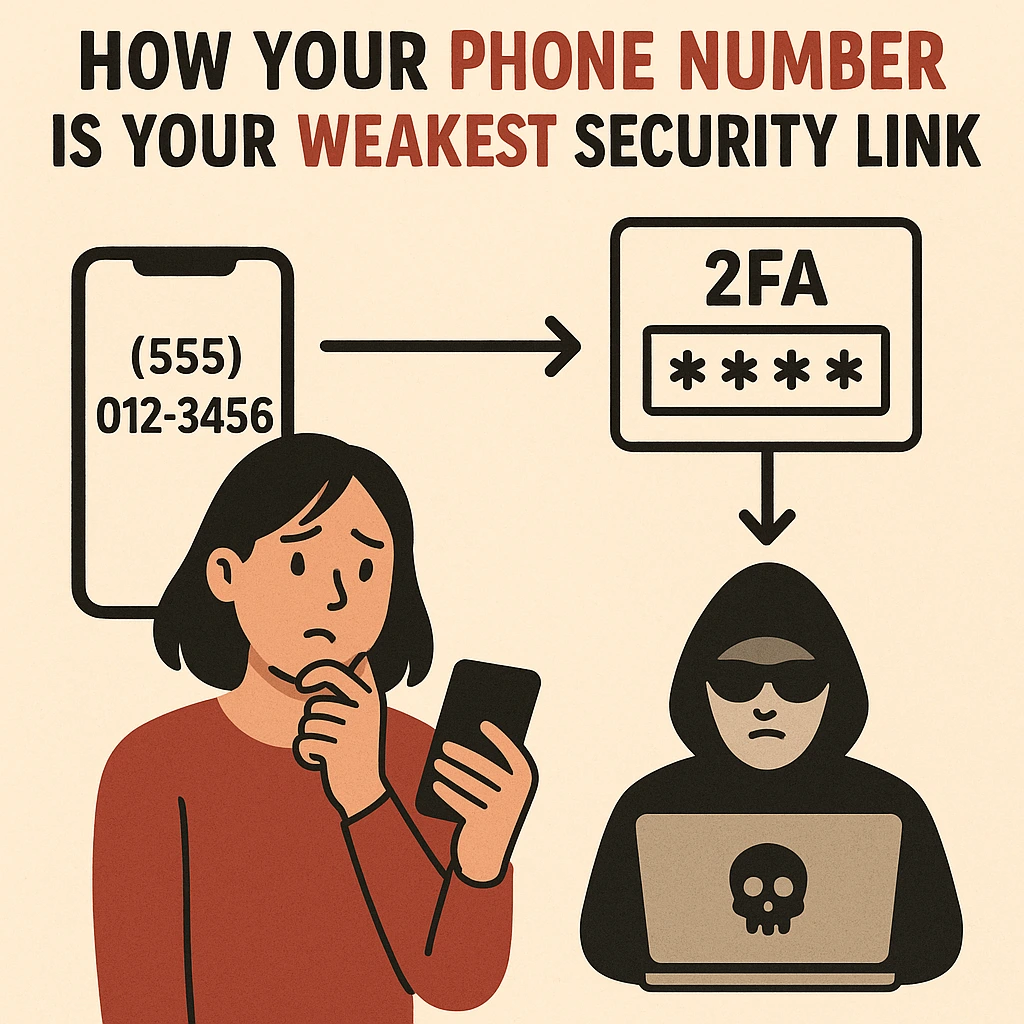
Attackers discovered that if they could take over your number, they wouldn't need your password. They have everything once they get that.
Your Phone Number Is a Master Key to Your Digital Life
Many individuals are unaware of how dangerous your phone number may be in the wrong hands. An attacker can use your number to track your whereabouts, reset your accounts, impersonate you, violate your privacy, and even access your finances. Phone numbers are accepted as recovery alternatives on the majority of online venues. The platform sends a code to your phone if you can't remember your password.
This implies that if someone steals your phone number, they can ask for password resets on your behalf. They can just change your password without of having to guess it.
Additionally, messaging services like Telegram and WhatsApp are linked to your number. An attacker can take over these accounts in a matter of minutes if they manage to gain control of your phone number.
They get access to your contacts, business mails, private talks, and personal images. Attackers may even message your friends while posing as you. The worst part is that your number is permanently linked to leaked lists, web databases, data brokers, and public information. It becomes a lifetime vulnerability once it is revealed.
The SIM Swap Attack: A Criminal’s Favorite Weapon
One of the riskiest types of identity theft is a SIM switch assault. In this attack, a criminal persuades your mobile provider to move your phone number to a SIM card under their control. They now have complete access to all incoming SMS texts. One-time passwords (OTPs) for login verification fall under this category.
Hacking your phone is not necessary for SIM changing. All that is needed is to manipulate the support system of the mobile carrier. Attackers frequently deceive customer support agents by using stolen data from data breaches, publicly accessible social media information, or phony identification. They occasionally even bribe carrier workers.
Your phone signal vanishes after the exchange is finished. You immediately lose access. Your digital identity is now under the attacker's control. They have the ability to read every verification message intended for you, reset your banking password, access your cryptocurrency wallet, and log into your email.
Globally, SIM swaps have resulted in losses of millions of dollars. Investors, business owners, celebrities, and regular people who were unaware of their vulnerability are among the well-known victims. SIM changing will continue to be one of the simplest and most destructive cyberattacks as long as SMS verification is in place.
SMS One-Time Passwords: Convenient but Extremely Unsafe
SMS-sent one-time passwords are frequently promoted as secure. They are actually some of the least reliable authentication methods. SMS messages are sent via antiquated telecom infrastructure that was never designed with encryption in mind. They can be faked, diverted, or intercepted.
SMS can be compromised by attackers in a number of ways. They might deceive your carrier into sending you a new SIM card. They might take advantage of weaknesses in networks such as SS7, a global telecom standard that has been in use for decades.
Additionally, they might use spyware on your smartphone that discreetly reads your notifications. Phishing assaults are a tactic used by certain hackers to send phony OTP forms, tricking you into divulging the code.
Because SMS is used by so many businesses, hackers are well-versed in how to take advantage of its flaws. Do you want to gain access to an account? Request an SMS code. Do you want to steal cryptocurrency? Use SMS to reset the wallet. Would you like to take over email? Text someone to get well. Because they are aware that the SMS channel is brittle, inadequately controlled, and infrequently questioned, criminals prefer to target phone numbers.
Data Breaches Are Fueling Phone Number Attacks
It's highly likely that there have been several data breaches involving your phone number. Over the past ten years, billions of phone numbers have been leaked by major platforms, including social networks, banks, marketing firms, hotels, and e-commerce behemoths. Your number is searchable on the dark web once it is included in a data breach. Lists with millions of numbers matched with names, emails, and occasionally even addresses are bought and sold by criminals.
For attackers, this information is incredibly valuable. They can carry out targeted frauds, impersonation attempts, phishing messages, or SIM switch assaults with just your phone number and a minimal quantity of personal information. Telemarketing and spam calls are frequently the outcome of compromised phone records.
You grow more vulnerable and find it more difficult to reclaim your privacy the more your number is shared online.
Your Phone Number Makes You Easy to Track
People don't realize how much information phone numbers can give. When you give your phone number to a website or app, it might be used to search vast databases for your identity.
Businesses compare numbers with internet activity, social media profiles, location information, and purchasing patterns. Advertisers use your number as a constant identifier to monitor your behavior across apps.
Even worse, with just your phone number, hackers can utilize online lookup tools to locate your email, address, age, family members, social media profiles, and compromised accounts. This puts you in a risky situation where all of your digital life is dependent on one readily available piece of information. Your number becomes the ideal place for an attacker to start if they wish to target you.
Phone Numbers Make Social Engineering Easier
The art of manipulating others is known as social engineering. Attackers are aware that they can pose as your bank, a friend, a government official, or even your employer if they have your phone number. Messages that seem to be from well-known numbers are more likely to be trusted. This trust is used by scammers to send phony account notifications, warning messages, or OTP requests.
For instance, they might text you to urge you to confirm a purchase while posing as your bank. You fall into their trap when you respond or click on a link. They might phone and ask for verification information while posing as your mobile carrier. After you reply, they collect enough data to switch SIM cards.
Some con artists even pose as you and message your WhatsApp contacts to demand money. Access to your number is the first step in all of this.
Your Phone Number Is Impossible to Change
One of the main causes of phone numbers being such a risky security link is this. You can make a new email if your current one is compromised. You can reset your password if it has been compromised. However, what is your phone number? For years or even decades, the majority of people maintain the same number. Banks, social media accounts, official documents, and business relationships are all connected to it. It seems too inconvenient to change it.
Your number is a very valuable target because of its permanency. Attackers are aware that even after an occurrence, you are unlikely to modify it. This implies that your number is at risk for the rest of your life once it is revealed. Because they are aware that the number will remain active, criminals can continue experimenting with different techniques year after year.
How to Protect Yourself from Phone Number Attacks
There are practical techniques to safeguard yourself even though your phone number is a significant vulnerability. For security reasons, the most crucial step is to discontinue using your phone number. Instead than using SMS codes, use built-in device prompts like biometrics or authentication apps like Authy and Google Authenticator. Because these techniques don't rely on telecom networks, they are much safer.
Whenever feasible, remove your phone number from accounts. Email-only recovery is possible on several platforms. For sign-ups, use a different number (sometimes known as a private number) rather than your primary number. Never post your phone number online or on social media.
Get account-level safeguards, like PIN numbers that stop unwanted SIM changes, by contacting your carrier. Keep an eye out for indicators of SIM shifting, such as abrupt service interruptions. Take immediate action if something seems suspect.
These behaviors lessen the risk but do not completely remove it. Reducing the frequency with which your number is used as a means of identification is crucial.
Conclusion: Treat Your Phone Number Like a Password
Your phone number is not an innocuous piece of data. Criminals are skilled at using this potent security key. Your identity, finances, and digital existence are at stake if you treat it carelessly. The truth is straightforward: a phone number was never intended to be secure. However, you may stop attacks and safeguard your most important data by being aware of the dangers and making a few wise adjustments.