The worldwide workplace has undergone one of the most significant and rapid changes in contemporary history over the past few years. Millions of workers moved overnight from conference rooms and cubicles to virtual meeting screens, kitchen tables, and living rooms. Working remotely became more than just a choice.
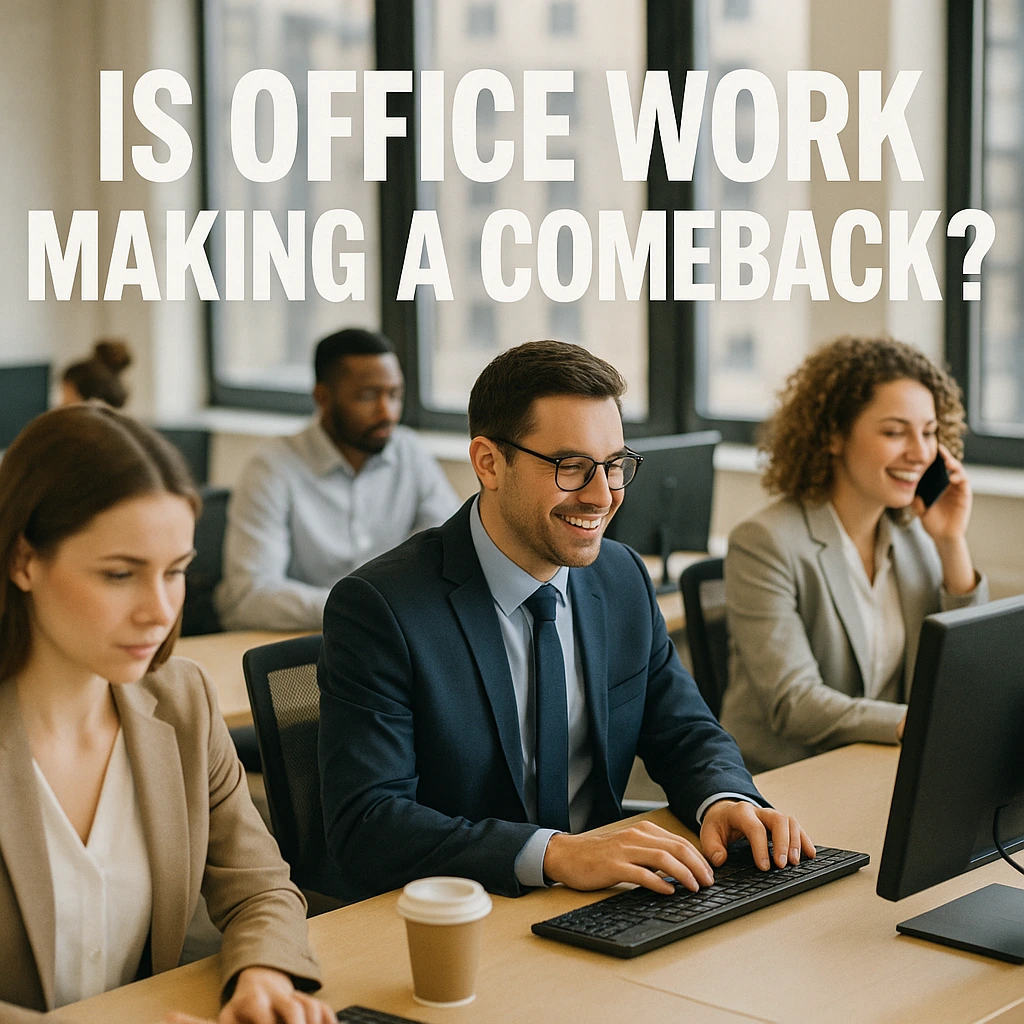
However, as the mid-2020s draw to a close, an unexpected issue is beginning to surface in online discussions, HR departments, and boardrooms: Is office work returning?
The solution is neither universal nor straightforward. A global rebalancing of work paradigms is taking place, with neither full-time office life nor completely remote employment being the norm. Rather, companies are redefining what "workplace" actually means. And it begs the question: despite the success of remote work, why are so many businesses gradually going back to the office?
Let's examine the main causes of this change, the proof that office work is gaining traction, and what workers should anticipate as contemporary workplace culture develops.
1. The Limitations of Remote Work Are Becoming Clear
When remote work first gained popularity, it was hailed as a breakthrough for worker autonomy, adaptability, and lifestyle balance. Indeed, it has provided innumerable advantages. However, certain fractures have started to appear after years of remote-first culture.
Nowadays, a lot of workers acknowledge that working from home has its drawbacks, which are sometimes overlooked in the thrill of flexibility. The most prevalent problems are communication gaps, fuzzy boundaries, and loneliness. Despite their strength, digital tools cannot completely replace interpersonal communication or impromptu teamwork.
Some employees have reported:
-
Difficulty separating work from personal life
-
Limited career visibility due to lack of physical presence
These difficulties do not imply that working remotely is inefficient. Rather, they demonstrate that not all workplace issues can be resolved by remote work alone. This insight is one of the reasons office work is gradually becoming more important, especially in businesses where cooperation and teamwork are crucial.
2. The Collaboration Effect: Why In-Person Still Works
Many workers find that working remotely is more convenient. However, in-person teams continue to yield more consistent results and richer cooperation for many businesses. The “collaboration effect” is one of the biggest drivers of the return-to-office movement.
Faster choices, less misconceptions, and more original problem-solving are frequently the results of face-to-face discussions. Digital platforms are unable to properly capture the body language, eye contact, and instantaneous feedback that come with being physically there.
Sessions for brainstorming became more lively. Solving problems gets quicker. New concepts come to mind organically. Many businesses come to the conclusion that some types of work just do better in physical, collaborative settings as a result of these subtle but potent characteristics.
As a result, more businesses are promoting partial returns in order to foster creativity, teamwork, and communication rather than to impose stringent control.
3. Rebuilding Company Culture After Virtual Drift
Everyday encounters, such as coffee breaks, team lunches, and talks in the corridor, used to naturally shape the company culture. These natural moments were disturbed by remote employment. As workers became isolated, many businesses began to detect cultural dispersion.
A strong workplace culture plays an essential role in:
-
Building trust
-
Strengthening team relationships
-
Developing employee loyalty
These aspects of culture start to disappear in the absence of common experiences. Even those who would rather work remotely admit that the company's online identity is less strong.
Because of this, office work is becoming more popular—not as a substitute for remote work, but rather as an addition that supports corporate identity and team cohesion.
4. Hybrid Models Are Outperforming Pure Remote Work
Office work is not the only way of the future. It's also not entirely remote. Hybrid art, which combines both worlds, is the true winner. And the resurgence of office work is being driven by this combination.
In the following areas, hybrid models are currently doing better than fully remote and totally onsite models:
-
Employee satisfaction
-
Productivity
-
Long-term performance
-
Retention
-
Work-life balance
Employees frequently benefit from the best aspects of both environments when they select a few days for work and a few days for remote work. They take pleasure in concentrated production at home and teamwork at work. Employees have more control over their weekly schedule and experience less burnout as a result of this balance.
The shift to hybrid work is frequently the primary cause of the recent increase in office attendance. It's a natural transition toward a better balance rather than a forced return.
5. Young Professionals Are Driving Office Return
It's interesting to note that Gen Z is among the demographics most in favor of going back to work. Many believe that working remotely doesn't provide them with the mentorship, visibility, or social learning they require early in their careers, despite their love of tools, technology, and flexibility.
Younger workers often report:
-
Difficulty finding mentors
-
Feeling isolated from colleagues
-
Missing structured professional development
-
Limited chances to build relationships
They may get advice from senior staff, see how teams operate, and learn more quickly when they are in the office. Because of this, a lot of Gen Z professionals actively favor office-first or hybrid setups. Global company decisions are being impacted by this generational shift.
6. Performance and Accountability Are Easier to Manage in Person
In remote settings, managers and team leaders are under increasing pressure to keep an eye on productivity. Although there is no intrinsic decrease in performance when working remotely, assessing it becomes more difficult. Some businesses just don't have the procedures or tools necessary to properly track output.
In contrast, office environments naturally support:
-
Transparent communication
-
Faster clarification of doubts
-
Easier coordination
-
Smoother delegation
The goal of returning to office work is to preserve consistency in performance and streamline processes, not to conduct surveillance.
7. Corporate Real Estate Investments Are Being Re-Optimized
Big businesses with substantial office expenditures are unable to maintain vacant facilities indefinitely. However, many companies are rebuilding facilities to meet contemporary needs rather than going back to antiquated layouts. Offices are becoming centers of innovation, creativity, and teamwork rather than just rows of desks.
This redesign includes:
-
Breakout zones
-
Flexible seating
-
Quiet focus rooms
-
Social and recreational spaces
Businesses can enhance the appeal and significance of in-person work by updating office environments.
8. The Psychological Benefits of Leaving Home
Even those who prefer working remotely acknowledge that being indoors all day can lead to emotional exhaustion. Home offices cannot provide the same level of mental stimulation as a change of setting, such as traveling, working with others, or interacting with people.
Employees who return to the office often report:
-
Increased motivation
-
Higher energy
-
Better focus
-
Reduced feelings of isolation
The office becomes a social and psychological anchor in addition to a place of employment.
9. The Return Is Not a Reversal—It’s a Redesign
The question "Is office work making a comeback?" may suggest that businesses are reverting to employment arrangements from before 2020. However, it isn't the case. Instead of a reversal, what we are witnessing is a makeover.
The new office culture blends:
-
Flexibility
-
Autonomy
-
Collaboration
-
Learning
-
Balance
It acknowledges that workers perform best when given choices rather than demands.
Because of this, a lot of businesses stress that the objective is to transform workplaces into meaningful environments that promote both individual well-being and organizational performance rather than forcing workers back into inflexible frameworks.
Conclusion: The Future Is Hybrid—Not Office-Only
Office work is becoming more popular, but not in the conventional sense. Rather, it is resurfacing as an essential component of a multifaceted work approach. Businesses are realizing that while if working remotely offers a great deal of independence, the office is still important for mentoring, communication, culture, and innovation.
The future of work is a partnership rather than a contest between the home and the office. Additionally, employees will have more flexibility and balance than ever before as hybrid models continue to develop.