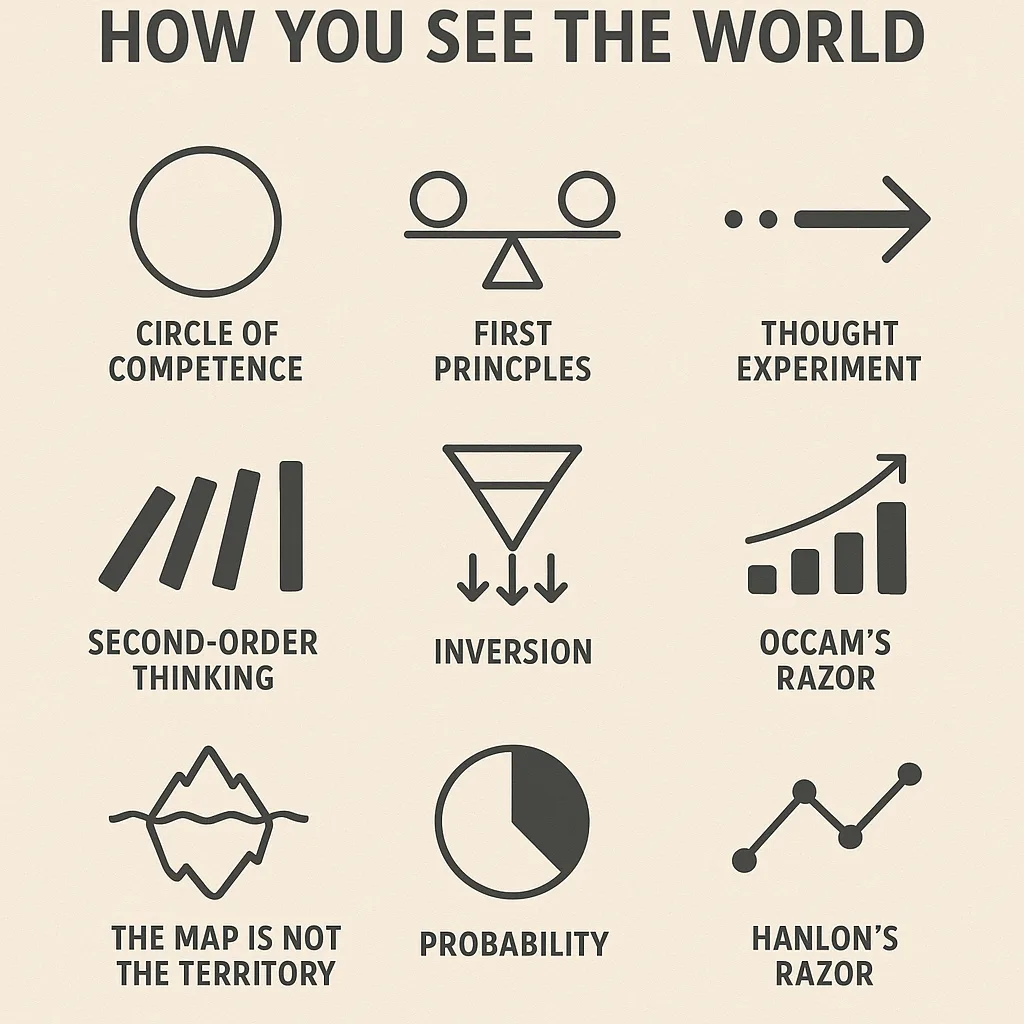
Have you ever questioned why certain people appear to be able to recognize patterns more quickly, make wiser decisions, and live clearly? It's mental models, not magic or innate intelligence.
Your understanding of the world is based on mental models. They influence your thoughts, perceptions, problem-solving techniques, and decision-making.
The most potent mental models that can drastically alter your perspective on the world, improve your ability to think clearly, and enable you to make more informed decisions in life will be discussed in this blog.
What Are Mental Models?
A mental model is a structure or perspective that aids in your understanding of the outside world. It functions similarly to a shortcut your brain uses to make difficult concepts simpler.
Think of them as mental “tools” that help you:
-
Analyze problems
-
Predict outcomes
-
Avoid mistakes
-
See reality more clearly
Although mental models are used by everyone, most people only use a small number of them, and they may not even be aware of it. Your ability to think more clearly improves as you study and use more models.
As Charlie Munger (Warren Buffett’s business partner) once said:
“You must have the models in your head and array them — on the wall of your mind — and use them all. You can’t just use one or two.”
Why Mental Models Matter
Life is complex. Mental models help reduce that complexity. They let you:
-
Cut through noise and distractions
-
Make faster and more accurate decisions
-
Avoid cognitive biases and emotional traps
-
See hidden connections and opportunities
You'll think more clearly about anything, from relationships to finances to career decisions, the more models you gather from fields like economics, psychology, physics, and biology.
Mental Models That Will Change Your Thinking
Let’s look at some powerful mental models you can start using today.
1. First Principles Thinking
Break things down to the most basic truths and reason up from there.
First principles compel you to doubt everything and start over rather than adopting presumptions or imitating others.
Used by: Elon Musk, Aristotle, top engineers and scientists.
Example:A first-principles thinker asks, "What's the real need I'm solving — transportation, status, safety, or savings?" as opposed to, "Which car should I buy?"
2. Second-Order Thinking
Think beyond the immediate result and ask: “And then what?”
First-order thinking looks for quick wins. Second-order thinking considers long-term consequences.
Example:
First-order: “I’ll take a loan to buy this car — I can afford the monthly payment.”
Second-order: “How will this debt affect my savings, stress, and flexibility five years from now?”
Used by: Strategic thinkers, investors, military leaders.
3. Opportunity Cost
Every choice has a hidden cost: the value of the next best alternative you gave up.
Time, energy, and money are limited. Smart people always ask:
“What am I giving up by doing this?”
Example:You could have spent those two hours exercising, learning a new skill, or starting a business instead of watching TV.
4. Inversion
Flip the problem on its head. Instead of asking, “How do I succeed?”, ask “How do I fail?”
Thinking backward helps you avoid mistakes and blind spots.
Used by: Charlie Munger, ancient Stoics, critical thinkers.
Example:
Instead of asking how to be productive, ask:
“What consistently kills my productivity?”
Answers: Social media, multitasking, unclear priorities.
5. Confirmation Bias
We tend to search for or interpret information in a way that confirms our existing beliefs.
Being conscious of this mental trap challenges your preconceptions and is a model in and of itself.
Example:
If you believe a diet works, you’ll focus on success stories and ignore criticism.
Mental model tip: deliberately seek disconfirming evidence.
6. Hanlon’s Razor
Never attribute to malice that which is adequately explained by stupidity or ignorance.
You become less paranoid, more forgiving, and less reactive when you follow this model.
Example:
Someone cuts you off in traffic. Instead of assuming they’re a jerk, consider they may be distracted, lost, or rushing to the hospital.
7. Circle of Competence
Know what you know — and admit what you don’t.
You can avoid overconfidence by staying within your "circle of competence." You are more likely to make mistakes when you venture outside of it.
Used by: Warren Buffett
Example:
If you don't fully understand real estate, startups, or cryptocurrency, don't invest in them. Remain focused on areas in which you are knowledgeable or experienced.
8. The Map Is Not the Territory
Models, labels, and descriptions are simplifications — not the full reality.
This reminds you to stay humble. Just because a theory, expert, or chart says something doesn’t make it absolute truth.
Example:
Your GPS says you’re on the road, but in reality, you're stuck in construction. Real life always has extra complexity.
9. Law of Diminishing Returns
The more you do something, the less benefit you get after a certain point.
This is particularly true when it comes to learning, exercise, and productivity. More work eventually results in burnout rather than improved outcomes.
Example:
Studying for 3 hours = improvement.
Studying for 10 hours = exhaustion and low retention.
10. Skin in the Game
Don’t trust advice from people who don’t bear the consequences of being wrong.
People who have “skin in the game” have more credibility because they risk something if things go bad.
Example:
Take business advice from a founder, not just a consultant.
Take health tips from someone who lives the lifestyle, not just someone who sells it.
How to Use Mental Models in Daily Life
You don’t need to memorize 100 models. Start by mastering a few and applying them consistently.
Here’s how to integrate them:
1. Ask Better Questions
Instead of reacting, pause and ask:
-
What’s the second-order effect here?
-
Am I inside my circle of competence?
-
What’s the opportunity cost of this?
-
What would I do if I inverted the problem?
2. Journal Your Decisions
When making big choices, write down:
-
What mental models are you using?
-
What assumptions are you making?
-
What’s the worst-case scenario?
This builds awareness and helps you refine your thinking over time.
3. Use Checklists and Frameworks
Create a checklist of your top 5–10 mental models and keep it visible.
Before making decisions or reacting emotionally, run through your list.
4. Learn Across Disciplines
Math, biology, economics, and psychology are just a few of the disciplines that have produced mental models. Don't limit your reading to what interests you. Extend your toolkit.
Final Thoughts
Not only CEOs, scientists, and philosophers can benefit from mental models. They are daily tools for improving living and thinking more clearly.
You become more strategic, less reactive, and better able to manage the complexities of life when you learn to think in models.
You don’t need to be a genius to think like one. You just need the right lenses — and a habit of using them.
Begin modestly. Select two or three models from this list. Put them to use for a week. See how they increase your awareness, decrease bad choices, and bring order and clarity to chaos.