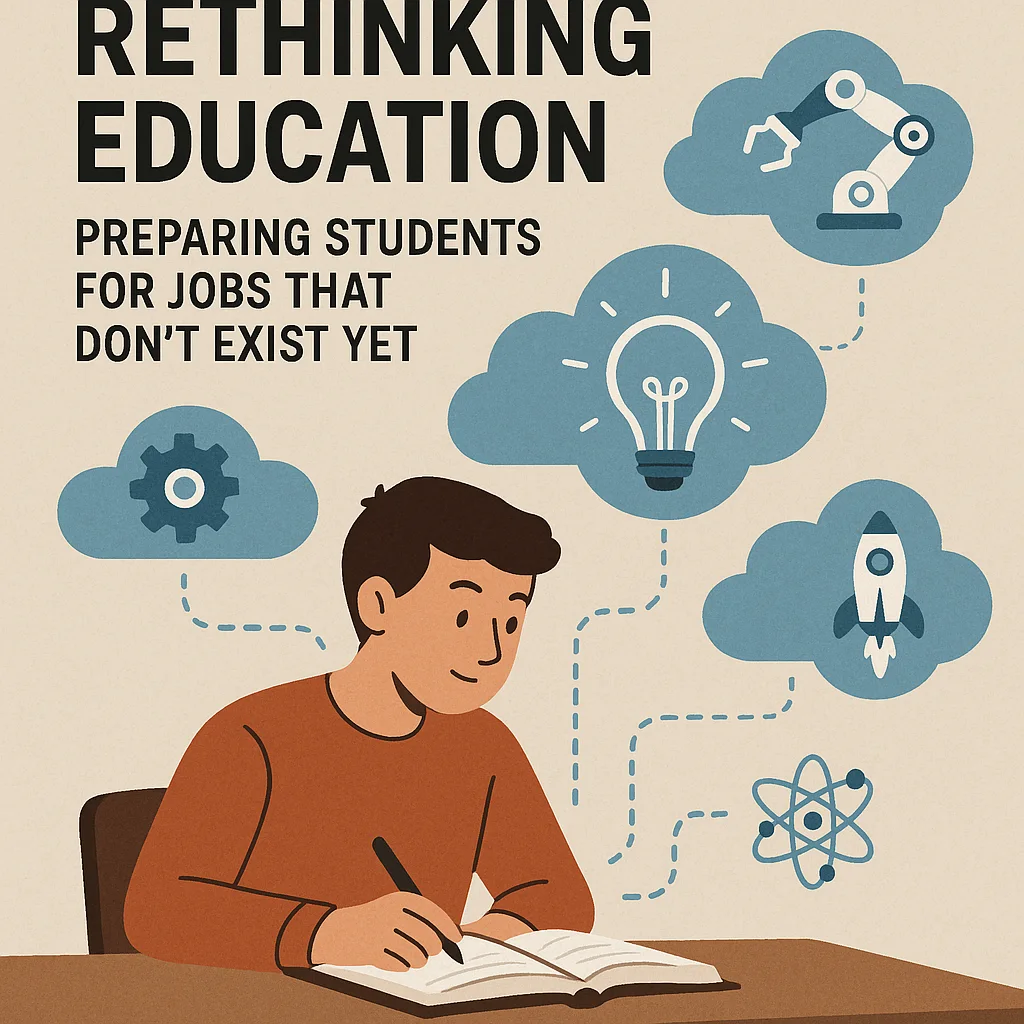
The workplace is changing more quickly than it has ever done. Jobs like blockchain analyst, data scientist, social media manager, and app developer weren't around a few decades ago. However, they are among the most sought-after professions nowadays. A sobering fact is brought to light by this quick evolution: many of the jobs that today's students will be performing in the next ten to twenty years haven't even been invented yet.
The goal of traditional educational systems, which were created during the industrial era, was to prepare students for foreseeable career paths, such as engineering, manufacturing, teaching, clerical work, or medicine. However, uncertainty, automation, artificial intelligence, and constant reinvention characterize the workplace of the twenty-first century. Students need more than just knowledge to succeed; they also need to be flexible, creative, resilient, and capable of lifelong learning.
This blog examines why education needs to be rethought, what skills are most important in a rapidly evolving labor market, and how parents, students, and schools can get ready for jobs that don't yet exist.
The Problem with the Traditional Education Model
The majority of educational systems worldwide are set up like assembly lines, with students following standardized curricula, taking tests based on knowledge they have learned, and being expected to graduate "job-ready." However, this model is predicated on the idea that work will remain stable. Regretfully, it is not.
-
Automation & AI are replacing jobs: Both cognitive and manual routine tasks are becoming more automated. AI is now capable of creating art, analyzing data, writing code, and even drafting legal documents.
-
Entire industries are shifting: Biotech is changing healthcare, Web3 is changing digital ownership and finance, and renewable energy is surpassing fossil fuels.
-
Gig economy growth: More people are engaged in non-9–5 jobs such as self-employed creation, digital nomad work, and freelancing.
Students who receive an education that solely teaches them to memorize facts and follow directions are ill-prepared for this changing environment.
Future Skills Students Will Need
We can still identify core competencies that help students be ready for uncertainty even if we are unable to predict specific job titles. These consist of:
1. Critical Thinking and Problem-Solving
Although they lack judgment, machines are very efficient. Pupils with problem-solving, logical thinking, and decision-making skills will always be valued.
2. Adaptability and Resilience
There will be non-linear career paths. It will be essential to be able to change careers, accept change, and remain composed in the face of uncertainty.
3. Digital Literacy and Tech Fluency
There will be a tech component to every future job. While mastering every tool is not necessary, students must feel at ease learning and quickly adjusting to new technologies.
4. Creativity and Innovation
Even though AI can imitate, human creativity is still distinct. Future opportunities will be driven by the capacity to think creatively, come up with novel solutions, and see beyond the obvious.
5. Collaboration and Emotional Intelligence
Workplaces are becoming more remote and global. Students need to learn how to manage relationships, collaborate across cultural boundaries, and establish trust—skills that machines cannot duplicate.
6. Lifelong Learning Mindset
The capacity to continuously learn is the most crucial ability. Students should learn how to learn, not just what to learn, through education.
How Education Must Change
Preparing for unknown jobs means schools must shift from rigid models to flexible, future-ready learning environments.
1. Focus on Skills Over Memorization
Schools should teach students how to conduct research, assess sources, and apply knowledge rather than teaching them to memorize dates or formulas.
2. Project-Based and Real-World Learning
Real-world problems should be solved by students, whether they are creating apps, launching small enterprises, or creating community projects. These encounters foster creativity and flexibility.
3. Integrating Technology into Classrooms
Schools should teach students how to use AI tools responsibly rather than outright prohibiting them. AI can assist with research, writing, and coding, for instance.
4. Teaching Financial and Entrepreneurial Skills
Jobs of the future may not be traditional employment. It is crucial to prepare students for careers in portfolio management, entrepreneurship, and freelancing.
5. Emphasizing Mental Health and Resilience
It can be stressful to be constantly changing. To stay rooted in uncertainty, students require coping mechanisms, mindfulness exercises, and emotional control.
The Role of Parents and Students
Not just schools are involved in this change. Both parents and students themselves need to adopt a new way of thinking.
-
Parents: Encourage exploration, curiosity, and independence instead of pushing only for “safe” careers.
-
Students: Develop side projects, experiment with hobbies, and embrace failure as part of growth.
-
Both: Value skills like creativity, communication, and resilience just as much as grades.
Examples of Emerging Careers
To make the future less abstract, consider careers that didn’t exist 15 years ago but are booming today:
-
App Developer
-
Data Scientist
-
Digital Marketer
-
Social Media Manager
-
AI Ethics Consultant
-
Blockchain Analyst
-
Virtual Reality Designer
This trend will continue. Job titles like "AI Relationship Manager," "Climate Adaptation Specialist," or "Neuro-Interface Designer" might be common by 2040. Students need to be prepared to face these unknowns through education.
A New Philosophy of Education
In the end, human preparation should become the primary goal of education rather than job preparation. Rather than preparing students for predetermined roles, we should enable them to:
-
Adapt to unpredictable challenges
-
Think critically and creatively
-
Stay curious and committed to lifelong learning
-
Make ethical decisions in a tech-driven world
Future employment will require not only competent workers but also considerate people who can strike a balance between advancement and compassion, fortitude, and insight.
Conclusion
Although we cannot foresee the precise nature of tomorrow's jobs, we do know that they will require resilience, creativity, and adaptability. The only way to prepare students for jobs that do not yet exist is to rethink education today. Schools must replace inflexible, antiquated models with adaptable ones that foster lifelong learning, digital fluency, and problem-solving skills. Risk-taking and exploration must be encouraged by parents. Additionally, students need to embrace their greatest strengths—curiosity and adaptability.
The next generation will not only survive the future if we are successful, but they will also help to shape it.