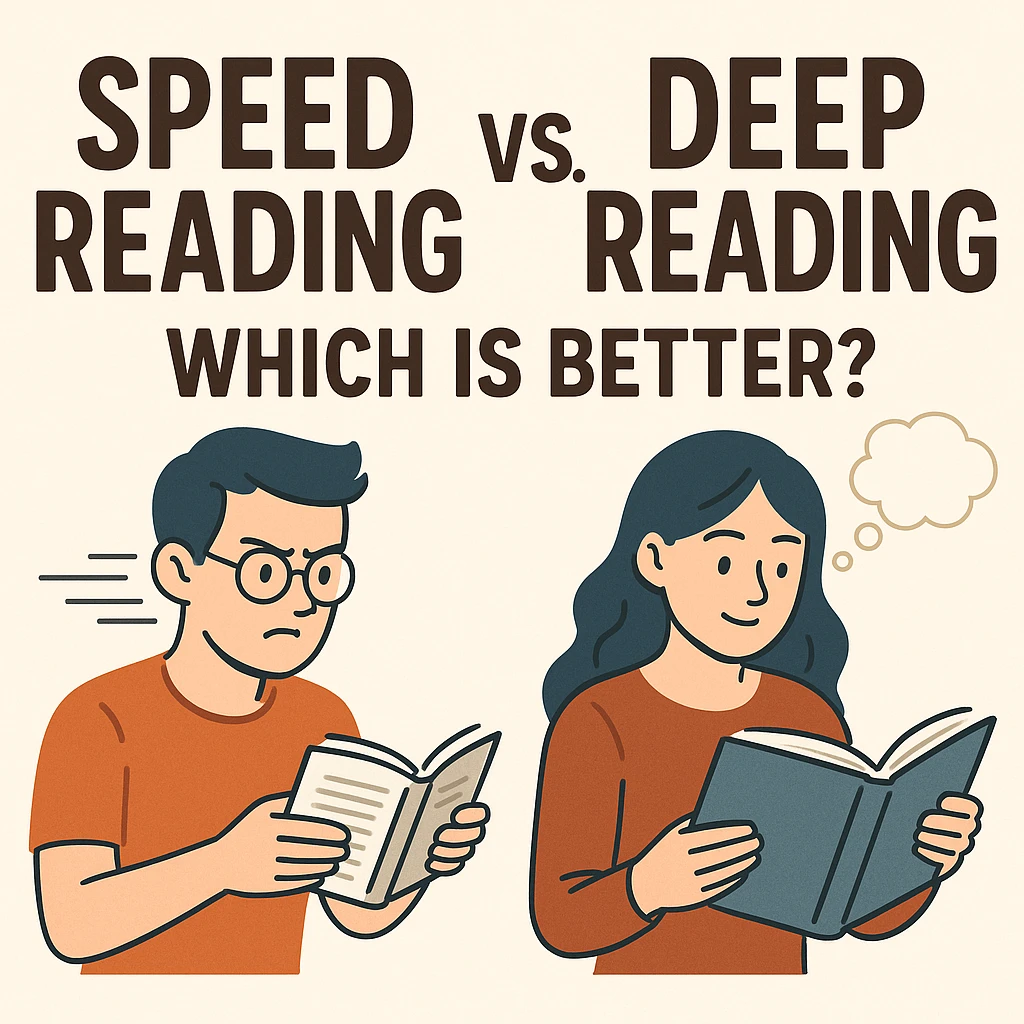
How we read has become as important as what we read in a world full of distractions and information. Whether you're a professional, student, or lifelong learner, you've undoubtedly encountered the same conundrum: should you read more quickly to cover more ground, or should you read more slowly and thoroughly to improve your comprehension and retention of the material?
Enter the age-old debate: Speed Reading vs. Deep Reading.
Efficiency is promised by one, and understanding by the other. But which approach actually accomplishes your objectives? We'll go into great detail about both approaches in this blog, including their advantages and disadvantages as well as how to pick the best strategy for your goals.
What Is Speed Reading?
The goal of speed reading is to increase your reading speed without significantly compromising your comprehension. While trained speed readers claim to read 600–1000 words per minute (wpm) or more, most people read 200–300 words per minute on average.
Common Speed Reading Techniques:
-
Skimming: Quickly glancing through text to get the general idea.
-
Meta guiding: Using a finger or pointer to lead your eyes quickly across the page.
-
Minimizing subvocalization: Reducing the inner voice in your head to read faster.
-
Chunking: Reading groups of words or phrases together instead of word-by-word.
Speed reading is frequently promoted as the secret to rapidly absorbing vast amounts of information and as a productivity hack. Does it, however, work?
What Is Deep Reading?
The process of deep reading is more deliberate and takes longer. It entails giving the text your whole attention, reflecting, evaluating, challenging, and taking in difficult concepts. It's how we read research papers, novels, and philosophical essays.
In deep reading, the goal isn’t speed — it’s understanding, retention, and meaning.
Deep Reading Involves:
-
Critical thinking: Actively evaluating the ideas presented.
-
Reflection: Pausing to consider the implications or relate it to prior knowledge.
-
Note-taking: Writing down insights or summarizing in your own words.
-
Re-reading: Going back over difficult sections for better clarity.
Compared to speed reading, deep reading stimulates different parts of the brain, particularly those related to memory, reasoning, and empathy.
The Science Behind Both Reading Styles
Speed Reading Science
Despite the allure of reading at 1000+ words per minute, several studies indicate that comprehension and speed must be traded off. You run the risk of missing deeper meaning, context, and subtleties the faster you read.
A 2016 meta-analysis published in Psychological Science in the Public Interest concluded:
“At speeds above 500–600 wpm, comprehension typically drops significantly, and claims of 'photographic' reading are not supported by evidence.”
Deep Reading Science
Conversely, it has been demonstrated that deep reading stimulates the language, memory, and empathy regions of the brain. According to neuroscientist Maryanne Wolf, digital skimming is impairing our capacity for deep reading, which prepares the brain for sophisticated thought.
“We are losing the cognitive patience for deep reading. It's not just what we read but how we read that shapes how we think.”
Pros and Cons of Speed Reading
✅ Pros:
-
Efficiency: Excellent for scanning documents, emails, and articles.
-
Time-saving: enables you to rapidly grasp the main idea of lengthy content.
-
Improved focus (short-term): Distraction can be avoided with the necessary intensity.
❌ Cons:
-
Reduced comprehension: You may miss key arguments or subtle details.
-
Lower retention: Faster reading often leads to shallower memory of content.
-
Not ideal for complex texts: Technical, literary, or philosophical works require time.
Pros and Cons of Deep Reading
✅ Pros:
-
Better understanding: makes it possible to understand intricate concepts and arguments.
-
Improved memory: Deeply processed information is longer retained by the brain.
-
Critical thinking: promotes participation and introspection.
❌ Cons:
-
Time-consuming: Deep reading is inherently slow.
-
Cognitive fatigue: Requires more mental energy and concentration.
-
Less practical for fast-paced tasks: Not ideal when you're on a deadline.
How to Improve Both Skills
How to Get Better at Speed Reading:
-
Keep your eyes moving by using your finger as a guide.
-
Use apps like Spreeder to train your eyes to see farther.
-
With deliberate practice, get rid of subvocalization.
-
To increase urgency and decrease distractions, set a timer.
How to Improve Deep Reading:
-
Turn off notifications and distractions.
-
Underline, annotate, and take notes while reading with a pencil.
-
Pause after paragraphs to summarize in your own words.
-
Listen to an audiobook or read aloud simultaneously.
Both styles are skills, and like all skills, they can be trained with practice.
The Digital Era Dilemma
Our attention spans are getting shorter in the current digital era. Our tendency to scan rather than interact has been conditioned by the emergence of social media and short-form content. Speed reading feels natural because of this, but there is a price for it.
Deep reading is being replaced by digital skimming, which could impair our capacity for critical thought, sustained focus, and in-depth reflection.
Even if you incorporate speed reading into your daily routine, it's crucial to maintain deep reading as a habit in order to combat this.
So, Which Is Better?
It depends.
For filtering, scanning, and superficial comprehension, speed reading is perfect. For analysis, insight, and emotional connection, deep reading is essential.
If your goal is to consume, choose speed.
If your goal is to transform, choose deep reading.
A proficient reader should ideally be able to intentionally and deliberately switch between the two modes, using depth to learn and speed to navigate.
Final Thoughts
In this day and age, knowledge is plentiful, but wisdom is scarce. While reading quickly might help you stay up to date, deep reading is what makes you stand out because it allows you to make connections between concepts, question presumptions, and develop a complex perspective on the world.
Don’t just read more. Read better.