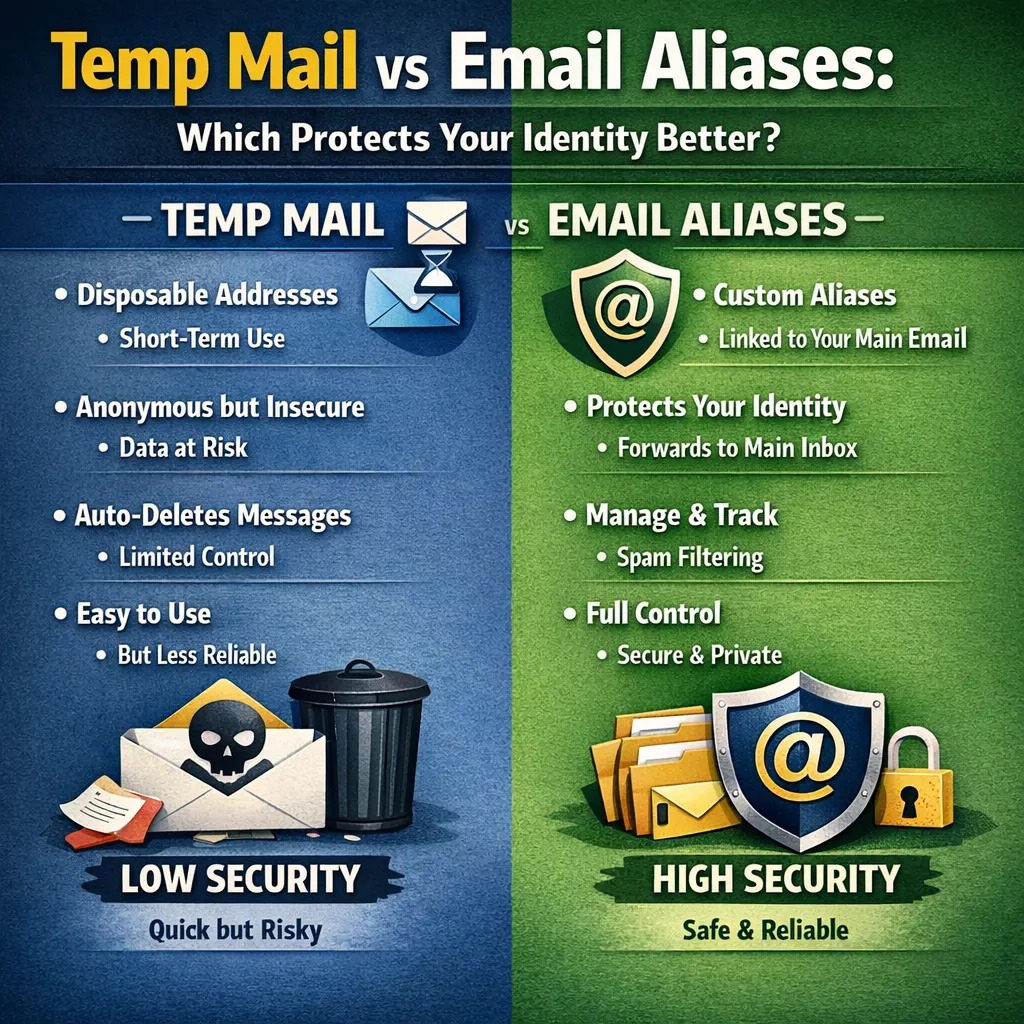
Your email address is more than simply a means of communication in the modern digital world. It is essential to your identity, online activities, purchases, social networks, and frequently personal information. Your email address is added to someone else's database each time you register for a website, download a resource, or sign up for a newsletter. This exposure may eventually result in tracking, spam, profiling, and even data breaches.
These days, a lot of people use two common techniques to safeguard their identity: email aliases and temp mail. They both seek to lessen the possibility that your actual email address will be discovered, but they do so in somewhat different ways. This blog examines how each approach functions, what it safeguards, its advantages and disadvantages, and, in the end, which approach best protects your identity based on your requirements.
Understanding Temp Mail: Identity Protection Through Disposability
You can get a temporary email account with temp mail providers that don't require a password, registration, or personal information. You can use it right away to get emails, usually for downloads, verification codes, or temporary service access.
Anonymity through transience is the central concept of Temp Mail. The address only lasts a little time before vanishing. There is no personal profile, no long-term mailbox, and no link to your true identity.
What Temp Mail Protects
Your actual email address won't be shared, saved, sold, or leaked thanks to Temp Mail. Any data associated with the address expires because it is disposable.
What Temp Mail Does Not Protect
Strong message security, encryption, and long-term access are not provided by Temp Mail. Incoming messages could be visible to anyone who has access to the inbox link. It is not intended for continuous or delicate communication.
✔ Hides your real email address
✔ Requires no account or personal data
✔ Prevents long-term identity linkage
✔ Does not encrypt messages
Understanding Email Aliases: Identity Protection Through Separation
Alternative email addresses that relay messages to your primary mailbox are known as email aliases. Typically, your email provider or a privacy-focused business creates these aliases. Aliases are not your primary address, but they are linked to your primary email account and are persistent, unlike Temp Mail.
Identity protection by compartmentalization is the fundamental concept of email aliases. You utilize distinct aliases for various services rather than disclosing your actual email address everywhere.
What Email Aliases Protects
Email aliases provide continuity and control while shielding your primary email address from prying eyes. You can disable an alias without affecting your primary inbox if it begins to receive spam.
What Email Aliases Does Not Fully Protect
Complete anonymity is not offered by email aliases. Behind the scenes, they are still connected to your primary email account, and in order to manage them, you typically need to create an account.
✔ Protects your main inbox
✔ Allows long-term communication
✔ Enables tracking of data leaks
✔ Still tied to your real email account
Anonymity vs Separation: Two Identity Protection Models
Temp Mail and email aliases represent two different strategies for identity protection.
Anonymity is a top priority for Temp Mail. It completely avoids creating an identity. There is no traceable connection, no profile, and no persistent account.
Separation is prioritized by email aliases. They divide various online activities into separate containers while permitting identity persistence.
✔ Temp Mail avoids identity
✔ Email aliases manage identity
✔ One erases, the other organizes
✔ Both reduce exposure in different ways
Which Protects Your Identity Better? It Depends on the Context
There isn't a single, universally accepted answer to the question of which better safeguards your identity. How, where, and why you provide your email address will determine the outcome.
Let’s examine different real-world scenarios.
Scenario 1: Signing Up for One-Time Services
When you only need to receive a verification code or access a resource once, identity persistence is unnecessary.
In this case, Temp Mail offers stronger identity protection because:
-
There is no long-term email address.
-
There is no account tied to you.
-
The address disappears, leaving no usable data trail.
✔ No identity creation
✔ No long-term data storage
✔ No future tracking
✔ Maximum anonymity
Email aliases produce a persistent data point that can be tracked over time, even if they are safer than using your own email.
Scenario 2: Managing Long-Term Accounts
Temp Mail becomes dangerous when you need to keep access to an account over time. You might not be able to access crucial services once the inbox expires.
In this case, email aliases offer stronger identity protection because:
-
You maintain control over the address.
-
You can disable or change it if compromised.
-
You can recover accounts and manage communication.
✔ Long-term access
✔ Better account recovery
✔ Controlled exposure
✔ Sustainable privacy
Temp Mail is not appropriate for long-term identity management because it does not enable continuity.
Scenario 3: Avoiding Spam and Marketing
Email aliases and temp mail both contribute to a decrease in spam, although they do it in different ways.
Temp Mail prevents spam entirely by avoiding permanent exposure. Once the address expires, spam becomes irrelevant.
You can monitor the source of spam by using email aliases. You can stop one alias from getting junk mail without affecting other services.
✔ Temp Mail blocks spam by disappearing
✔ Email aliases manage spam through control
✔ Both reduce inbox clutter
✔ Both improve digital hygiene
Scenario 4: Protecting Against Data Breaches
Exposed email addresses become targets for fraud and phishing when a website experiences a data breach.
Temp Mail offers strong protection here because:
-
The address is already expired or abandoned.
-
The breached data becomes useless.
Email aliases also offer strong protection because:
-
You can disable the compromised alias.
-
Your main email remains safe.
✔ Temp Mail eliminates long-term risk
✔ Email aliases isolate damage
✔ Both reduce breach impact
✔ Both protect your main inbox
Security and Privacy Considerations
Temp Mail prioritizes anonymity over security. Since messages are frequently not encrypted, anyone who knows the inbox address may be able to see them. Additionally, control over data deletion and storage is restricted.
Email aliases rely on the security of your main email provider. If your main account is secure, your aliases benefit from the same protection, including encryption, authentication, and storage controls.
✔ Temp Mail offers anonymity without security
✔ Email aliases offer security with identity
✔ One protects exposure, the other protects access
✔ Both serve different risk profiles
Control, Ownership, and Trust
There is really little control with Temp Mail. Long-term inbox management, message recovery, and setting changes are typically not possible. You have faith that the service will appropriately and briefly manage your data.
More control is provided with email aliases. They can be added, removed, disabled, renamed, and arranged. Additionally, you can keep an eye on which services are utilizing various aliases.
✔ Temp Mail offers simplicity
✔ Email aliases offer control
✔ One minimizes management
✔ The other maximizes oversight
Psychological Impact: Freedom vs Structure
Psychological freedom is provided by Temp Mail. There is no management, no commitment, and no long-term accountability. It lessens cognitive load and feels portable and light.
Psychological structure is provided by email aliases. They let you keep continuity, monitor exposure, and arrange your digital life without compromising privacy.
✔ Temp Mail offers freedom
✔ Email aliases offer structure
✔ One reduces attachment
✔ The other supports organization
Cost and Accessibility
Generally speaking, anyone can use temp mail services for free. They are therefore perfect for consumers looking for quick, free privacy protection.
Premium privacy services or expensive email plans frequently feature email aliases. Advanced alias management typically costs money, however some providers give a limited number of free aliases.
✔ Temp Mail is free
✔ Email aliases may be paid
✔ One favors accessibility
✔ The other favors sustainability
Common Mistakes to Avoid
Using Temp Mail for critical accounts is one common error. When the inbox expires, this could lead to a permanent loss of access.
Another mistake is using only one email alias for everything. This defeats the purpose of separation and increases exposure.
A third mistake is assuming aliases provide full anonymity. They do not; they simply reduce exposure.
The Hybrid Strategy: Using Both Together
The strongest identity protection strategy often involves using both Temp Mail and email aliases.
For example:
-
Use Temp Mail for untrusted websites, one-time signups, and quick access needs.
-
Use email aliases for trusted services, subscriptions, and long-term accounts.
This layered approach provides both anonymity and control, reducing risk while maintaining usability.
✔ Temp Mail for short-term anonymity
✔ Email aliases for long-term management
✔ Hybrid approach maximizes protection
✔ Balances privacy with practicality
Future of Identity Protection
Identity protection measures will continue to advance as data tracking becomes more complex. Instead of depending on a single email address, we are heading toward a future in which people manage several digital identities.
The need for transient identification is reflected in temp mail. The need for modular identification is reflected in email aliases. When taken as a whole, they symbolize the future of digital existence that respects privacy.
Conclusion: Which Protects Your Identity Better?
Temp Mail and email aliases both protect your identity, but in different ways.
By removing long-term identity exposure, Temp Mail provides the highest level of anonymity. For brief, low-risk encounters when you wish to leave no trace, it is perfect.
Controlled identity isolation is provided by email aliases. They are perfect for account administration, long-term use, and maintaining an ordered online life without disclosing your personal email address.
Temp Mail better secures your identity if you want to vanish. Email aliases are a preferable option if you want to control and safeguard your identity over time.
The most effective strategy is not choosing one over the other, but knowing when to use each.