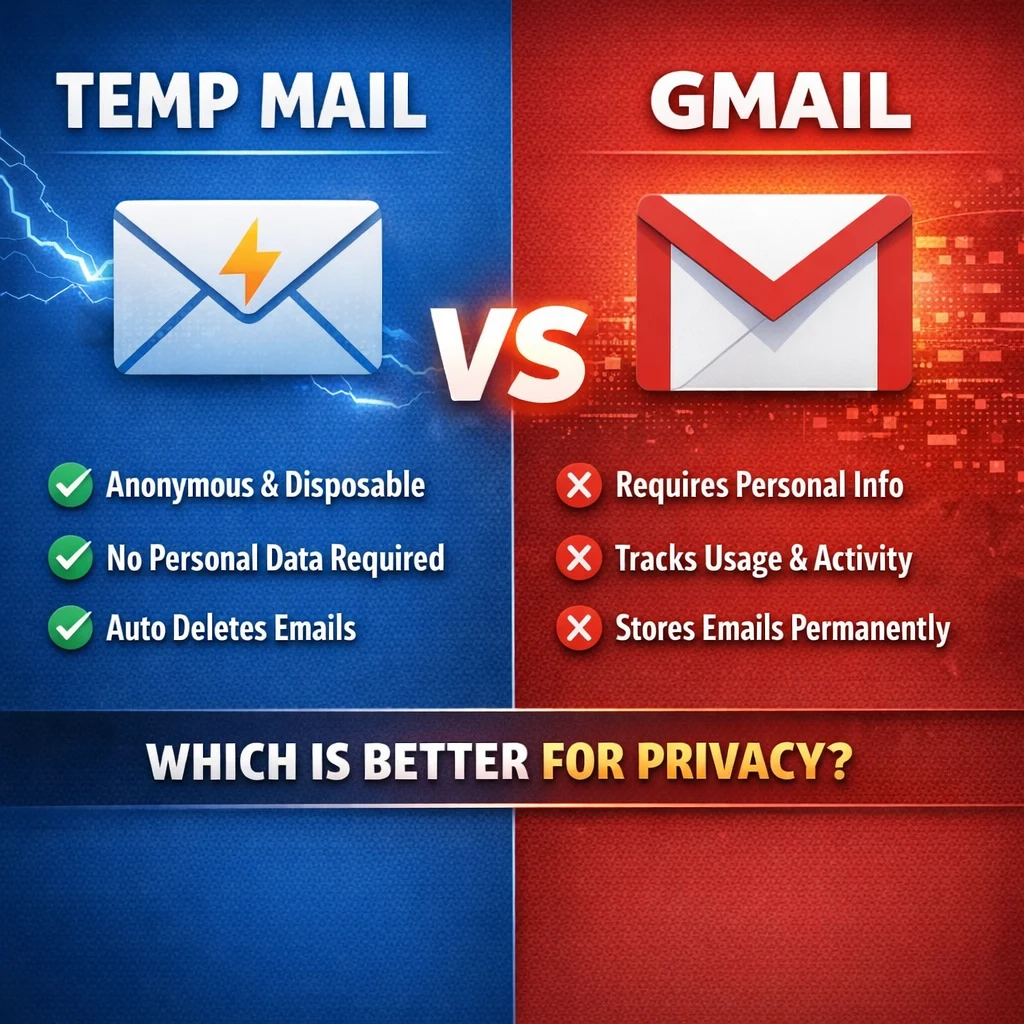
Email has evolved into a digital identity. An email address is frequently the first thing that websites request when you sign up for apps, validate social media accounts, or access services. However, not every email service was created with the same objectives. Convenience and ecosystem integration are important to some, whereas privacy and anonymity are important to others. This is the point at which comparing Gmail and Temp Mail becomes crucial.
It can seem unfair to compare a temporary email service to Gmail at first. While Temp Mail is intended for temporary usage, Gmail is a feature-rich email platform that is utilized by billions. However, the analogy takes on significance when privacy is the exclusive topic of discussion. In 2025, it will be crucial to comprehend how different services manage user data, identity, and monitoring.
This article examines the privacy differences between Gmail and Temp Mail, the risks associated with each, and which is better based on your requirements.
Understanding Temp Mail and Gmail
It's crucial to comprehend the purposes of these two services before comparing privacy.
What Is Temp Mail?
Temp Mail, sometimes referred to as disposable or temporary email, gives users a temporary email address. Typically, these addresses are produced automatically, don't require registration, and expire on their own. Temp Mail is frequently used for free trials, email verification, and spam protection for your actual mailbox.
What Is Gmail?
Google's main email service is called Gmail. It is a long-term email solution with extensive integration with Google's ecosystem, which includes Google Ads, YouTube, Android, and Search. Advanced services that Gmail provides include cloud storage, account recovery, spam filtering, and cross-device syncing.
Although both platforms send and receive emails, they have entirely distinct privacy philosophies.
Privacy Philosophy: Anonymity vs Identity
The way that Temp Mail and Gmail handle user identity is the primary distinction between them.
The foundation of Temp Mail is anonymity. The majority of services don't request recovery emails, phone numbers, or personal information. Since you don't need to create an account in order to get emails quickly, your actual identity remains distinct from the mailbox.
In contrast, Gmail is centered around identity. Your name, phone number, IP address, device information, and frequently your actual identity are all connected to a Gmail account. This makes Gmail dependable and recoverable, but it also implies that your email behavior is closely associated with your identity.
Anonymity offers less exposure than identity-based systems when it comes to privacy.
Data Collection and Tracking
How Temp Mail Handles Data
The majority of temp mail services gather very little information. Emails are momentarily saved and then erased after a predetermined amount of time. Many systems do not permanently link inboxes to IP addresses, and there is typically no long-term message tracking.
However, each service has a different level of privacy. Although some free services might display advertisements or gather simple usage data, the overall data footprint is minimal.
How Gmail Handles Data
Google's data-driven ecosystem includes Gmail. Gmail continues to add to a more comprehensive profile that includes usage behavior, device information, location signals, and interactions across Google services, even though Google claims it no longer reads emails for ad targeting in the conventional sense.
Your Gmail activity becomes a part of a much wider data network rather than existing in a vacuum.
✔ Temp Mail reduces exposure time and saved data.
✔ Gmail keeps emails forever unless they are erased by hand.
✔ Gmail activity is connected to other Google services.
Account Security vs Privacy Trade-Off
Although they are sometimes mistaken, security and privacy are not the same.
Gmail is quite secure. It provides robust infrastructure, AI-based phishing detection, account recovery alternatives, and two-factor authentication. Gmail provides you with ways to recover access in the event that someone attempts to hack your account.
Temp Mail prioritizes privacy over long-term security. Once an inbox expires, it is lost permanently because there is no way to log in or retrieve it. Because of this, Temp Mail is great for low-risk usage but not appropriate for critical accounts.
This is the main distinction:
- Gmail protects accounts
- Temp Mail protects identity
Depending on the situation, neither is always superior.
Spam, Marketing, and Digital Noise
One of the main reasons individuals use temporary email services is spam.
Even though Gmail has one of the finest spam filters in the world, it still gets newsletters, promotions, and marketing emails—especially if your address has been sold or shared.
By serving as a throwaway layer, Temp Mail completely eliminates this issue. You just stop using the email after you're done using it. There isn't a long-term inbox to maintain or tidy.
✔ Temp Mail keeps spam from accumulating over time.
✔ Spam is filtered by Gmail, yet undesired emails are still stored.
✔ Promotions are separated from your actual inbox by Temp Mail.
Third-Party Website Risk
You run a risk each time you enter your email address on a website. Email addresses are frequently the first piece of information to be compromised in frequent data breaches.
An address linked to your true identity and digital history is exposed when you use Gmail due to a data breach. Phishing attempts, impersonation, and targeted scams may result from this.
The risk is limited while using Temp Mail. The temporary address has already expired or been cut off from you, even if a website has been compromised.
Because of this, Temp Mail is especially helpful for:
- Unknown websites
- One-time downloads
- Free trials
- Forums or comment sections
Long-Term Reliability and Recovery
There are restrictions on privacy, and Temp Mail is no different.
You can view emails years later, reset passwords, and recover accounts with Gmail. It is perfect for formal communication, work, and banking because of its dependability.
Recovery is not provided by Temp Mail. Messages cannot be retrieved if you lose access or the inbox expires. Although it restricts usability, from a privacy standpoint, this is an advantage rather than a drawback.
For this reason, Gmail should never be completely replaced with Temp Mail. Rather, it ought to enhance it.
Legal and Ethical Considerations
While most places allow the use of temp mail, abuse can result in moral and legal problems. Anonymity does not excuse fraud, fraudulent activity, or the creation of false accounts.
Because accounts are identifiable and require real-name-style accountability, Gmail is designed to deter abuse.
The instrument itself is not as important as responsible use.
✔ Instead of being used for deceit, temp mail should be utilized for privacy.
✔ For accountability-based communication, Gmail works better.
✔ Trust is defined by ethical use, not by the type of email.
Which One Is Better for Privacy?
Temp Mail is unquestionably superior if privacy is defined as minimizing data, maintaining anonymity, and limiting exposure. It stops long-term data collection and restricts what websites can learn about you.
Gmail provides more robust security, but at the expense of greater data integration, if privacy is defined as controlled identification, secure access, and account protection.
Knowing when to employ either is the true solution, not picking one over the other.
When to Use Temp Mail vs Gmail
Use Temp Mail When:
✔ Signing up for unfamiliar websites
✔ Downloading free resources
✔ Testing apps or services
✔ Avoiding newsletters and ads
Use Gmail When:
✔ Managing personal or work communication
✔ Handling financial or legal accounts
✔ Needing account recovery
✔ Building long-term digital identity
Conclusion
Gmail and Temp Mail have quite distinct functions. Gmail is a strong, safe, and dependable email service, but it also collects a lot of personal information and links users to their identities. Despite its limitations, Temp Mail provides true anonymity and transient exposure, which Gmail does not.
Digital privacy in 2025 is about utilizing the appropriate tool for the job, not about giving up on popular technologies. A balanced, privacy-conscious digital life is produced by combining Temp Mail for transient encounters with Gmail for reliable communication.
There are several options when it comes to privacy. It's a tactic.