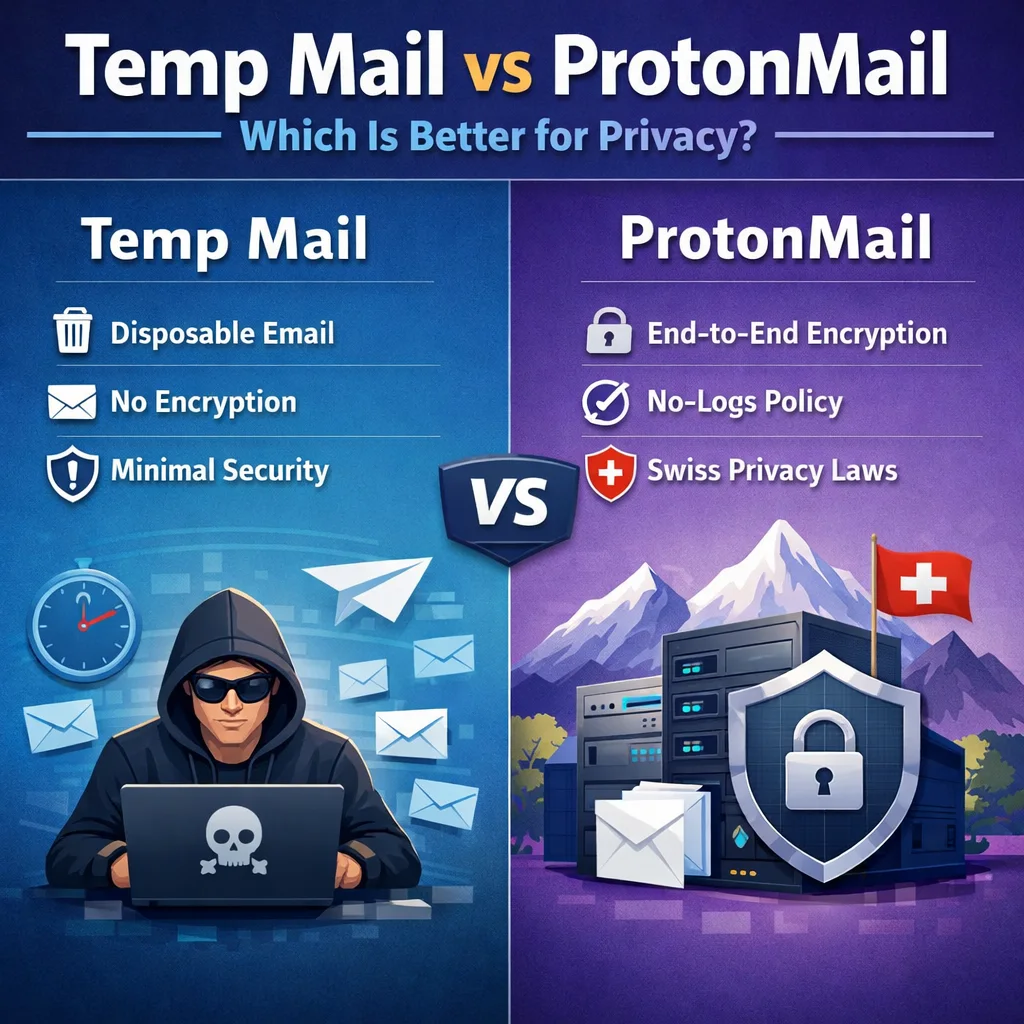
Introduction: Why Email Privacy Matters in 2025
Email is become more than just a medium for communication. It is a digital identity key that is utilized for professional correspondence, social media, banking, subscriptions, and recovery alternatives. People are looking for solutions to safeguard their email exchanges as privacy concerns rise as a result of data breaches, monitoring, spam, and surveillance.
Two very different tools have emerged in this landscape:
- Temporary email services (“temp mail”) — emails that appear for a brief time before vanishing.
- ProtonMail — a long-term encrypted email service for communication that prioritizes privacy.
They both seek to reduce your exposure to the internet, but they accomplish this in somewhat different ways. Let's examine each one's strengths and how they operate.
What Is Temp Mail?
Quick, disposable email addresses are offered by temporary email services that:
✔ require no account creation
✔ expire after a short period (minutes to days)
✔ help avoid spam and tracking
✔ mask your real email from websites
When you don't want unsolicited contacts, marketing communications, or newsletters clogging your actual inbox, you frequently use temp mail. Its ephemeral architecture reduces long-term digital exposure because the address and messages vanish as they expire.
Typical Temp Mail Features
✔ Instant generation
✔ No login required
✔ Short lifespan (minutes to days)
✔ No encryption guarantee
✔ Usually free and easy to use
Temporary mail's simplicity is one of its advantages, but it also implies that sensitive data is not well protected. These services work well for one-time sign-ups or verifications, but not for continuous correspondence or private messaging.
What Is ProtonMail?
ProtonMail is a well-known encrypted email service with its headquarters in Switzerland, a nation with strict privacy regulations. It highlights confidentiality and data security by providing:
✔ End-to-end encryption
✔ Zero-access architecture
✔ Strong privacy protections
✔ Paid plans with advanced features
ProtonMail is intended for long-term communication, in contrast to temporary mail. You can use your inbox as your primary email for private, business, or personal purposes without disclosing your information to outside parties.
How Temp Mail and ProtonMail Differ in Privacy
1. Purpose and Lifespan
-
Temp Mail: Short-term, disposable, ideal for one-time verification or spam protection.
-
ProtonMail: Long-term, secure communication channel designed to protect daily email usage.
In summary, ProtonMail safeguards your identity and message content over time, while temp mail shields your email address from exposure.
2. Encryption and Security
Temp Mail
Temp mail services rarely provide encryption. Most often:
✔ Emails are stored in plain text
✔ Anyone with the inbox link might see messages
✔ No end-to-end security
This implies that if the inbox format is guessable or unprotected, private information sent to a temporary email may be available to the whole public.
ProtonMail
ProtonMail’s core strength lies in encryption:
✔ End-to-end encryption is automatically applied to emails sent between ProtonMail users.
✔ Zero-access encryption protects messages stored on Proton's servers, making it impossible for Proton to read your emails.
✔ The bar for privacy is raised considerably by additional capabilities like encryption for external recipients and self-destructing messages.
Winner: ProtonMail clearly offers superior encryption and data security.
3. Anonymity vs Identity
Temp Mail
✔ Maximizes anonymity — no identity required
✔ You don’t register with personal info
✔ Inbox vanishes when expired
Because of this, interim mail is great when you don't want your own email address or identity to be associated with it.
ProtonMail
❌ Requires an account (even if anonymous)
❌ Usually tied to at least some verification method
✔ To protect identification in daily use, ProtonMail permits aliases and improved privacy procedures (such as Proton aliases and non-identifying account creation).
Summary: ProtonMail offers managed anonymity in long-term email history, whereas temp mail wins for absolute anonymity in extremely short-term use cases.
4. Practical Use Cases
Best Uses for Temp Mail
✔ Sign up for free services without giving your real email
✔ Avoid spam and marketing messages
✔ Quick downloads or one-time verifications
✔ Keeping disposable addresses for testing
Even public inboxes can be viewed by outsiders, therefore temp mail does not secure your email content or communications.
Best Uses for ProtonMail
✔ Sensitive communication (personal, legal, financial)
✔ Encrypted messaging with clients, partners, or friends
✔ Long-term email management
✔ Professional or privacy-centered correspondence
✔ Staying in control of your message history with strong security
ProtonMail is perfect for serious privacy demands because of its encrypted mailbox, zero-access design, and Swiss privacy legislation.
5. Spam, Tracking, and Data Harvesting
Temp Mail
✔ Stops spam from reaching your main email
✔ Prevents tracking by hiding your real address
However, trackers placed in emails can still gather basic metadata because temporary mail is public or transient, and messages are visible to anybody with the inbox link.
ProtonMail
✔ Blocks trackers and scanning within the encrypted inbox
✔ No ad-based profiling
✔ Doesn’t harvest user data for third parties
Even message information is reduced thanks to ProtonMail's architecture, which stops trackers at many levels.
Checkmark List — When Temp Mail Makes Sense
✔ One-time sign-ups or online trials
✔ Protecting your main email from spam
✔ Anonymous testing or verification
✔ Quick disposable addresses
✔ Temporary accounts or throws away identity
Temp mail is easy to use and convenient, but it just protects your address—not the content of the email.
Checkmark List — When ProtonMail Is Better
✔ Communication requiring encryption
✔ Long-term inbox use
✔ Sensitive personal or work emails
✔ Preventing tracking and data harvesting
✔ Secure identity and metadata protection
Deep privacy measures that go well beyond transient masking are provided by ProtonMail.
Limitations to Understand
Temp Mail Limitations
❌ Not secure for private content
❌ Often public or guessable inbox links
❌ No encryption
❌ Not suitable for serious or professional use
ProtonMail Limitations
❌ Requires account setup
❌ Paid plans for advanced features
❌ Proton aliases are helpful, but they are not the best option for anonymous throwaway use.
❌ Email performance can be slower due to encryption layers
It is easier to use the appropriate instrument for the job when you are aware of their constraints.
Hybrid Approach: When Use Cases Overlap
Some privacy-savvy users blend both tools:
✔ Use temp mail for disposable sign-ups and untrusted sites
✔ Use ProtonMail for all sensitive or ongoing communication
This two-tier model keeps your workspace clean and protected.
ProtonMail also allows the creation of aliases that include identity masking and encryption, much like semi-permanent throwaway addresses.
Conclusion: Which Is Better for Privacy?
The answer depends on your privacy goals.
🛡 Temp Mail
Ideal for situations where you wish to keep your primary email address private and require temporary anonymity. It's quick, anonymous, and stops spam, but aside from masking your email, it doesn't protect message content or prevent tracking.
🔐 ProtonMail
ideal for genuine privacy protection. It provides long-term secure communication, reduces data collecting, prevents trackers, and encrypts emails from beginning to end. ProtonMail is the best option for confidential correspondence and a privacy-conscious lifestyle.
👉 In summary:
✔ For disposable, short-term privacy: Temp Mail
✔ For secure, encrypted, long-term privacy: ProtonMail
Both tools have their uses: ProtonMail for long-term, profound privacy, and temp mail for instant anonymity.