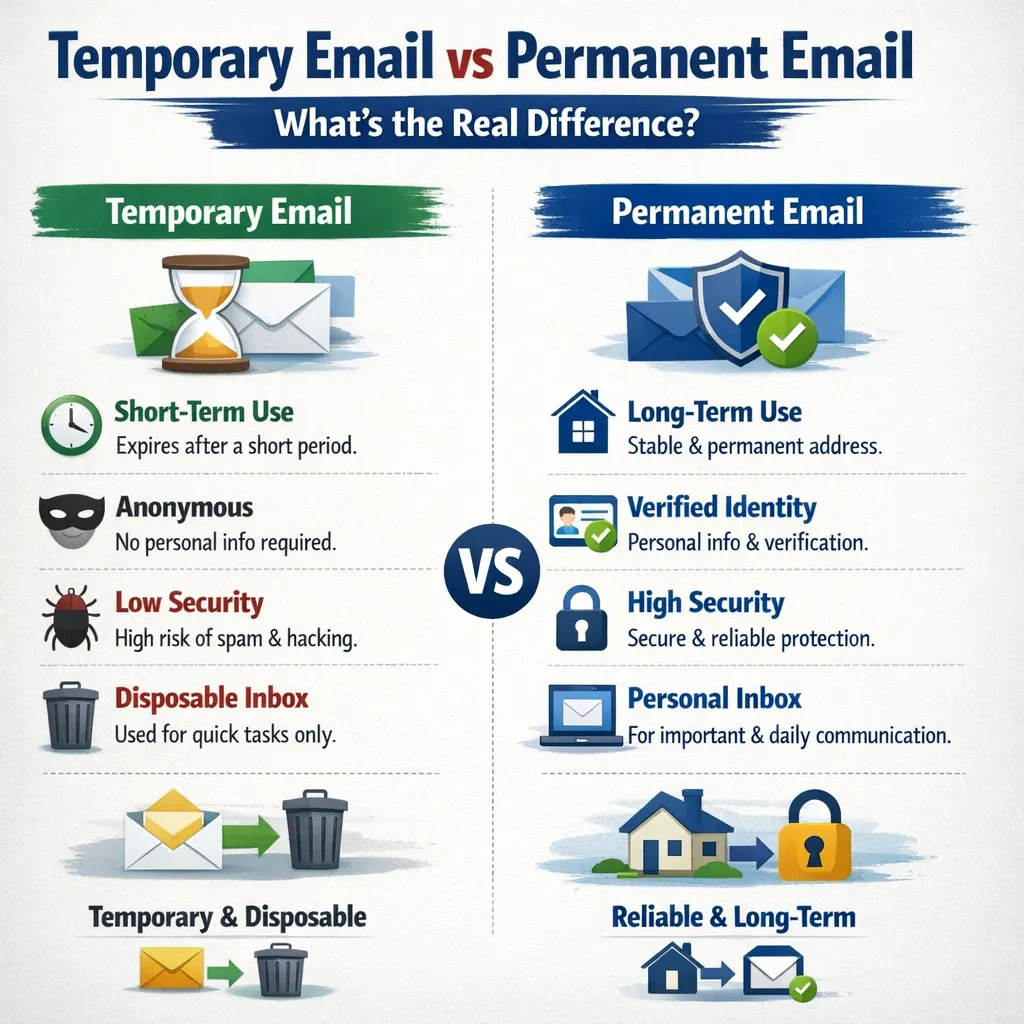
Email has evolved into a digital persona. Our inboxes silently monitor our online activities, from social media and shopping to banking and professional correspondence. However, not every email account is made with the same intention. The dominance of established permanent email providers like Gmail, Outlook, and Yahoo has been called into question by the emergence of transitory email services. This has prompted a lot of people to pose an important question: which email should you use and what is the true distinction between temporary and permanent email?
The difference appears to be straightforward at first glance. One endures forever, while the other vanishes. However, the truth is more nuanced. Emails that are temporary or permanent have extremely distinct effects on online behavior, security, privacy, and even digital stress. In 2025, when online surveillance and data harvesting are more invasive than ever, knowing these distinctions will help you make wiser decisions.
Understanding Permanent Email Accounts
Long-term use is the goal of permanent email accounts. Users are expected to maintain the same address for years or even decades while using services like Gmail or Outlook. These emails are connected to contacts, subscriptions, cloud storage, personal identification, recovery choices, and business correspondence.
A persistent email serves as a virtual home address. It gathers digital history, documents, and messages over time. Although this stability has its benefits, it also entails obligations. It becomes challenging to regulate where an email gets up or how it is utilized once it has been extensively disseminated.
Why Permanent Emails Became the Standard
Because they provided constancy, permanent email accounts became more and more popular. For long-term contact, government services, employment, and education, people required a single, trustworthy address. They were essential to digital life because of their seamless integration with calendars, cloud storage, and productivity applications.
But the dangers also changed as the internet did. Permanent email addresses are increasingly a major factor in data breaches, spam operations, phishing attempts, and targeted advertising.
What Is Temporary Email and Why It Exists
Short-term use is the purpose of temporary email, often known as disposable email or temp mail. These services create an email address that is valid for a set amount of time—minutes, hours, or days—before automatically expiring. It is not necessary for users to create passwords, give personal information, or register.
The purpose of temporary email is to address the issue of digital overload. Not every website should have access to your actual email. Emails are frequently requested for marketing, data collecting, or account creation hurdles rather than for communication.
The Purpose Behind Disposable Emails
Users have control over temporary emails. Users can isolate danger rather than exposing a permanent mailbox to unidentified platforms. When the goal is achieved, such getting a verification code, the email vanishes, taking tracking and spam with it.
Key Differences Between Temporary and Permanent Email
They both let you send and receive messages, but they have quite distinct mindsets.
Permanent email emphasizes identification and continuity. Temporary email emphasizes seclusion and secrecy. One creates a lasting digital footprint, while the other reduces it.
The true distinction is behavioral rather than technological. Trust is assumed by permanent email. Temporary emails are assumed to be cautious.
Privacy: Where the Difference Matters Most
The biggest distinction between temporary and permanent email is privacy.
In order to enhance services, customize advertisements, or incorporate AI features, permanent email providers frequently examine inbox data. Even while this information is typically secure, it is nevertheless stored on servers that are directly linked to your identity.
In comparison, temporary email services gather very little data. The majority don't need recovery emails, phone numbers, or identities. Automatic message deletion minimizes long-term exposure.
✔ Temporary email limits data collection and digital tracking
✔ Permanent email builds a long-term data profile over time
✔ Disposable inboxes reduce exposure during data breaches
Temporary email provides a degree of anonymity that permanent accounts just cannot in a world where privacy is becoming more and more vulnerable.
Security and Risk Management
Security works differently for each email type.
Permanent emails are dangerous when exposed, yet they are secure by design. They become appealing targets because they are utilized everywhere. Multiple accounts can be compromised by a single breach or phishing error.
Temporary emails use isolation to lower risk. Disposable inboxes often don't include any personal information and expire rapidly, even if they are compromised.
Temporary emails, however, are not appropriate for high-security requirements such as account recovery or banking. Instead of long-term defense, their power lies in protection through transience.
Spam and Inbox Overload
Spam is one of the main annoyances of persistent email. Users' inboxes eventually fill with promotions, newsletters, and automated emails that they never planned to receive.
This cycle is completely avoided using temporary email. Spam has nowhere to build up because the inbox expires..
✔ Disposable emails keep your main inbox clean
✔ Permanent emails often become marketing targets
✔ Temporary inboxes prevent long-term spam buildup
Disposable email serves as a digital filter for those who are overloaded with unread emails.
Convenience vs Control
It's convenient to have permanent email. It connects with everyday tools, syncs across devices, and remembers passwords. It is vital for business, family communication, and critical services.
Instead of convenience, temporary email provides control. It necessitates intentional use, manual verification code copying, and knowledge of the expiration date. The purpose of this minor annoyance is to promote thoughtful online conduct.
Neither is superior in every circumstance. Knowing when to use each is what makes them valuable.
When Permanent Email Is the Better Choice
Temporary email should never be used in place of permanent email in certain circumstances.
✔ Banking and financial services
✔ Government or legal communication
✔ Work, education, and professional networking
✔ Long-term subscriptions and account recovery
In situations where accountability is important, permanent email offers consistency, stability, and confidence.
When Temporary Email Makes More Sense
When danger is unknown and commitment is low, temporary email works well.
✔ Free trials and one-time downloads
✔ Newsletter signups
✔ Social media or forum exploration
✔ App testing and software trials
Disposable email avoids needless exposure in these situations without compromising functionality.
Psychological Impact of Email Choice
It's interesting to note that the kind of email you use has an impact on your mental health. Permanent inboxes frequently lead to stress due to unread messages, responsibilities, and digital clutter.
Emotional distance is created by transient emails. There is no long-term obligation. Online interactions may feel lighter and more deliberate as a result.
People who combine both often report feeling more in control of their digital lives.
Ethical and Responsible Use
Most places allow temporary email, but accountability is important. It is unethical to use disposable email to evade responsibility, trick platforms, or misuse systems.
Emails that are temporary should be utilized to preserve privacy rather than undermine confidence.
Conversely, permanent email is inherently responsible. Its endurance and visibility promote more responsible behavior.
The Future of Email: Coexistence, Not Competition
Permanent and temporary email are not competitors. For various digital purposes, they are complementing tools. Users are learning to distinguish between low-trust interactions and identity-based communication as privacy awareness increases.
Hybrid behavior—one permanent email for core identification and one temporary email for exploration and protection—is probably the way of the future.
✔ Permanent email for trust and continuity
✔ Temporary email for privacy and experimentation
✔ Smarter digital boundaries for healthier online habits
Conclusion
The true distinction between temporary and permanent email is not only how long they last, but also how they affect your interaction with the internet. Identity, history, and connection are all strengthened via permanent email. Temporary email establishes control, safety, and distance.
Digital awareness is required in 2025. Reducing spam, protecting privacy, and enhancing mental clarity can all be achieved by selecting the appropriate email type for the given circumstance. The greatest strategy is to recognize when each one actually works best for you rather than picking one over the other.