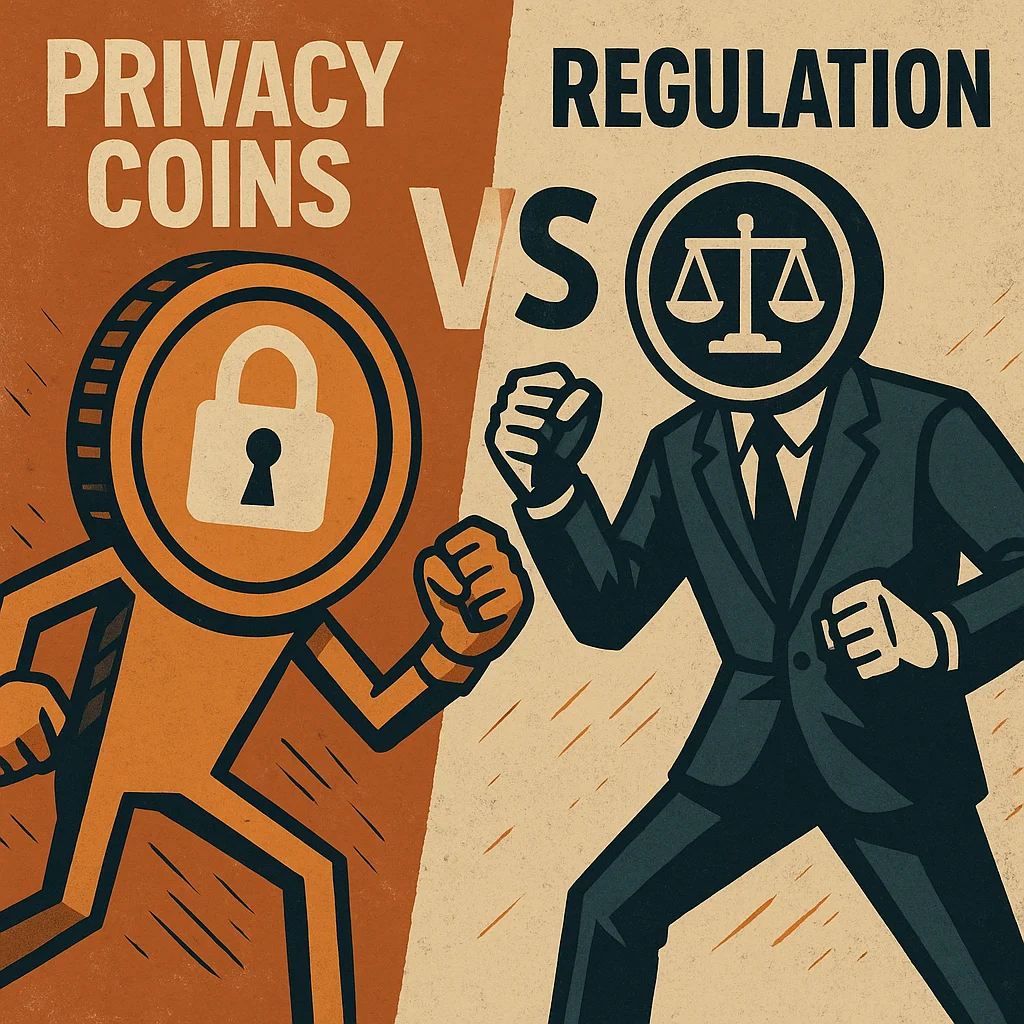
A new form of financial freedom—decentralized, anonymous, and borderless—was promised by the emergence of cryptocurrencies. However, one specific category of cryptocurrencies—privacy coins—has become a hot topic for debate as governments and businesses scramble to control the digital economy.
These coins, like as Dash (DASH), Zcash (ZEC), and Monero (XMR), were created to keep user identities and amounts private. By doing thus, they undermine the fundamental basis of conventional financial supervision.
Regulators see privacy coins as a danger to international efforts to combat illicit funding and anti-money laundering (AML) legislation. They represent digital sovereignty, or the freedom to conduct business without being watched, for privacy activists.
The conflict between regulation and privacy coins is about ideology as much as technology. The outcome of this struggle between the state's desire for control and the individual's right to privacy could determine how digital freedom develops in the future.
1. What Are Privacy Coins—and Why Do They Matter?
Privacy coins employ sophisticated cryptography to hide transaction data, as contrast to Bitcoin or Ethereum, where each transaction is documented on an open blockchain.
For instance:
-
Monero (XMR) uses stealth addresses and ring signatures to conceal the sender, recipient, and transaction amount.
-
Zcash (ZEC) uses zero-knowledge proofs (zk-SNARKs) to verify transactions without disclosing any information.
-
Dash (DASH), provides optional mixing features for anonymity, although it is not as private by default.
Because of this, privacy coins are the digital equivalent of money in a world where surveillance is becoming more widespread. Without banks, governments, or businesses monitoring every transaction, they let people to transact freely.
Why is that important?
Because keeping privacy in a time of digital surveillance is more important than simply concealing. It's the difference between being constantly watched and having the freedom to act without worrying about being watched.
2. The Regulatory Backlash: Fear of the Invisible Economy
Privacy coins present a nightmarish scenario for regulators. How can authorities monitor tax evasion, money laundering, and terrorism financing without visibility?
Governments all over the world and organizations like the Financial Action Task Force (FATF) contend that privacy coins compromise financial transparency. A wave of limitations has resulted from this:
-
In 2018, Japan outlawed the use of privacy coins on cryptocurrency exchanges.
-
Following suit, South Korea outlawed anonymous cryptocurrency trading.
-
Exchanges are under pressure to delist assets with a privacy focus due to the stringent compliance standards imposed by the United States and Australia.
Due to regulatory concerns, even well-known platforms like Binance and Huobi have eliminated privacy coins in some areas.
For regulators, the reasoning is straightforward: you cannot prevent crime if you are unable to track the flow of money. However, the ramifications for consumers extend well beyond law enforcement; they signify a global deterioration of financial privacy.
3. Privacy vs. Transparency: The Ethical Crossroads
The conflict between privacy and legislation is not new; it is the same issue that surrounds internet surveillance, data gathering, and encryption.
Governments assert that visibility is necessary to safeguard society from terrorism and criminal activity. However, history demonstrates that once granted, monitoring powers are rarely restricted to their intended use.
Blockchain transparency already provides previously unheard-of financial insight into the flow of money. Although anonymous, Bitcoin transactions can be tracked. Tools that track wallet behavior and connect addresses to actual identities include Chainalysis and Elliptic.
This surveillance economy is challenged by privacy coins. They believe that you can have both freedom and transparency, but on your own terms.
The ethical dilemma is clear:
-
Because some people might misuse privacy, should it be restricted?
-
Or should it be safeguarded as a fundamental right, notwithstanding the possibility of abuse?
The debate over civil liberties, encryption, and freedom of speech is the same.
4. The Technology That Makes Privacy Possible
It helps to understand how privacy coins function in order to comprehend why regulators are worried.
-
Ring Signatures: This method, which Monero uses, blends the sender's transaction with numerous others, making it impossible to identify which user sent which money.
-
Stealth Addresses: For each transaction, create a distinct, one-time address to protect recipient privacy.
-
Confidential Transactions: While demonstrating mathematically that no coins are created or destroyed, conceal the quantity of cryptocurrency being transferred.
-
Zero-Knowledge Proofs (zk-SNARKs): Permit transaction verification without disclosing the amount, sender, or recipient.
These technologies are state-of-the-art developments in cryptography that move blockchain beyond mere transparency and into a realm where integrity and confidentiality can coexist.
Ironically, if regulators and developers can come to an agreement, the same cryptographic concepts that give privacy coins their strength may also improve compliance.
5. Regulators’ Main Arguments Against Privacy Coins
Three main issues are at the heart of governments' worries about privacy coins:
-
Money Laundering and Terrorism Financing:
Authorities worry that money obtained through illicit actions may be concealed using privacy coins. Tracing such funds becomes almost impossible in the absence of a visible trace. -
Tax Evasion:
Anonymous transactions undermine tax collection efforts by making it more difficult for governments to monitor income or capital gains. -
Sanctions Evasion:
Privacy coins could be used by entities in sanctioned nations to get around international regulations, undermining geopolitical enforcement systems.
Although these worries are legitimate, they frequently exaggerate the extent of abuse. Less than 1% of all cryptocurrency transactions are illegal, according to research from blockchain analytics companies, and the majority of these transactions take place on open networks like Bitcoin rather than private coinage.
Nevertheless, regulatory action is more motivated by the perception of risk than by actual use.
6. The Case for Privacy: Why It Still Matters
Crime and privacy are not the same thing. It's an acknowledgement that people should have authority over their financial and personal lives, which is a kind of dignity.
Privacy coins can be essential for survival in nations with autocratic governments. They provide funding to dissidents, journalists, and activists without the authorities noticing. They provide a reliable, censorship-resistant form of exchange in hyperinflationary economies like Zimbabwe and Venezuela.
Financial data can be used as a weapon even in democracies. Governments are increasingly using data profiling to track behavior, banks are selling user insights, and corporations are gathering spending trends.
In this situation, privacy coins are instruments of empowerment rather than secrecy. They enable people to engage in the digital economy without having to give up their identities.
7. The Middle Ground: Can Privacy and Regulation Coexist?
There may be a middle ground emerging despite their ideological disagreement. Privacy-preserving compliance, or solutions that preserve anonymity while permitting legal scrutiny, is being investigated by several developers and regulators.
For instance:
-
Users of Zcash can choose reveal transaction details for compliance or audit purposes.
-
Law enforcement may be able to confirm legitimacy without disclosing personal information to the public thanks to research into view keys and zero-knowledge regulatory proofs.
A new era of cryptocurrency regulation may be built on this equilibrium, or "selective transparency." It addresses valid worries about abuse while upholding privacy.
Making sure that oversight doesn't turn into surveillance creep and that privacy is still a right rather than a privilege is the difficult part of execution.
8. The Global Landscape: Diverging Approaches
Regulators' perspectives on privacy coins differ greatly:
-
Europe: While focusing on monitoring and reporting, the EU's AML directives do not completely prohibit anonymous transactions.
-
United States: Instead than outlawing particular coins, the Treasury and FinCEN concentrate on exchange-level compliance.
-
Asia-Pacific: While Singapore and Hong Kong adopt a more liberal stance, countries like South Korea and Japan uphold stringent prohibitions.
-
Africa & Latin America: In unstable economies, some governments view privacy coins as instruments for financial inclusion.
Because of this patchwork of rules, privacy coins may flourish in one area while disappearing in another, creating a complex ecosystem. Privacy coins may either adapt or further withdraw into decentralization if international regulations become more stringent.
9. The Future of Privacy Coins: Adaptation or Extinction?
Whether privacy coins continue to exist as legal instruments or are driven underground will be determined in the next years.
Several possible futures exist:
-
Integration with compliance tools: As privacy coins develop, audit features that satisfy regulators without sacrificing anonymity are included.
-
Decentralized exchanges (DEXs): Enforcement becomes more difficult if trading moves away from centralized platforms that are subject to regulations.
-
Layer-2 privacy solutions: Privacy layers are adopted by popular blockchains like Ethereum, which complicates regulation.
No matter how it is expressed, privacy will always exist. As surveillance increases, the need for digital anonymity will only increase. Whether privacy will be protected by the law or not is the question.
Conclusion: The Right to Be Unseen
A larger philosophical struggle—the freedom to remain invisible in a time where everything is monitored—is reflected in the conflict between privacy coins and regulations.
Coins for privacy are not flawless. Like money or cryptography, they can be misused. They serve as a reminder that technology can empower people, not just institutions, and they also represent one of the final frontiers of digital freedom.
The question of whether society wants a future of perfect monitoring, where every transaction is monitored, must be answered as authorities tighten regulations and blockchain technology advances.
Or a future in which freedom and privacy continue to be central to digital life?
The solution will influence not only cryptocurrencies' future but also the foundation of trust in the digital era.