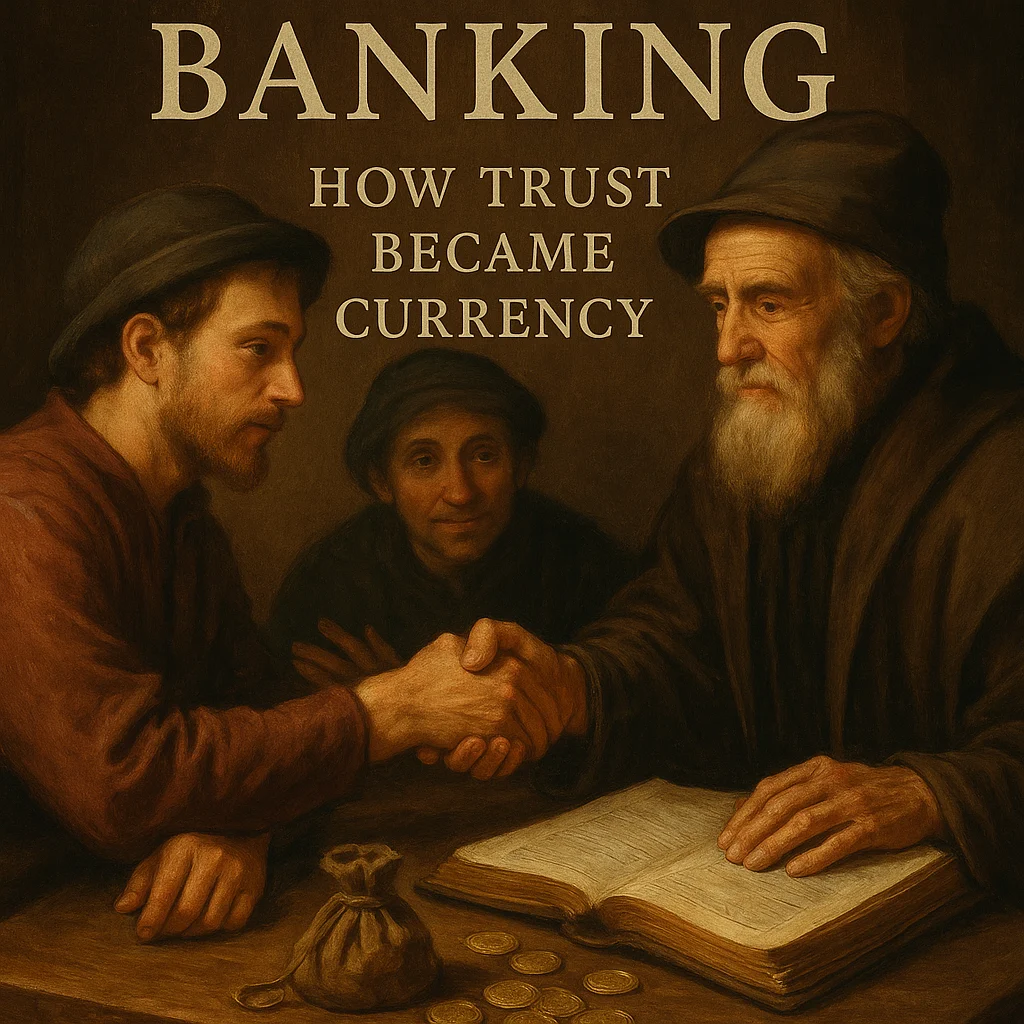
The Birth of Banking: How Trust Became Currency
A straightforward yet effective idea—trust—was the cornerstone of contemporary banking long before ATMs, smartphone apps, or even coins.
The management of promises—promises to pay, store, lend, and return—is at the heart of banking. It started with traders, farmers, and temple priests attempting to keep track of who owed what—and to whom—rather than with complex structures. These acts of trust developed over centuries into a global system that now affects every part of our lives and impacts economies.
This is the tale of how trust evolved into money and how humanity's need for commerce and security led to the creation of one of its most revolutionary inventions: the bank.
Before Banks: When Trade Was Personal
Barter was the only method of commerce in early society. A potter exchanged pots for fabric, while a farmer traded grain for meat. However, barter's reliance on a double coincidence of wants was problematic. What each side offered had to be desired by the other.
People started looking for intermediates of value—items that could be trusted by others and signify worth—as trade increased. Early money was made from cowrie shells, salt, cattle, and finally metals.
However, one problem persisted despite currency: trust. In a world without paper or banks, how might someone securely lend money, store money, or move money across long distances?
That problem would give rise to the world’s first financial systems.
Temples: The World’s First Banks
About 4,000 years ago, in the temples of Sumer and Babylon in ancient Mesopotamia, the first banking systems emerged. In addition to being places of worship, these temples were the first reputable establishments in society.
Grain, silver, and other treasures were deposited in temple storehouses by farmers and tradesmen. The priests marked ownership and transactions with clay tablet receipts because they were regarded as trustworthy middlemen. These receipts evolved into the first sort of banking records and, in certain respects, a precursor to banknotes.
The system was trusted because of the moral authority of the temple. People thought that God was keeping an eye on their wealth. This relationship between religion and money was not coincidental; it was a reflection of humanity's early realization that trust is necessary for money to function.
From Clay Tablets to Credit: The Rise of Lending
Trade became more difficult as societies expanded. Early trade routes, such as those connecting Mesopotamia, Egypt, and the Indus Valley, required capital for merchants to purchase commodities before reselling them.
Wealthy people and temples started lending silver and grain in return for interest. The interest rates and payback schedules for these loans were noted on clay tablets.
A tablet discovered in Babylon circa 1800 BCE details a silver loan with an annual interest rate of 20%, demonstrating that finance had already established itself as a key component of ancient economies.
This marked a turning point: money was no longer just an object—it was a promise.
Greece and Rome: Banking Goes Commercial
Banking had transitioned from temples to private businesses by the fifth century BCE in ancient Greece. Rich traders who ran unofficial banks from marketplace seats were called as trapezitai (from "trapeza," which means table).
These early bankers provided essential services:
- Safekeeping of deposits
- Currency exchange
- Loans for trade and shipping
- Money transfers between cities
Large-scale Mediterranean trade was financed in part by Greek banks. They made it possible for business owners to transfer money effectively, which was a significant step toward commercial banking.
The method was further extended by the Romans. They established mensarii (public bankers) and argentarii (money changers), who handled deposits, processed payments, and even issued crude letters of credit.
Because banking became so important in Rome, early interest rules and record-keeping requirements were introduced by the government.
Trust now had an infrastructure.
The Middle Ages: Faith and Finance Intertwined
Europe experienced economic fragmentation with the fall of the Roman Empire. However, banking endured, albeit with changes brought about by trade and religion.
Christian philosophy originally denounced usury (charging interest) as evil during the Middle Ages. However, trade kept expanding, particularly as a result of the Crusades and trade with the Islamic world. Merchants came up with creative ways to get around these regulations, such as employing complicated contracts that avoided clear interest rates or disguised loans as partnerships.
In the meantime, medieval banking was pioneered by Jewish and Italian traders who were not subject to the same constraints imposed by the Church. Networks of operatives were established throughout Europe by families such as the Medici, Bardi, and Peruzzi in Florence.
They introduced innovations such as:
- Double-entry bookkeeping, which tracked assets and liabilities transparently.
- Bills of exchange, allowing merchants to send payments across borders without transporting coins.
- Letters of credit, precursors to modern checks and credit systems.
Thanks to these tools, banking is now a system built on documentation and trust rather than just cash. Because both sides trusted the network that ensured its worth, a trader in Venice could purchase silk from Constantinople with a piece of paper.
Banking Becomes Power: The Renaissance Era
By the fourteenth and fifteenth centuries, banking had evolved beyond simple loan to include influence. The Medici family of Florence, who are frequently referred to be the inventors of modern banking, showed how money might influence religion, politics, and even the arts.
Popes, artists, and kings were all funded by the Medici Bank. They supported projects like trade missions and the building of cathedrals, which fueled the Renaissance's economic and cultural boom.
A complex web of trust—a network of branches spread over Europe that interacted via coded correspondence, accounting systems, and interpersonal connections—was the foundation of their success.
The Medici’s model was revolutionary:
Money was now multiplied by reputation, trust, and calculated risk rather than merely being held.
It gave rise to the idea of creditworthiness. The value of a person's word, reputation, and dependability surpassed that of the gold in their vault.
The Rise of Central Banks
The emergence of national financial systems marked the next phase. During the 17th century, as European trade and empires grew, governments required dependable methods to handle currency, finance wars, and maintain economic stability.
The first real central bank, the Amsterdam Wisselbank, was founded in 1609. It issued standardized receipts that worked like money, took deposits, and moved money between accounts.
The Bank of England was established in 1694, a few decades later. Its goal was to finance the British Empire's international aspirations by lending money to the government in exchange for bonds.
This marked a major transformation:
- Banking shifted from private enterprise to public institution.
- The concept of national trust emerged—citizens and investors trusted a government-backed bank to secure their money.
- Paper money began replacing metal coins as representations of trust in the state.
Banking Expands Across the World
Banking developed become the foundation of industrial civilization by the 18th and 19th centuries. Global commerce lines, factories, and railroads were all funded by banks. They fueled the growth of capitalism and linked continents.
New institutions emerged:
- Commercial banks to fund businesses.
- Savings banks for ordinary citizens.
- Investment banks to manage large-scale capital flows.
Additionally, the idea of trust changed. It was now institutional rather than personal. People trusted the bank's brand, its charter, and its legal protections rather than specific people.
Banks discovered that trust might be brittle at the same time. Financial disasters, such as the Great Depression and the Panic of 1837, demonstrated the consequences of a loss in confidence.
When people stopped trusting the system, even the strongest currencies could crumble.
The Digital Age: Trust Without Touch
Banking got more abstract in the 20th and 21st centuries. We went from gold coins to paper, then from paper to plastic, and finally to pixels.
Yet the foundation remained unchanged: trust.
Your pay is just a number on a screen these days. Your payments, loans, and investments all depend on the unseen assurance that your government will support its currency, your bank will keep its word, and your data will be safe.
The emergence of blockchain and cryptocurrencies has caused people to reconsider trust once more. Decentralized finance (DeFi) envisions a society in which intermediaries are replaced by algorithms and confidence is coded rather than pledged.
Ironically, even that depends on trust—trust in technology rather than people.
What Trust Really Means in Banking
Throughout history, the evolution of banking has mirrored the evolution of human trust:
- In temples, people trusted gods and priests.
- In medieval trade, they trusted families and reputations.
- In national banks, they trusted governments.
- In the digital era, they trust systems, encryption, and algorithms.
Each stage reflects the same fundamental truth: money only moves when trust does.
Conclusion: The Currency of Confidence
The history of banking is about faith as much as money. Not in the religious sense, but in the conviction that institutions can protect our shared destiny, that promises can be kept, and that people will honor their commitments.
Every invention, from mobile banking apps to Mesopotamian clay tablets, has been an effort to address the same question:
“Who can I trust with my wealth?”
The premise has not changed, but the solution has. Fundamentally, banking is still about turning trust into money and maintaining that trust.
One thing never changes as we head toward a world of artificial intelligence, digital currencies, and transnational economies: the unseen link of trust that underpins every transaction.
Because in the end, money isn’t just what we spend—it’s what we believe in.