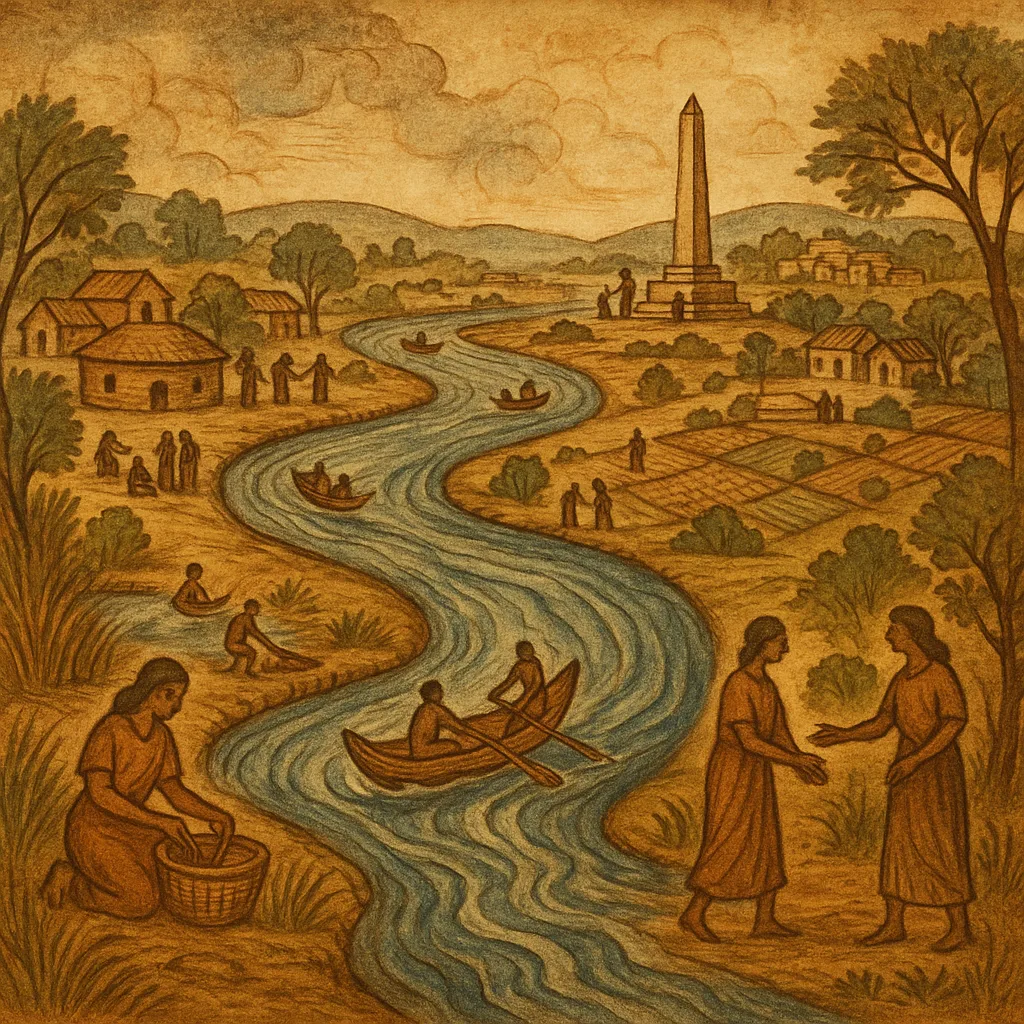
Rivers have been vital to human civilization since the dawn of time. They supplied trade routes, fertile soil for crops, and drinking water. Rivers gave birth to, nourished, and supported entire civilizations, from the Nile Valley to the banks of the Indus and the great rivers of China. However, rivers have profound cultural significance that extends beyond their utilitarian uses. They act as metaphors for human life itself, mold identities, and evoke myths.
Rivers represent strength, continuity, and connection and are more than just natural features. They carry the cultural weight of societies all over the world as they move through our histories, stories, and imaginations.
Rivers as Cradles of Civilization
Rivers are practically synonymous with "cradle of civilization." Mesopotamia emerged between the Tigris and Euphrates, ancient Egypt flourished along the Nile, and the Indus Valley civilization flourished along the Indus River. These rivers gave societies stability in addition to water.
The soil was restored by yearly floods, enabling sustainable agriculture. Population growth made possible by the food surplus gave rise to cities, governments, and culture. The early pillars of civilization—writing, trade, religion, and government—might not have established themselves as firmly in the absence of rivers.
Rivers served as cultural anchors in addition to being natural resources. Their festivals, customs, and economies all revolved around their cycles, giving life a rhythm.
The Sacred Role of Rivers
Rivers have sacred significance in nearly every culture. The Ganges is revered in Hinduism as the purifying and redeeming goddess Ganga. Every year, millions of pilgrims come to her waters to bathe, pray, or carry out funeral rites.
The Nile was more than just a river in ancient Egypt; it was the source of life. Its role in agriculture was inextricably linked to religious practices, and its floods were regarded as divine blessings. The river became the focal point of creation and god myths.
The Yangtze, the Amazon, and the Mississippi all have cultural tales to tell. Rivers frequently symbolize the divine flow of life and the bond between the human and the cosmic, whether as gods, ancestors, or spiritual mentors.
Rivers as Symbols in Literature and Myth
For a very long time, rivers have represented time and life's journey. The River Styx served as the demarcation line between the world of the living and the world of the dead in Greek mythology. Rivers are metaphors for change and transition because crossing them meant entering a different world.
Rivers are frequently used as locations for introspection and rebirth in literature. The Mississippi is transformed into a representation of liberty and self-realization in Mark Twain's Adventures of Huckleberry Finn. Rivers that never stop flowing are used in poetry as symbols of continuity, memory, and change.
This power of symbolism is universal. Rivers, such as the Danube in Europe and the Yamuna in India, convey tales that influence cultural identities and values.
The Social Power of Rivers
Rivers have always been places where people congregate. They are surrounded by cities, villages, and markets. They serve as hubs for social interaction, commerce, and storytelling. From dragon boat festivals in China to boat races in Kerala, festivals frequently center around rivers.
Rivers are viewed by communities as public commons, which are areas that are shared by all. Along the water's edge, elders pass down customs, fishermen cast their nets, and children play on their banks. The notion that rivers serve as a cultural glue that unites people is supported by these commonplace encounters.
Rivers and Political Power
Having control over rivers frequently equated to having control over societies. Economic and political power belonged to the person in charge of water distribution and irrigation systems. In order to secure their power, ancient rulers constructed levees, dams, and canals to harness rivers.
River access disputes still have the power to influence geopolitics today. Countries that share rivers, such as the Mekong or the Nile, negotiate and fight over water rights. This proves that rivers continue to be tools of survival and power in addition to being cultural symbols.
The Artistic Inspiration of Rivers
Rivers have long served as a source of inspiration for storytellers, musicians, and artists. They reflect the moods of human existence by being depicted as calm, tumultuous, or endless. Folk songs frequently bemoan rivers' floods or commend them for their beauty.
Rivers are considered muses in many cultures. Rivers meandering through hazy mountains are a common motif in Chinese landscape paintings, signifying the balance between nature and humanity. Western composers such as Johann Strauss used music, such as The Blue Danube, to honor rivers.
Art and culture draw on rivers not just as backdrops but as living presences, shaping imagination and expression.
Rivers as Carriers of Memory
Cultural memory is preserved by rivers. They carry tales of migration, adversity, and survival as they move through the histories of families and countries. Rivers are frequently viewed by indigenous peoples as ancestors—living entities with their own memory and spirit.
For Native American tribes, for example, the Missouri River is deeply significant because it is a part of their origin stories. Likewise, the Amazon is the epicenter of indigenous cosmologies and traditions in addition to being a natural feature.
Rivers are historical witnesses as well. They have witnessed revolutions, transported armies, and facilitated trade routes. They tell the history of humanity in silence.
Rivers and Identity
You can see how rivers influence identity by asking someone from Varanasi about the Ganges or someone from Cairo about the Nile. They become a part of the way that people define their heritage and themselves. Cities and their rivers are frequently inseparable: Shanghai has the Huangpu, London has the Thames, and Paris has the Seine.
By defining landscapes and lifestyles, these rivers contribute to the formation of urban culture. They appear in literature, songs, and acts of patriotism. For the people who live alongside it, a river is more than just water; it is a sense of shared identity.
The Environmental and Cultural Crisis of Rivers
However, the cultural significance of rivers is frequently overlooked by contemporary society. Numerous waterways have been deteriorated by pollution, damming, and excessive use. Once a sacred river, the Ganges now faces challenges from industrial waste. Huge infrastructure projects are posing ecological risks to the Yangtze.
This deterioration is cultural as well as environmental. Communities lose more than just water when rivers are damaged; they also lose connection, memory, and tradition. Therefore, conserving cultural heritage is just as important as protecting the environment when it comes to river protection.
Rivers as Teachers
We learn from rivers as well. They serve as a reminder that life moves, sometimes smoothly and other times turbulently. They demonstrate to us that perseverance can overcome challenges and that the process is just as significant as the final destination.
Rivers teach societies how to balance growth and conservation, resource use and limit respect. They serve as a reminder of interdependence, demonstrating the interconnectedness of human life in the same way that rivers link nations and villages.
Conclusion: The Timeless Flow of Culture
Rivers are cultural arteries that give societies vitality; they are more than just geographical features. They have been revered as deities, dreaded as natural forces, and hailed as emblems of liberation and rebirth. They preserve identities, customs, and stories for future generations.
Rivers serve as a constant reminder of our ancestry in a time when technology frequently separates us from the natural world. They influence who we are and how we coexist by permeating both culture and the land.
To comprehend the cultural significance of rivers is to comprehend the fundamentals of human civilization. The legends, customs, and societies that have developed alongside rivers will endure as long as they do.