Introduction
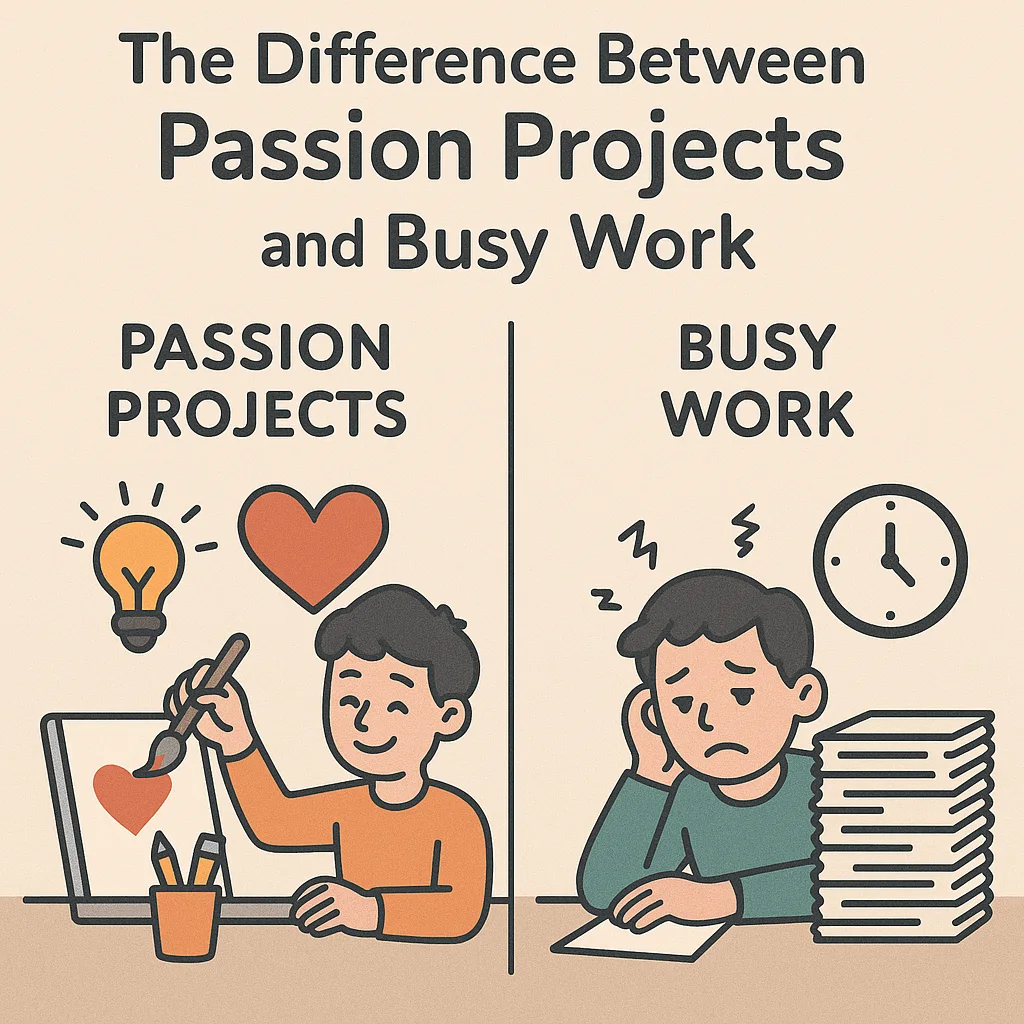
Have you ever felt unfulfilled after spending a whole day crossing things off your to-do list? You're not by yourself. A lot of us mistake productivity for purpose. It's simple to confuse "doing stuff" with "doing what matters" in the hustle culture of today, where being busy is frequently regarded as a badge of honor. But there's a big difference between working on a project that makes you feel passionate and just wasting your time on busy work.
This blog examines the distinction between busy work and passion projects, how to spot the former, and how to redirect your focus to what genuinely brings you fulfillment.
What Is a Passion Project?
A personal project that you are enthusiastic about is called a passion project. It's something you choose to do because it gives you happiness, fulfillment, and purpose rather than for financial gain, fame, or duty. Passion projects can be altruistic (volunteering to create a nonprofit), technical (developing an app), creative (writing a novel), or entirely original to you.
Key characteristics of passion projects:
-
Deep personal interest
-
Intrinsic motivation
-
Long-term satisfaction
-
Opportunity for growth or expression
-
Feels meaningful even when it's challenging
Passion projects frequently exist outside of your primary duties or employment. You can fully express yourself there, experiment, and explore. Deeper connections, new professional opportunities, or even a more contented life can result from these endeavors.
What Is Busy Work?
Tasks that appear productive but have little to no actual value are referred to as "busy work." These are the things you do all day long that don't help you get closer to your objectives. Organizing files and answering emails are examples of busy work that may be required, but when it takes up too much of your time and diverts from your priorities, it becomes an issue.
Examples of busy work:
-
Rewriting the same presentation multiple times
-
Checking email or Slack every few minutes
-
Organizing your digital folders again and again
-
Doing tasks that someone else could automate or delegate
-
Saying yes to meetings that could’ve been emails
Since busy work offers instant satisfaction, it frequently feels good. They say you're "doing things." But since there is no greater goal or advancement, the satisfaction wears off fast.
Why We Default to Busy Work
Many people fall into busy work for several reasons:
1. Fear of Failure
There is a chance of failure with genuine, significant projects. Busy work is secure. It enables you to avoid the vulnerability that comes with exposing yourself.
2. Lack of Clarity
It is simpler to cross off low-stakes tasks than to get into in-depth, challenging work when priorities are unclear.
3. Cultural Conditioning
Being busy is rewarded by society. We equate success with having a full schedule. In order to feel accomplished, we might therefore occupy our days with pointless activities.
4. Procrastination in Disguise
Procrastination is often concealed by busy work. Maintaining our "productivity" helps us avoid the difficult things.
How to Tell the Difference in Your Day-to-Day Life
Ask yourself the following questions:
-
Does this task align with my long-term goals or values?
-
Would I do this if nobody was watching or rewarding me?
-
Am I excited to do this, even if it’s hard?
-
Do I feel energized or drained after working on this?
You are most likely working on a passion project if you said "yes" to the majority of these questions. If you said "no," it might be time to reconsider your time management.
How to Shift from Busy Work to Passion Projects
1. Audit Your Time
For a week, keep a record of your everyday activities. Designate tasks as "meaningful" or "busy work." The amount of time you spend on the former may surprise you.
2. Define What Matters
Make your values, passions, and long-term objectives clear. When you are in line with what you are most passionate about, passion projects typically come to life.
3. Schedule Passion Time
Like a meeting, schedule regular time on your calendar to work on your passion project. Even half an hour a day has an impact.
4. Set Small Milestones
Divide complex concepts into manageable chunks. At first, passion projects can be frightening. Celebrate little victories to keep the momentum going.
5. Limit Distractions
Keep your creative time safe. Disable notifications. Refuse meetings and assignments that don't fit your priorities.
Real-Life Examples of Passion Projects
-
A teacher writes a children’s book on weekends.
-
A software developer builds a mindfulness app in their free time.
-
A nurse starts a podcast about emotional health in caregiving.
-
A student volunteers to teach coding at a local nonprofit.
-
A retiree grows a YouTube channel focused on sustainable living.
These are profoundly meaningful and frequently result in unanticipated opportunities, but they aren't "productive" in the conventional sense.
The Hidden Cost of Sticking to Busy Work
You risk losing your most valuable resource—time—if you continue to be mired in busy work. You may discover after weeks, months, and years that you have been putting in a lot of effort but not making any progress.
Ambition to be creative is numb by busy work. It may result in stagnation, resentment, and burnout. Contrarily, passion projects uplift your soul, encourage curiosity, and aid in your personal development.
Conclusion
It's simple to fall into the trap of busy work in a society that values productivity. However, doing better does not always equate to doing more. Making time for the things that really excite you is crucial if you want a fulfilling life, both personally and professionally.
Passion projects are manifestations of who you are, not merely pastimes. Even though it may be essential at times, busy work shouldn't take over your life. Acknowledge the difference, regain your time, and work on projects that fulfill you.
Your calendar should reflect your values—not just your obligations.