Critical minerals are in high demand as the world economy rapidly shifts to innovative manufacturing, renewable energy, and digitization. Electric grids are powered by copper, batteries are produced using cobalt and nickel, and electronics and defense systems depend on rare earth metals. The majority of mineral mining takes place on land, but the ocean floor is receiving more and more attention. Once a far-off scientific idea, deep-sea mining is currently being investigated as a possible answer to the world's expanding resource demands.
Deep-sea mining has the potential to unleash enormous unexplored mineral reserves, which is what gives it economic potential. Its future is shaped by the political, environmental, and technological challenges that accompany this opportunity.
What Is Deep-Sea Mining?
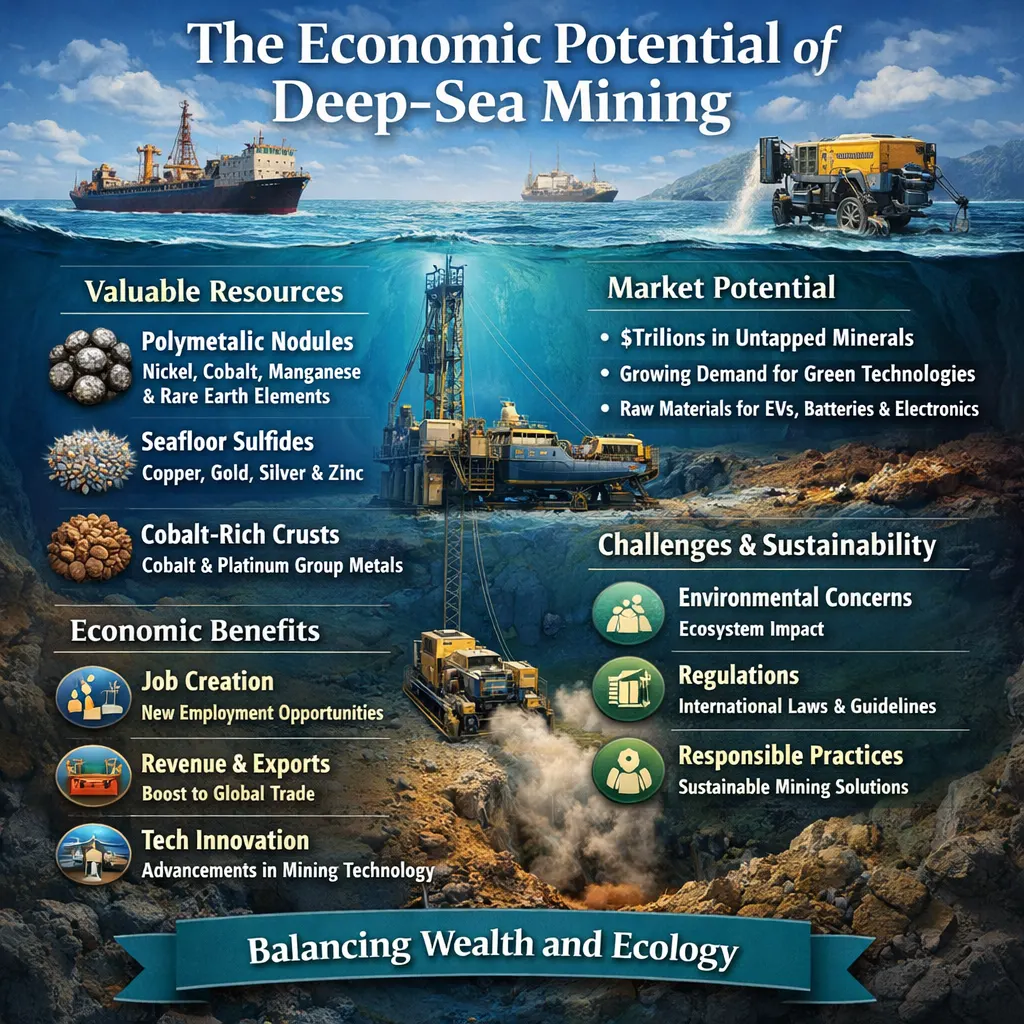
Deep-sea mining is the process of extracting mineral resources from the ocean floor, usually at depths of more than 200 meters and occasionally up to several thousand meters. Polymetallic nodules, seabed massive sulfides, and cobalt-rich crusts are some of the several types of these deposits.
The important metals manganese, nickel, cobalt, and copper are found in polymetallic nodules, which are potato-sized boulders found throughout abyssal plains. Rich in copper, silver, gold, and zinc, seafloor massive sulfides are frequently found close to hydrothermal vents. Crucial components for battery technology are found in cobalt-rich crusts that grow atop underwater mountains.
The wealth of these resources has drawn the attention of businesses and governments looking to ensure long-term mineral security.
Rising Demand for Critical Minerals
The demand on current mineral supply chains has increased with the shift to electric vehicles and renewable energy. Compared to conventional combustion-engine vehicles, electric vehicles require substantially greater mineral input. Large amounts of copper and rare metals are necessary for grid storage devices, wind turbines, and solar panels.
Securing access to these resources becomes a strategic priority as countries commit to decarbonization ambitions. Declining ore grades, environmental constraints, and geopolitical concentration in specific areas are some of the difficulties faced by land-based mining.
Deep-sea mining offers a potential alternative source that could diversify supply and reduce dependence on a few dominant producers.
Key economic drivers include:
✔ Rapid expansion of electric vehicle production
✔ Growth in renewable energy infrastructure
✔ Increasing demand for battery storage systems
✔ Technological advancement in electronics and defense
These factors collectively increase interest in ocean-based mineral extraction.
Scale of Untapped Resources
Mineral amounts in some deep-ocean locations may be comparable to or greater than those found in known terrestrial deposits, according to studies. For instance, it is expected that billions of tons of polymetallic nodules can be found in the Pacific Ocean's Clarion-Clipperton Zone.
Global markets may be greatly impacted by the size of these deposits. Deep-sea mining could reduce supply bottlenecks and stabilize mineral prices if it is economically feasible.
Large-scale production could also influence trade balances for resource-poor countries, reducing reliance on imports.
However, the transition from exploration to commercial extraction remains complex.
Technological Innovation and Investment
Remote-operated vehicles, sophisticated robots, and extraction systems that can function in the dark and under extreme pressure are all necessary for deep-sea mining. Its economic sustainability is largely dependent on technological innovation.
Companies are investing heavily in:
✔ Autonomous underwater collection systems
✔ High-pressure lifting mechanisms
✔ Real-time environmental monitoring tools
✔ Advanced mineral processing technologies
These developments create spillover benefits in marine engineering and robotics industries.
Proponents contend that long-term mineral demand might support significant expenditures despite the high initial capital costs. Operating costs may decrease as technology advances, increasing profitability.
Job Creation and Industrial Development
Deep-sea mining has the potential to provide jobs in engineering, research, logistics, and maritime services if it is done sustainably. Additionally, it might promote expansion in the fields of mineral processing, data analysis, and shipbuilding.
Port growth, service sectors, and centers of technological innovation could be advantageous for coastal countries that house support infrastructure.
Economic benefits may extend beyond direct extraction, supporting broader marine industries.
Geopolitical Implications
An intricate international legal system governs deep-sea mining operations. The International Seabed Authority (ISA) is in charge of environmental regulations and exploration licenses for areas outside of national jurisdiction.
The notion that seabed resources are a part of the "common heritage of mankind" is reflected in the governance system. The goal of this idea is to guarantee fair benefit-sharing across countries.
Competition for exploration rights, however, draws attention to geopolitical conflicts. Early investment could provide nations a strategic edge in securing future mineral supplies.
Control over mineral supply chains increasingly intersects with national security considerations.
Environmental and Regulatory Considerations
Environmental issues continue to be at the center of the discussion, despite the substantial economic possibilities. Among the world's least understood environments are deep-sea ecosystems. Biodiversity and delicate environments may be harmed by mining operations.
Concerns include habitat degradation, sediment plumes, and noise pollution. The development process must include preventive regulations and environmental impact evaluations.
Balancing economic gain with environmental protection will determine public acceptance and long-term sustainability.
Responsible governance frameworks are essential for ensuring that economic benefits do not come at irreversible ecological cost.
Market Impact and Price Stability
Deep-sea mining has the potential to change the global commodity markets if it becomes profitable. Increased supply could help companies that depend on steady inputs by stabilizing the pricing of essential minerals.
Lower price volatility could accelerate renewable energy adoption by reducing material cost uncertainties.
However, current mining industries that depend on terrestrial extraction may also be disrupted by rapid supply increase. There may be pressure from competitors for nations that rely significantly on mineral exports.
Economic modeling suggests that gradual, regulated introduction to markets would minimize shocks.
Investment Risks and Uncertainty
Deep-sea mining is still theoretical despite its potential. Uncertainty is caused by varying commodity costs, environmental resistance, regulatory approval procedures, and technical challenges.
Investors must weigh long-term demand forecasts against potential reputational and legal risks.
Financial viability depends on several factors:
✔ Regulatory clarity from international authorities
✔ Stable long-term mineral prices
✔ Technological reliability at scale
✔ Public and environmental acceptance
Without these conditions, large-scale investment may be delayed.
The Long-Term Outlook
Deep-sea mining's economic promise resides in its ability to augment the world's mineral supply during a crucial energy transition. Ocean-based resources could join a varied supply chain as the market for key metals expands.
But development is probably going to be cautious. International talks, pilot projects, and environmental monitoring initiatives will all influence the direction of the sector.
Technological advancement and regulatory clarity will determine whether deep-sea mining remains experimental or evolves into a major economic sector.
Conclusion
There are opportunities and responsibilities associated with deep-sea mining. The abundance of minerals found on the ocean floor has the potential to boost technological advancement, economic diversification, and the growth of renewable energy.
Diversification of the supply chain, employment creation, technological advancement, and price stability for essential materials are some of its economic potential. However, proper governance and environmental stewardship are also necessary.
As the world's mineral needs continue to grow, the controversy surrounding deep-sea mining raises more general issues like resource equality, sustainable development, and long-term economic planning.