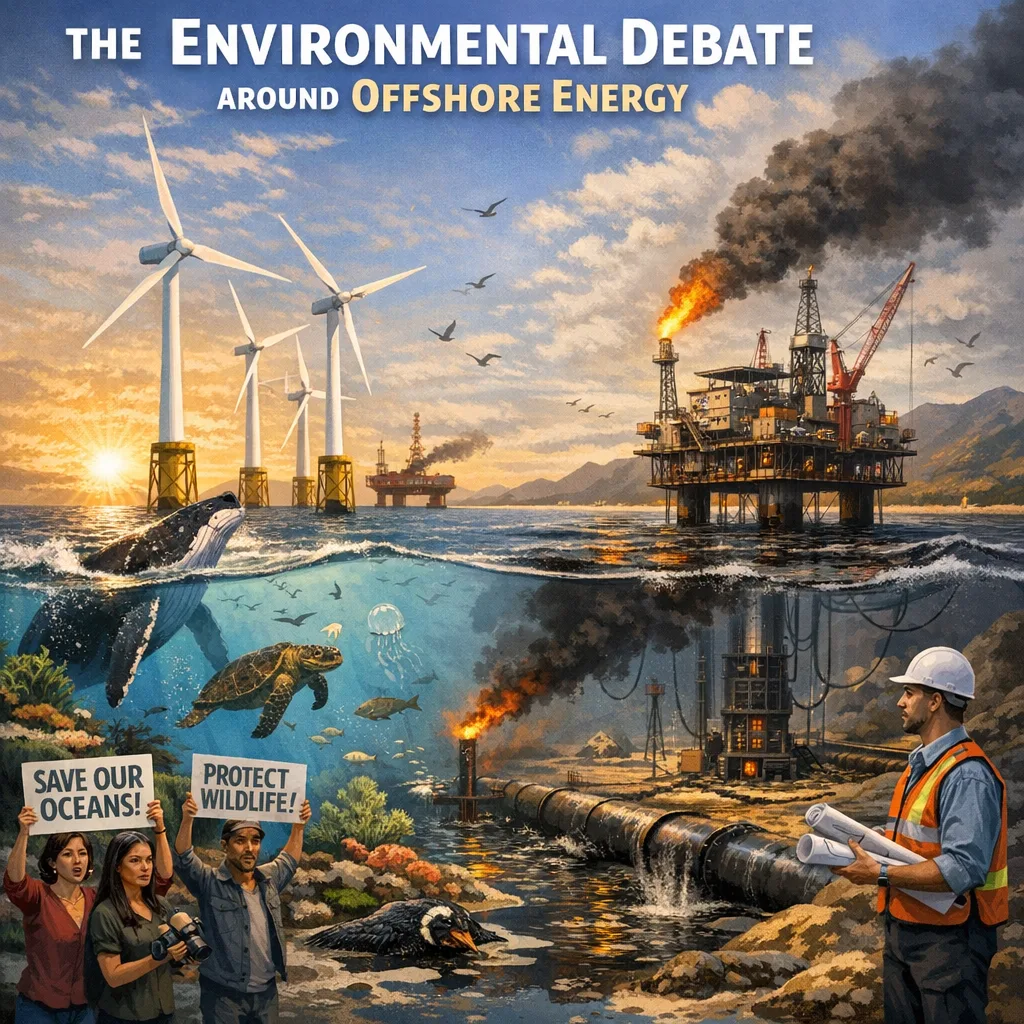
The focus of international climate and economic debates has shifted to offshore energy as countries compete to obtain greener, more dependable electricity sources. The oceans have emerged as crucial frontiers in the energy transition, from massive offshore wind farms to deep-water oil rigs and new tidal energy systems. However, there has been a great deal of environmental discussion about the growth of offshore energy projects.
Proponents contend that offshore energy, especially renewable energy, provides a route to long-term sustainability and decarbonization. Marine habitats, biodiversity loss, and unforeseen ecological repercussions are among the issues raised by critics. The argument highlights a larger worldwide issue: how to balance the preservation of delicate ecological systems with the growing demand for energy.
The Rise of Offshore Energy
Offshore energy encompasses a variety of operations carried out in maritime settings. This area has historically been dominated by offshore gas and oil exploitation. Nonetheless, renewable energy sources including wave energy, tidal power, and offshore wind have become more popular in recent decades.
Across Europe, Asia, and North America, offshore wind farms in particular have grown significantly. Turbines can produce significant amounts of electricity when ocean breezes are strong and steady. Transmission lengths to urban areas are also shortened by being close to the coast.
Meanwhile, deep-water drilling has become more practical due to technological advancements, opening up previously unreachable areas for fossil fuel exploitation.
Because each technology has unique advantages and disadvantages, the variety of offshore energy sources complicates the environmental discussion.
Climate Benefits and the Case for Expansion
The climatic benefits of offshore renewable energy are emphasized by its proponents. While in operation, offshore wind farms generate power without releasing greenhouse emissions. Utilizing the natural motions of the ocean, tidal and wave energy systems provide reliable and sustainable power sources.
Key environmental benefits of offshore renewables include:
✔ Significant reduction in carbon emissions
✔ Decreased reliance on fossil fuels
✔ Support for national climate targets
✔ Improved long-term energy security
By shifting energy production away from coal and oil, offshore renewables contribute to global decarbonization efforts.
In regions where land availability is limited, offshore installations also reduce pressure on terrestrial ecosystems.
Marine Ecosystems Under Pressure
Environmentalists warn that offshore projects may disturb marine habitats despite the advantages to the climate. Sensitive habitats may be disrupted by construction operations including cable installation, pile driving, and seabed drilling.
Construction-related noise pollution can have an impact on marine mammals, especially dolphins and whales that depend on echolocation. Disturbance of the seabed may affect coral forms and benthic organisms.
Local ecosystems can be changed by renewable energy installations as well. Sediment patterns may be altered by turbine foundations, and migratory animals may be impacted by electromagnetic waves from undersea cables.
Concerns often focus on:
✔ Habitat fragmentation
✔ Disruption of migration routes
✔ Increased ship traffic and pollution
✔ Long-term ecological uncertainty
Balancing renewable energy goals with biodiversity protection remains a central challenge.
Offshore Oil and Gas: A Continued Controversy
Even though offshore renewable energy sources are getting a lot of attention, offshore oil and gas extraction is still a key global energy source. Drilling for fossil fuels is known to pose environmental problems.
Drilling accidents, methane leaks, and oil spills can all seriously harm marine ecosystems. Offshore drilling failures have long-term environmental and economic repercussions, as demonstrated by the Deepwater Horizon accident in 2010.
Expanding offshore fossil fuel projects, according to critics, goes against climate pledges. Proponents argue that as renewable infrastructure grows, transitional sources are still needed to meet the world's energy needs.
The debate over offshore oil and gas underscores tensions between economic reliance and environmental responsibility.
Technological Innovation and Mitigation Efforts
The goal of technological advancements is to lessen offshore energy projects' environmental impact. Many governments now require environmental impact studies prior to the start of development.
Developers are implementing mitigation strategies such as:
✔ Seasonal construction to avoid breeding periods
✔ Noise-reduction technologies during pile driving
✔ Artificial reef creation around turbine bases
✔ Continuous environmental monitoring systems
In certain instances, the foundations of offshore wind turbines have produced artificial reefs that serve as new habitats for marine species. Simplistic narratives of harm are complicated by these unforeseen ecological benefits.
Innovation continues to play a key role in addressing environmental concerns.
The Role of Policy and Regulation
The environmental effects of offshore energy production are shaped by government legislation. International maritime regulations, biodiversity protection, and stringent permitting procedures all have an impact on the planning and execution of projects.
Marine spatial planning is increasingly used to balance competing ocean uses—energy production, fishing, shipping, and conservation.
Policy frameworks aim to ensure that offshore projects align with environmental standards while supporting energy transition goals.
Effective governance can mitigate environmental risks and enhance public trust.
Community Perspectives and Coastal Economies
Reactions to offshore energy projects are frequently conflicting in coastal communities. Infrastructure investment and employment possibilities could result from renewable energy installations. Opposition, however, may arise due to worries about the consequences on tourism, fishing, and aesthetics.
Public perception plays a significant role in shaping project approval and expansion.
Transparent communication, stakeholder engagement, and benefit-sharing mechanisms are essential for maintaining social acceptance.
Environmental debates are not purely scientific; they are also social and political.
The Long-Term Ecological Question
Uncertainty is among the most difficult elements of the offshore energy controversy. On Earth, deep-sea ecosystems continue to be one of the least studied habitats. Predicting the long-term cumulative consequences of several installations is challenging.
Analysis is made more difficult by climate change. Indirectly shielding marine habitats from heat and acidification, offshore renewable energy may lower global emissions.
This creates a paradox: short-term localized ecological disruption versus long-term global environmental benefit.
Determining the appropriate balance requires ongoing research and adaptive management.
The Path Forward
Offshore energy will probably continue to grow in the future, especially in renewable energy. In their climate action plans, governments are establishing aggressive goals for offshore wind development.
To ensure environmental responsibility, collaboration between scientists, policymakers, industry leaders, and environmental groups is critical.
The most effective path forward includes:
✔ Robust environmental monitoring
✔ Transparent regulatory processes
✔ Investment in cleaner technologies
✔ Adaptive management strategies
The development of offshore energy doesn't have to be a binary decision. It might be possible to preserve marine biodiversity while using ocean resources with careful planning.
Conclusion
The complexity of contemporary sustainability issues is reflected in the environmental discussion surrounding offshore energy. Oceans have enormous potential for producing renewable energy, which helps to mitigate climate change and ensure energy security. However, they also support delicate ecosystems that need to be preserved.
Careful thought must be given to balancing ecological protection, energy demand, and economic expansion. Offshore energy projects need to be assessed for their long-term environmental effects in addition to their immediate financial benefits.
The oceans will continue to be a major topic of discussion as the globe moves toward cleaner energy systems. In order to ensure that environmental integrity and climate goals advance together, the discussion goes beyond whether offshore energy should be developed to include how to do it ethically.