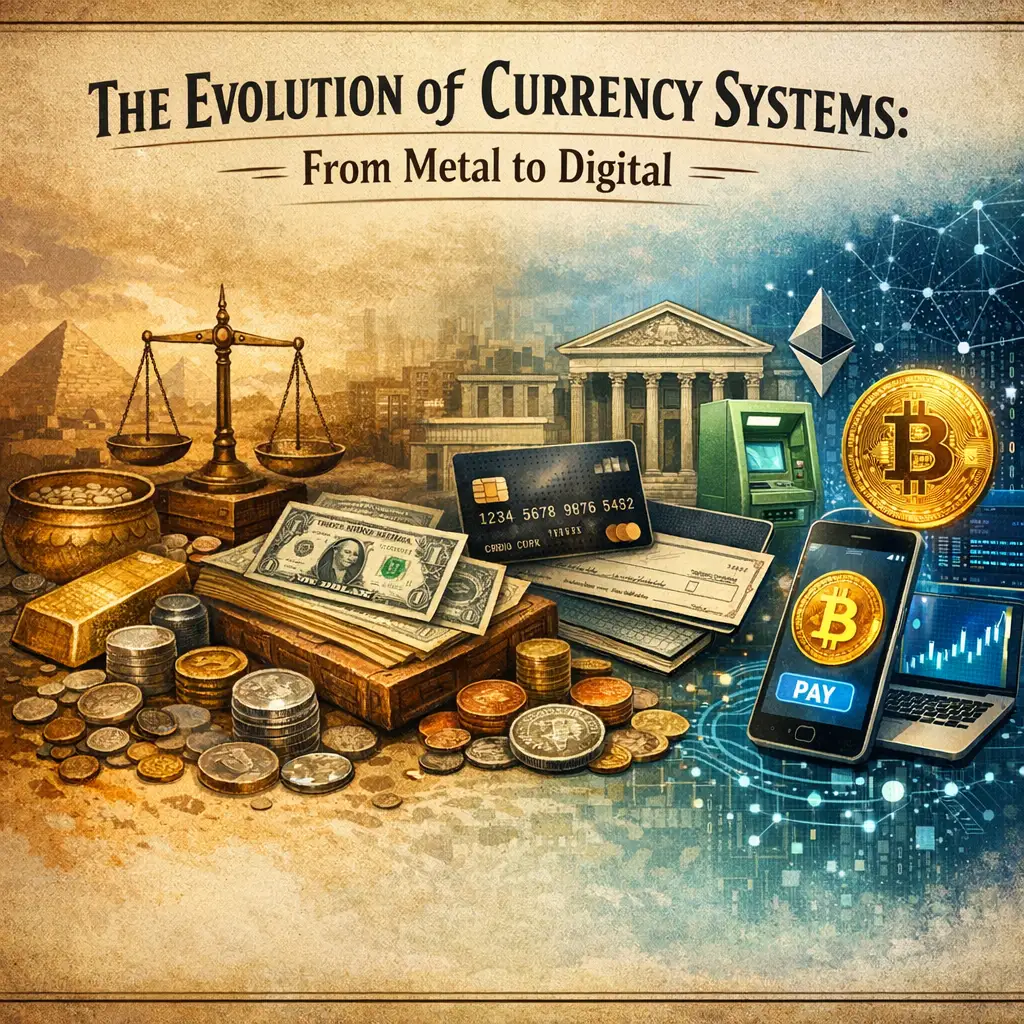
One of humanity's most potent inventions is money. It determines how civilizations exchange value, shapes economies, and affects political systems. Money, however, has never been constant. Currency systems have seen significant change over the course of thousands of years, moving from heavy metal coins to lightweight paper money to undetectable digital transactions. Every change reflects advancements in technology, evolving trade trends, and evolving notions of value and trust.
Knowing how currency systems have changed over time can help one understand how contemporary economies operate and where financial systems might go in the future.
The Era of Barter and Commodity Money
Barter was used by societies prior to the invention of official currency. Direct trade took place between goods and services. Craftspeople exchanged crafts for cattle, and farmers exchanged grain for equipment. Barter was effective in tiny towns, but it had obvious drawbacks. A "double coincidence of wants" was necessary for transactions, which meant that both parties had to require what the other offered.
Early societies used commodity money—items with inherent value that were universally accepted—to get around this inefficiency. Salt, cattle, shells, and precious metals were among them. These products were appropriate trade mediums since they were recognized and long-lasting.
Trade was inconsistent, nevertheless, because items differed in weight and quality. Standardized money was urgently needed as economies grew.
The Rise of Metal Coinage
A significant advancement came with the introduction of metal coinage. Gold, silver, copper, and bronze coins were first produced by ancient societies like the Lydians, Greeks, Romans, and Chinese.
Metal coins offered several advantages:
✔ Standardized weight and purity
✔ Durability over long periods
✔ High intrinsic value
✔ Wide acceptance in regional trade
Large-scale taxes and commerce were made easier by coins. To ensure authenticity, governments affixed official seals to coinage. This established trust between buyers and sellers.
But metal money had disadvantages as well. Coins were heavy, required mining resources, and were challenging to move in bulk. Carrying bags of currency proved problematic when trade networks expanded across continents.
These limitations paved the way for another innovation.
The Birth of Paper Money
During the Tang and Song dynasties, paper money initially appeared in China. When coins were deposited, businesses first provided paper receipts. These receipts eventually developed into banknotes endorsed by the government.
Paper money represented a revolutionary shift. Unlike metal coins, it had little intrinsic value. Its worth depended on trust in the issuing authority.
The advantages of paper money were transformative:
✔ Lightweight and easy to transport
✔ Suitable for large transactions
✔ Reduced reliance on precious metals
✔ Simplified taxation and trade
Over time, paper money made its way to other countries. Centuries later, with the help of central banking organizations, European countries began using banknotes.
With the switch from metal to paper, a new economic principle was established: money could operate efficiently on the basis of shared conviction rather than tangible material.
The Gold Standard and Monetary Stability
Governments looked for measures to preserve trust in their monetary systems as paper money spread throughout the world. The gold standard was one remedy.
Paper money might be exchanged for a set quantity of gold under this arrangement. Foreign traders and citizens were reassured by this connection that currency had real support.
By stabilizing currency exchange rates, the gold standard encouraged stability in global trade. But it also made it harder for governments to react flexibly to economic crises.
Economic downturn and international conflicts put pressure on the gold standard during the 20th century. Most countries eventually stopped using it and switched to fiat currency.
The Rise of Fiat Money
Currency that is not backed by a tangible good and has no inherent value is known as fiat money. Rather, it gets its worth from economic stability and governmental power.
Modern paper currencies and coins are examples of fiat money. Central banks control money supply, interest rates, and inflation.
Fiat systems give governments more leeway in controlling economic expansion and handling emergencies. But in order to avoid excessive inflation, they need to be carefully regulated.
Public trust remains essential. If citizens lose confidence in a currency, its value can decline rapidly.
Fiat currency represents the culmination of the shift from tangible value to institutional trust.
The Digital Payment Revolution
The late twentieth and early twenty-first centuries introduced another transformation: digital payments.
Reliance on hard currency was lessened by credit cards, internet banking, and mobile wallets. Transactions become easier, quicker, and more internationally connected.
Digital systems offer clear advantages:
✔ Instant cross-border payments
✔ Reduced transaction costs
✔ Enhanced financial record-keeping
✔ Greater convenience for consumers and businesses
Digital payments became crucial to modern economies as e-commerce grew. In many nations, the use of physical cash started to decrease.
A move toward invisible currency—value stored electronically rather than physically—is represented by the switch from paper to digital.
Cryptocurrencies and Decentralized Finance
Currency evolution took on a new dimension with the advent of cryptocurrencies. Cryptocurrencies run on decentralized blockchain networks, in contrast to conventional digital payments that are managed by institutions.
When Bitcoin was introduced in 2009, it offered peer-to-peer transactions devoid of centralized authority, challenging established financial institutions.
Transparency, cryptographic security, and restricted supply mechanisms are key components of cryptocurrencies. Discussions concerning the function of central banks and the future of money have been triggered by them.
While still volatile and evolving, digital assets highlight the ongoing transformation of currency systems.
Central Bank Digital Currencies
Many governments are investigating central bank digital currencies (CBDCs) in reaction to the development of cryptocurrencies. These digital fiat currencies combine state-backed security with the effectiveness of digital transactions.
CBDCs aim to improve financial inclusion, reduce transaction costs, and enhance payment system resilience.
The development of digital state currencies suggests that monetary evolution is far from complete.
The Core Principle: Trust
Throughout history, the common thread connecting metal coins, paper notes, and digital tokens is trust.
✔ Trust in the material value of metals
✔ Trust in government-backed paper currency
✔ Trust in financial institutions
✔ Trust in digital security systems
Money functions effectively only when people believe in its value and stability.
The structure of money has changed due to technological advancements, but institutional and psychological trust are still the cornerstones.
Looking Ahead
Digital innovation and governmental monitoring will probably be combined in money systems of the future. Blockchain, secure encryption, and artificial intelligence will influence the development of new financial instruments.
Although cash may keep going down, actual currency is not going to completely vanish anytime soon. Instead, hybrid systems that strike a balance between conventional stability and digital ease may appear.
Currency systems must change to accommodate international trade, economic resiliency, and technological advancement as economies grow more interconnected.
Conclusion
Humanity's quest for economic exchange efficiency, stability, and trust is reflected in the development of money systems. Each stage, which included barter and commodity money as well as metal coins, paper banknotes, fiat currency, and digital assets, addressed the shortcomings of the one before it.
Digital code saved on servers has replaced the physical metal that was once kept in pockets. However, money still fulfills its fundamental purposes of promoting trade, preserving value, and gauging economic activity in spite of significant changes in form.