Introduction
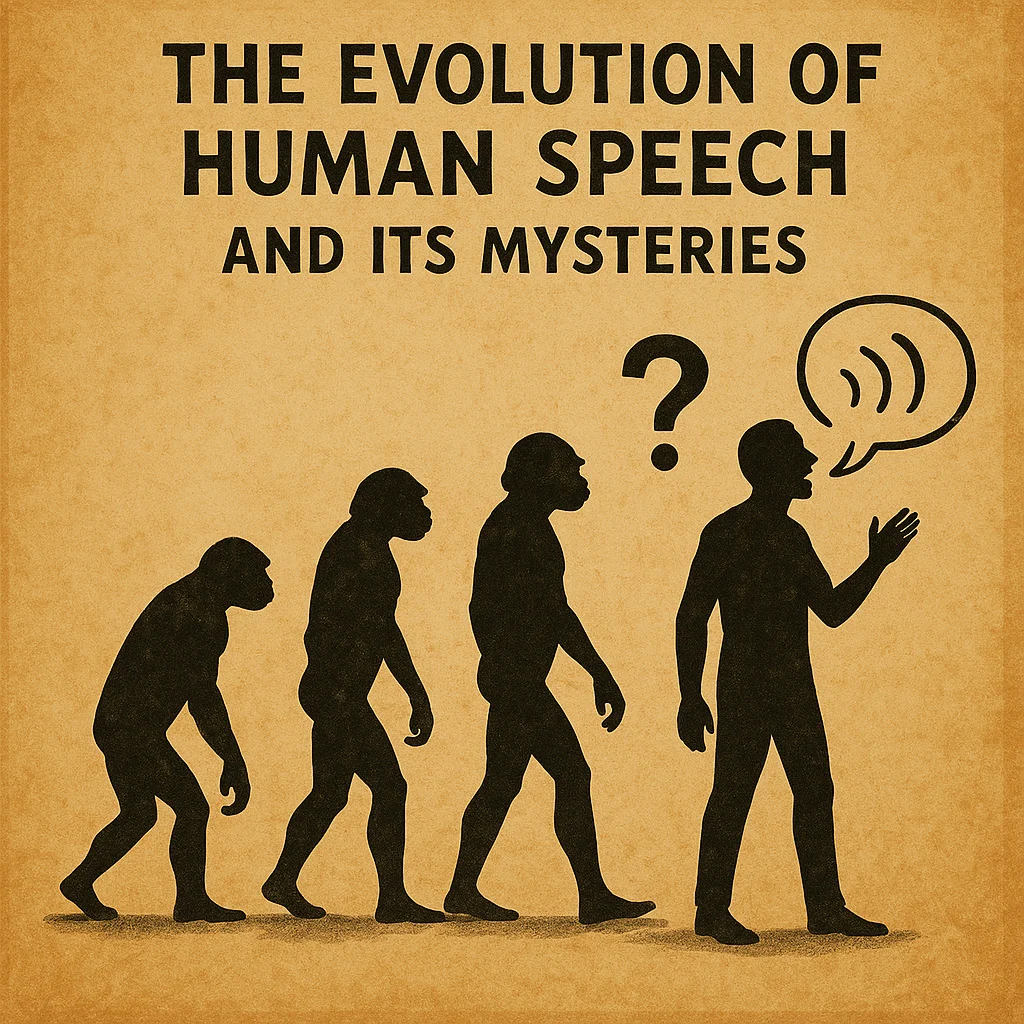
Speaking is one of the few things that most profoundly distinguishes humans from other animals. Societies are held together by speech, which enables us to exchange ideas, transmit knowledge, and create intricate cultures. However, one of science's most intriguing mysteries is how humans came to be able to speak. Words do not leave fossils like bones or stone tools do. Language cannot be unearthed like fragments of pottery. Rather, the study of living languages, comparative anatomy, and genetics are used to trace its history.
How and why did people develop this extraordinary ability? Why did it develop in humans rather than in our closest relatives, such as gorillas or chimpanzees? And why does speech still seem like a gift that is not limited by biology? Let's investigate the development of human speech and solve the riddles that linguists, philosophers, and scientists alike still find fascinating.
The Roots of Speech in Early Humanity
Though some contend it may have originated much earlier, human speech most likely started at least 100,000 years ago. Symbolic artifacts such as cave paintings, carvings, and beads are cited by archaeologists as proof that early humans had the mental capacity necessary for language.
The appearance of Homo sapiens, who showed not only bigger brains but also differently organized ones, was a significant turning point. It was crucial that the brain's Wernicke's and Broca's areas, which are linked to speech and comprehension, developed. Despite having large brains, Neanderthals and other ancestors may not have been able to produce the same variety of sounds as modern humans due to issues with their vocal tracts and breathing control.
The Anatomy of Speech: A Perfect Storm of Evolution
Human speech is not just about the brain—it’s also about anatomy. Several evolutionary changes uniquely prepared us for spoken language:
-
The Descent of the Larynx
Compared to most other mammals, humans have a lower larynx, or voice box. We are able to produce a greater range of vowels and consonants as a result. However, there was a risk involved: an increased risk of choking. The fact that nature kept this dangerous trait implies that speech offered significant benefits for survival. -
Fine Motor Control of the Tongue and Lips
Our ability to control our muscles precisely is what allows us to produce a variety of sounds. Humans are able to produce an amazing variety of sounds due to the exceptionally intricate nerve connections that exist between the brain and the tongue, lips, and jaw. -
Breath Control
Long, structured sentences are made possible by humans' development of fine breath control, in contrast to apes' short bursts of sound. This might have developed in tandem with respiratory modifications and endurance running.
Together, these changes created what could be called a “perfect storm” for speech to emerge.
Why Did Speech Evolve?
The question of why speech evolved is as intriguing as how it evolved. Scientists suggest several theories:
-
Social Bonding
Like monkeys, early primates were able to form alliances through grooming. However, physical grooming became impracticable as human groups grew in size. As a means of bonding, language may have taken the place of grooming—sharing jokes, stories, or gossip. -
Coordination of Group Activities
The earliest hunters and gatherers required a means of communicating intricate tactics. Hunts, migrations, and defenses against rivals or predators could all be coordinated with words. -
Transmission of Knowledge
Humans were able to transmit survival skills through language, such as how to make tools, locate food, or stay safe. Because of this, humans had a distinct advantage over animals that only imitated. -
Symbolic Thought and Culture
Speech created culture in addition to aiding in survival. Humans used words to plan for the future, discuss the past, and conjure up imaginary concepts like laws, gods, and myths.
The Mysteries of Language Origins
Despite decades of study, the origins of human speech remain wrapped in mystery. Here are some of the biggest puzzles:
-
The FOXP2 Gene
Researchers found that a gene known as FOXP2 is involved in speech and language in the late 20th century. Speech disorders can be caused by mutations in this gene. Uncertainty surrounds why only Homo sapiens developed fully modern speech, but Neanderthals also carried a version of FOXP2, indicating that they might have had some linguistic abilities. -
The Diversity of Languages
More than 7,000 languages exist today, each with its own distinct rules, structures, and sounds. How did one ancestral form of speech give rise to such diversity? Was there a "proto-language" from which all human languages descended, or did different speech patterns develop separately? -
Why Other Animals Don’t Talk
No other species uses structured, generative language, although apes can learn sign language and parrots can mimic human speech. What difference in thinking made us different from them? -
The Role of Music and Rhythm
According to some theories, singing evolved into speech. It's possible that rhythmic communication, such as chanting or drumming, predated structured language. This begs the question: did language originate in song rather than in conversation?
Speech as a Window Into the Mind
Speech not only shows how we communicate, but also how we think. According to the well-known theory of linguistic relativity, our perception of the world is influenced by the language we use. For instance, while some languages do not differentiate between blue and green, others have dozens of terms for snow.
This indicates that speech shapes thought rather than merely conveying it. Our ancestors created a system that molded consciousness itself, not merely a survival tool.
Speech and the Birth of Human Identity
Speech evolved into the basis of identity. It paved the way for nations, established shared myths, and set one tribe apart from another. Languages, dialects, and accents still influence how people view one another and themselves.
Literature, politics, religion, and philosophy wouldn't exist without speech. The claim that speech is the origin of civilization is not hyperbole.
Modern Science and the Future of Speech
These days, with the advent of voice recognition and artificial intelligence, speech is still developing. Speech synthesis, translation applications, and virtual assistants are changing the way we use and comprehend language.
However, its origins are still a mystery. The origins of speech, its evolution, and the reasons it is specific to humans are still up for debate among scientists. Perhaps there will never be a complete answer, but that is part of the allure.
Conclusion
Speech is both commonplace and extraordinary. Despite the fact that we frequently use it without realizing it, it is one of the most significant evolutionary advances in human history. It has shaped our identities, from influencing ideas to forming societies.
The mysteries of speech serve as a reminder that humankind is characterized by connection, imagination, and creativity in addition to survival. Speech is ultimately about what it means to be human, not just about words.