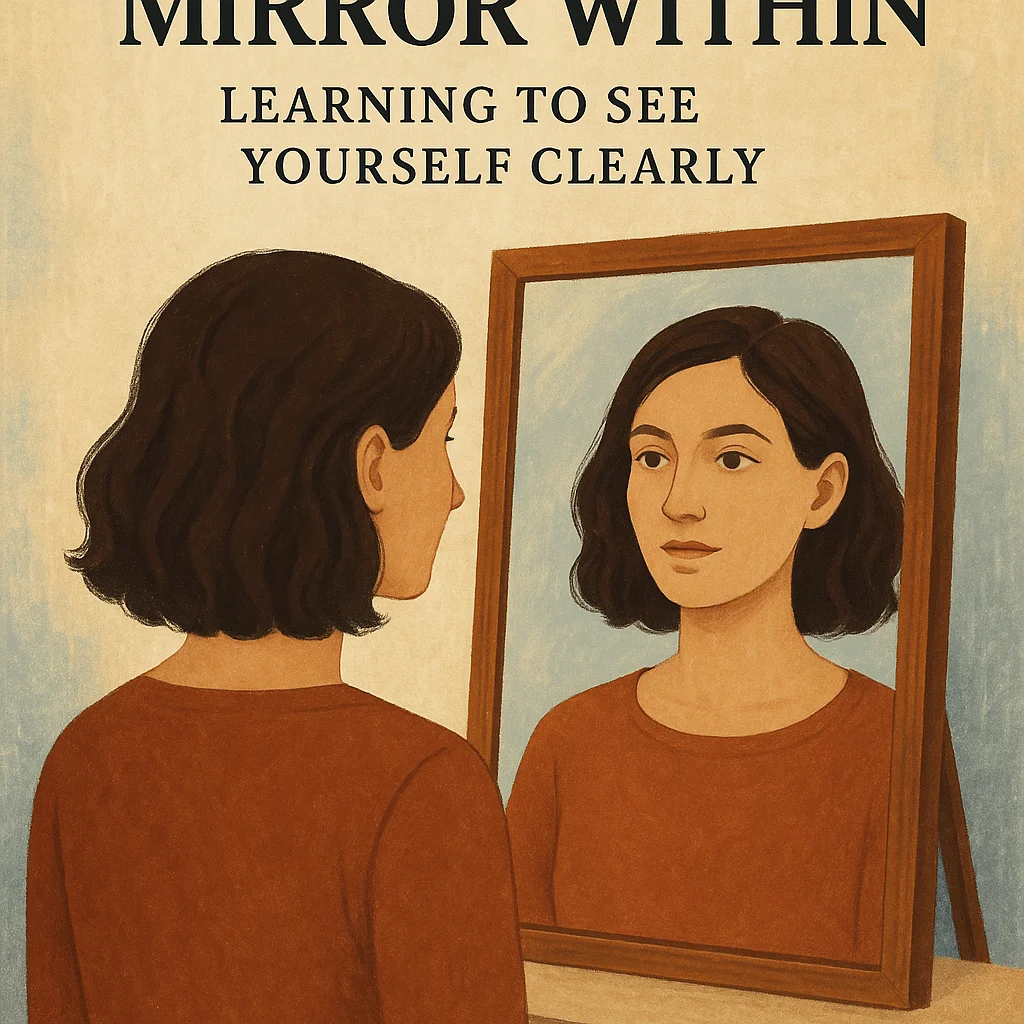
A large portion of our lives are spent staring at other people, expectations, accomplishments, and appearances. However, the best mirror you will ever encounter isn't composed of glass. When the cacophony of the outside world subsides, your inner reflection—the mirror within—reveals who you are.
One of the most challenging and life-changing experiences is discovering your true self. Honesty is the key, not conceit or ego. It's about discovering who you are—not the one molded by pride, fear, or comparison, but the one that lurks under the surface, longing to be acknowledged.
We'll discuss what it really means to see yourself clearly, why it's so challenging, and how you may start developing a more sincere, caring relationship with the person you see in your inner mirror in this blog.
Why Seeing Yourself Clearly Is So Difficult
The majority of people see who they believe themselves to be—or who they have been persuaded they are—rather than who they actually are. We pick up labels like "smart," "lazy," "sensitive," "strong," "shy," and "funny" from an early age. These labels eventually create an internal fog that warps reality.
Then there are societal expectations, such as productivity, success, beauty, and perfection. These values, which are based on comparison rather than authenticity, produce mirrors that reflect warped pictures.
As a result, a lot of people don't feel connected to themselves. Rather of seeking clarification, they seek validation. Rather than reflecting, they perform.
It takes guts to see yourself clearly, not just self-reflection. Because being truly self-aware entails facing your fears, paradoxes, and shadows in addition to your strengths.
"Until you make the unconscious conscious, it will direct your life and you will call it fate," as psychologist Carl Jung famously stated. The internal mirror compels you to examine what has been subtly molding you throughout.
The Layers That Hide the True Self
You must identify the layers that obstruct your reflection before you can see yourself properly. These layers can obstruct true self-understanding, but they are not "bad"—they are normal reactions to life's stresses.
-
The Mask of Achievement – We frequently use our accomplishments to define who we are. Failure, however, seems like erasure when identity is linked to achievement. When you're not succeeding, this disguise conceals who you are.
-
The Mask of Approval – We mold ourselves to meet expectations because many of us yearn to fit in. However, our reflection turns into a compilation of borrowed viewpoints when we live to appease others.
-
The Mask of Avoidance – It's difficult to deal with pain, embarrassment, and disappointment. As a result, we avoid them and divert our attention with denial or busyness. However, avoidance prevents us from healing, and healing is the source of clarity.
-
The Mask of Comparison – In the social media era, comparing is a continuous. We compare our value to carefully chosen images of other people's life, not realizing that mirrors warp when held at an angle.
You must carefully peel back these layers in order to see oneself clearly—not in a single dramatic act, but via persistent, thoughtful honesty.
Self-Awareness: The First Step Toward Clarity
The basis for having a comprehensive understanding of oneself is self-awareness. It's the capacity to watch your feelings, ideas, and actions without passing judgment.
But being truly self-aware is knowing why you feel the way you do. Finding the cause of an emotion is more important than identifying oneself (e.g., "I'm confident," "I'm anxious").
For example:
-
Ask yourself, "What boundary was crossed?" when you're feeling angry.
-
Ask yourself, "What unfulfilled desire is being mirrored?" whenever you feel envious.
-
Ask yourself, "What story am I telling myself about the future?" whenever you experience fear.
Emotions become instructors rather than adversaries through this type of introspection. Every one of them reveals a reality about your needs and identity.
The Practice of Honest Reflection
You have to become both the observed and the observer in order to perceive yourself clearly. Journaling, meditation, therapy, and even quiet times are all examples of this activity. Honesty is the key.
Here are a few powerful practices to begin:
-
The “Why” Journal – Write down one action or feeling that caught your attention at the conclusion of each day. Then, five times, ask why. Your comprehension goes beyond simple logic as a result.
-
The Mirror Exercise – Spend two minutes silently staring at yourself in the mirror. As you stare into your own eyes, pay attention to how you feel rather than how you appear. Uncomfortable? Feeling proud? Sad? Are you curious? What you've been avoiding is frequently revealed by that discomfort.
-
The Quiet Walk – Take some time to stroll without interruptions or headphones. Let your ideas come to you. As if you were listening to a friend, listen to them without passing judgment.
Curiosity is what drives reflection, not self-criticism. Understanding oneself is more important than trying to "fix" oneself.
The Role of Compassion in Self-Clarity
It's not necessary to be harshly honest in order to see yourself clearly. Clarity is sometimes confused with criticism, but judgment obscures introspection.
The lens that keeps the mirror clear is compassion. When you treat yourself with compassion, you establish a psychological safe place where you can examine your shortcomings and errors without succumbing to guilt.
TImagine how you would console a buddy who had failed or felt lost. "It's okay," you would probably say. You are a human. You're gaining knowledge. Give yourself the same consideration.
Self-acceptance is necessary for true self-awareness. If not, being honest turns into self-punishment.
Shadows and Light: Accepting the Whole Picture
You must embrace both your light and your shade in order to see yourself clearly. Everybody has aspects they'd prefer to keep hidden and aspects they're proud of. Denying your shadow, however, only pushes it underground, where it unintentionally affects you.
Jealousy, rage, insecurity, or selfishness are some examples of your shadow. You become entire when you acknowledge these aspects of yourself. Because every shadow contains information: fear may indicate what really matters, jealousy may highlight desire, and wrath may show boundaries.
Owning your impulses so they no longer rule you is what it means to integrate your shadow, not acting on them all.
"One does not become enlightened by imagining figures of light, but by making the darkness conscious," according to Jung.
Seeing yourself clearly entails treating every aspect of who you are with empathy rather than denial.
Feedback: The External Mirror
Sometimes you need other people's assistance to see yourself clearly. Additionally, external feedback serves as a mirror, reflecting aspects of you that are difficult to notice from the inside.
But not every mirror is precise. Some people transfer their prejudices or anxieties onto you. The secret is discernment—knowing which reflections are constructive and which warp your perspective.
When someone offers feedback, pause before reacting defensively. Ask yourself:
-
Does this represent a reality I've sensed but disregarded?
Does it disclose something about their viewpoint or about me?
What can I learn without becoming less genuine?
Internal awareness and external feedback are combined in the healthiest reflection. Each mirror is insufficient on its own, but when combined, they produce clarity.
Clarity Is an Ongoing Process
Gaining self-awareness is a continuous process. It's a continuous dance between evolution and discovery that lasts a lifetime.
Your reflection shifts as you mature. What used to be true might not be appropriate now. You are not the same person at 25 as you are at 40. Seeing oneself clearly entails not sticking to outdated definitions but remaining receptive to change.
It's about not waiting for perfection before you can love yourself; rather, it's about living as a work in progress.
Being honest enough to ask better questions is more important for clarity than having all the answers.
Signs You’re Beginning to See Yourself Clearly
As you deepen your relationship with the mirror within, subtle shifts occur:
-
You reply more deliberately and less impulsively.
-
Rather than being overcome by emotional patterns, you are able to identify them.
-
Because you believe in your own value, you quit seeking approval from others.
-
You make choices based on your principles rather than your anxieties.
-
In your own company, you start to feel at ease.
When your inner and exterior identities finally start to line up, these are the subtle indicators of clarity.
The Freedom That Comes with Inner Clarity
Life becomes easier when you have a firm understanding of who you are. You begin to live from the truth instead of resisting it. You become yourself instead of just acting.
When you finally realize what matters to you, rather than what other people think should matter, clarity provides you direction. Because authenticity draws other authenticity, it improves relationships. Additionally, it strengthens resilience because turbulence from the outside world doesn't upend your foundation when you know who you are.
The inner mirror turns into a source of serenity rather than a location of condemnation.
Final Thoughts
The mirror within of you is something you have to learn to confront rather than something you discover. It demands compassion, bravery, and honesty. It challenges you to peel back the layers, face your shadow, and pay attention to the silent reality that lies underlying your thoughts.
Understanding who you already are, beneath the clutter, is more important than trying to change who you are.
And you understand that achieving clarity isn't the end of the trip when you eventually see that reflection—the unadulterated, delightfully flawed version of yourself.
It's the start of living a genuine life.