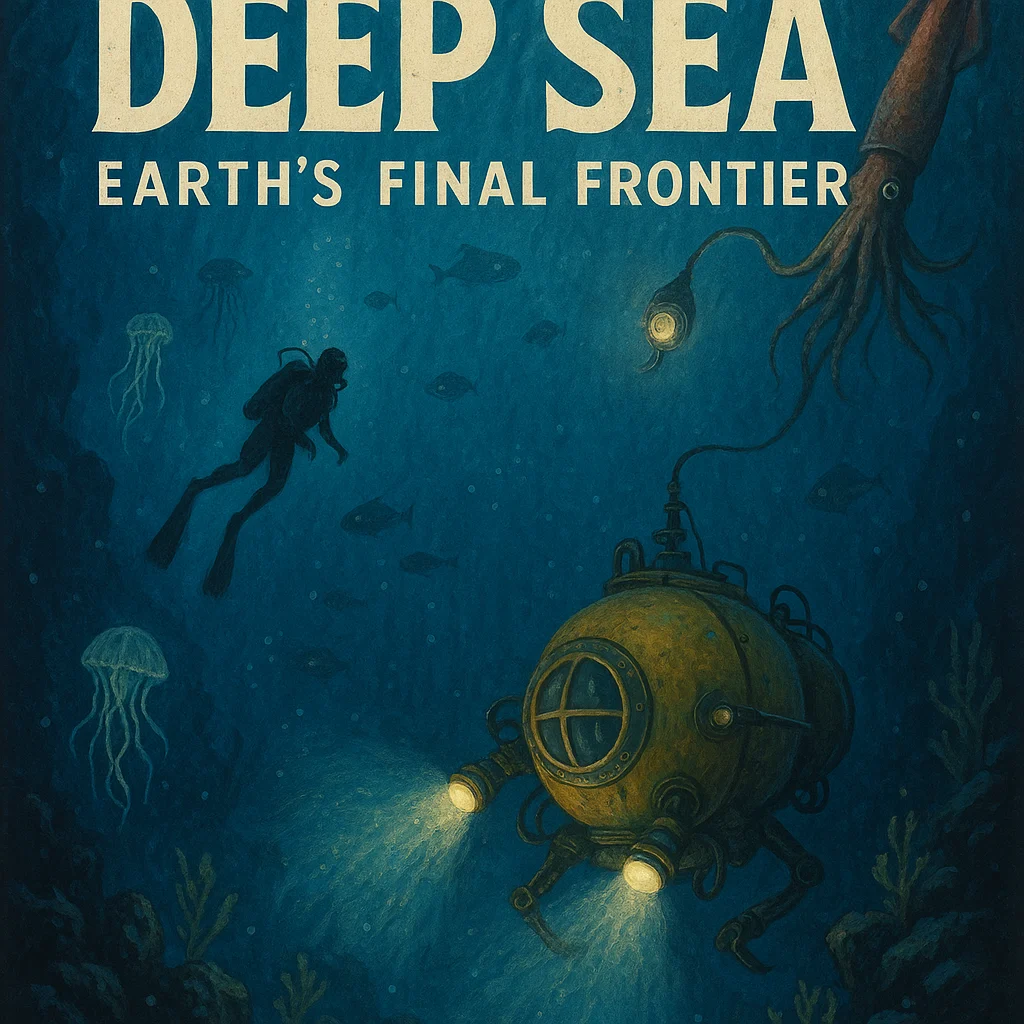
The stars, far-off planets, or galaxies far beyond our own are frequently the first things that come to mind when someone thinks of exploration. However, the deep sea is arguably the most uncharted region on Earth. The ocean, which makes up more than 70% of the planet's surface, is enormous, strong, and little understood. Only 20% of the ocean floor has been mapped using contemporary technology, and even less of the deep ocean has been directly explored, despite centuries of seafaring.
Because it contains mysteries that rival—and in many respects even surpass—those of outer space, the deep sea is frequently referred to as "Earth's final frontier." The deep sea is a place that tests our knowledge of life and the boundaries of human technology, with its bizarre bioluminescent creatures, massive underwater mountains, hydrothermal vents, and hidden ecosystems.
What makes the deep sea so enigmatic, why it hasn't been explored much, and what humanity can learn from exploring its murky depths will all be covered in this blog.
1. The Hidden World Beneath the Surface
The majority of people encounter the ocean at its surface, whether it be through beaches, waves, or shallow waters for snorkeling. However, there is a world beneath the sunlit zone that few people can imagine. Around 200 meters below the surface, where sunlight no longer reaches, the deep sea begins. Conditions worsen from there, becoming colder, darker, and under more pressure. The landscape is nearly foreign by the time you arrive at the hadal zone, which consists of trenches that are between 6,000 and 11,000 meters deep.
However, life persists in spite of the harsh circumstances. Scientists have found an incredible variety of species that have adapted to this darkness, including fish with translucent bodies that are meant to blend in with the abyss, squid that grow to amazing lengths, and jellyfish that glow like stars.
Humanity has only touched the surface of what lies beneath, as evidenced by the discovery of new species on every expedition into the deep.
2. Why the Deep Sea Remains Unexplored
The fact that humans have mapped the Moon and Mars more thoroughly than the ocean floor may surprise some. The explanation is simple: one of the hardest places on Earth to explore is the deep sea.
-
Crushing Pressure: At the bottom of the Mariana Trench, the deepest point in the ocean, pressure exceeds 1,000 times the standard atmospheric pressure at sea level. Few machines can survive, and even fewer humans.
-
Complete Darkness: Exploration depends on artificial lights, which only light up small areas, in the absence of sunlight.
-
Sheer Vastness: Because the ocean is 361 million square kilometers in size, thorough mapping is extremely difficult.
-
Technological Barriers: Satellites can map the surface of other planets, but sonar and specialized submersibles are needed because radio waves and GPS signals cannot pass through deep water.
Despite being vital to life on Earth, the deep sea is still one of the least understood regions of the planet, which can be explained by these difficulties.
3. Bioluminescence: Nature’s Hidden Light Show
The capacity of living things to generate light through chemical reactions, known as bioluminescence, is one of the deep sea's most intriguing phenomena. This ability has several uses in the abyss's darkness:
-
Attraction: Certain species use light to draw their prey near enough for them to be caught. For example, the notorious anglerfish uses a glowing lure that hangs from its head.
-
Camouflage: To hide from predators, some squid and fish emit a faint glow that helps them blend in with the dim light from above.
-
Communication: Additionally, bioluminescence can be used to alert predators or attract mates.
The variety of light colors, patterns, and tactics employed by deep-sea organisms is astounding. One of the most bizarre reminders that nature can survive in the most harsh environments is still this phenomenon.
4. Hydrothermal Vents: Life Without Sunlight
For centuries, scientists thought that all life began with sunlight. Researchers then found hydrothermal vents on the ocean floor in 1977. These fissures release mineral-rich superheated water, forming ecosystems driven by chemosynthesis—bacteria that transform chemical energy into food—rather than photosynthesis.
Entire communities of enormous tube worms, crabs, and clams thrive around these vents. By demonstrating that life can exist in previously unthinkable locations, this discovery fundamentally altered biology.
Additionally, it broadened the scope of potential extraterrestrial life by speculating that similar vent systems could support life in oceans beneath the icy shells of moons like Europa or Enceladus.
5. The Role of the Deep Sea in Earth’s Balance
The deep sea isn’t just a fascinating mystery; it plays a critical role in the health of the planet.
-
Climate Regulation: About 30% of carbon dioxide emissions are absorbed by the ocean, which also redistributes heat globally to stabilize the climate.
-
Oxygen Production: More than half of the oxygen on Earth is produced by phytoplankton, which is mostly found in oceans.
-
Carbon Storage: The deep sea acts as a massive carbon sink, locking away greenhouse gases.
-
Biodiversity Reservoir: Innovations, biotechnology, and new medications may result from the genetic material of deep-sea organisms.
In many ways, understanding and protecting the deep sea is vital not just for curiosity, but for the future survival of humanity.
6. Human Impacts on the Deep
Despite its remoteness, the deep sea is not untouched. Human activities are already leaving their mark:
-
Plastic Pollution: Microplastics have been found in the deepest trenches.
-
Overfishing: Fishing for deep-sea species, like the orange roughy, is outpacing their ability to procreate.
-
Deep-Sea Mining: The increasing need for rare earth metals could upset delicate ecosystems before we fully comprehend them.
-
Climate Change: The balance of life is threatened by acidification and warming oceans in ways that are still unclear.
The tragedy is clear: humanity may destroy deep-sea ecosystems before uncovering their full secrets.
7. The Future of Deep-Sea Exploration
Technological advancements are ushering in a new era of exploration. The deep can now be mapped, studied, and even filmed in previously unheard-of detail thanks to high-resolution sonar, robotic submersibles, and autonomous underwater vehicles (AUVs).
Organizations such as NOAA, OceanX, and private businesses are investing resources to solve the abyss's mysteries. Every new finding expands our knowledge of Earth's systems and helps us imagine what life might be like in other parts of the universe.
It is still unclear whether we will utilize this information to safeguard the deep sea or to take advantage of it before its secrets are known.
Conclusion: Earth’s True Frontier Lies Below
The deep sea serves as a reminder of both the brittleness and tenacity of life, making it more than just a scientific curiosity. It pushes the boundaries of our technology, broadens our perspectives, and stabilizes the very mechanisms that enable us to live on Earth.
Even though we are fascinated by space, the most significant journey that humanity can make is probably down into the dark, tense depths of our own planet. Exploring the deep sea is an opportunity to discover not only a foreign world beneath us but also the limits of human knowledge and creativity.
The quest itself will influence our understanding of life, Earth, and even our place in the cosmos, even though the mysteries of the deep may never be fully solved.