Introduction
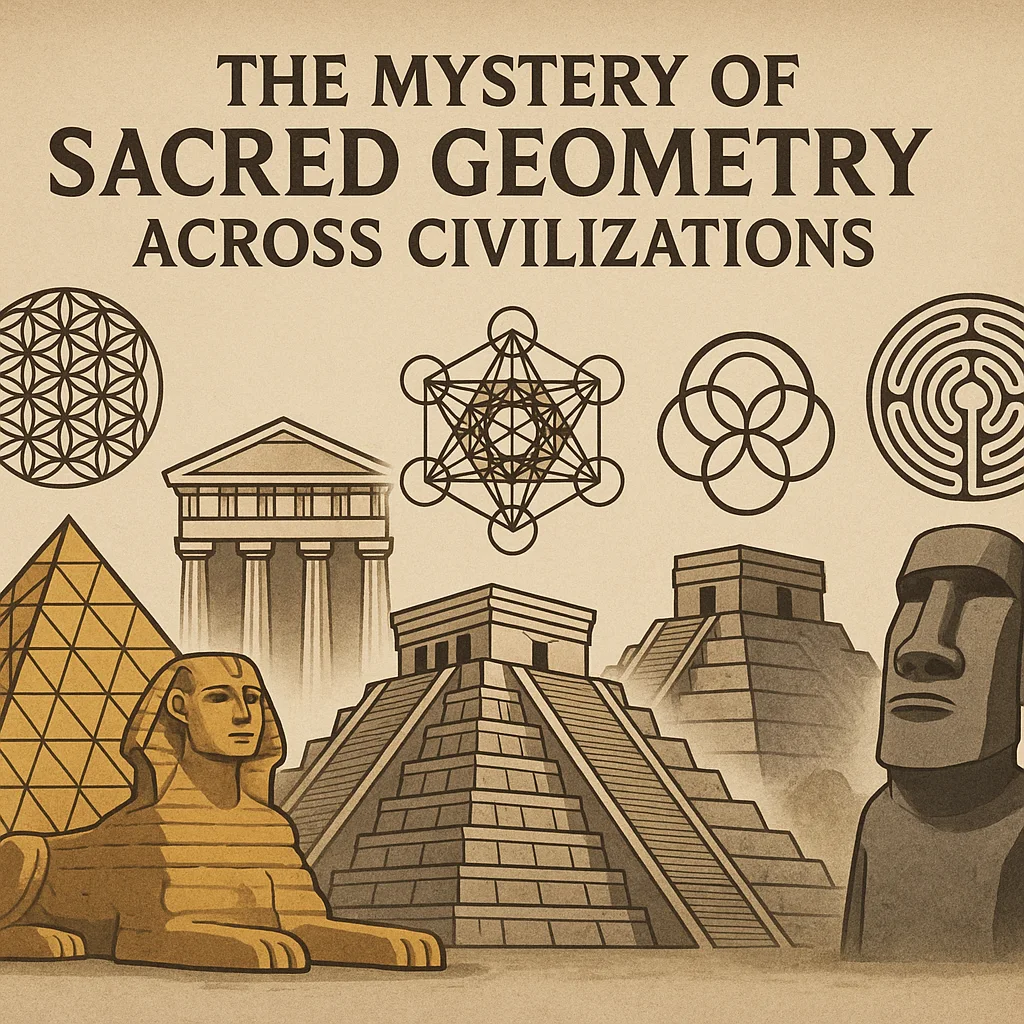
Although geometry is frequently taught in schools as a subject of lines, angles, and formulas, its roots go much beyond the blackboards in the classroom. Geometry has been revered throughout history and can be found in cathedrals, mosques, temples, pyramids, and even natural formations. This isn't just a coincidence. The idea that specific patterns, shapes, and proportions are universal keys to understanding the universe, life, and the divine is embodied in sacred geometry, as it has come to be known.
However, why did cultures that were separated by centuries and great distances—from Mesoamerica, India, and China to ancient Egypt and Greece—resort to the same geometric patterns? Why does sacred geometry continue to enthrall artists, architects, and spiritual seekers today, and what mysteries does it conceal?
1. What Is Sacred Geometry?
The symbolic and spiritual meanings attached to particular shapes and proportions are known as sacred geometry. It is thought that these patterns represent basic cosmic truths. Sacred geometry, in contrast to ordinary geometry, is about meaning rather than just measurement.
Key elements of sacred geometry include:
-
The Circle: symbol of unity, infinity, and wholeness.
-
The Triangle: symbol of balance, strength, and spiritual ascent.
-
The Square: symbol of stability, material order, and the earthly realm.
-
The Golden Ratio (φ ≈ 1.618): a proportion found in nature, art, and architecture that has long been associated with beauty and harmony.
-
The Flower of Life: an interlocking circle design said to represent the blueprint of creation.
Throughout history, these patterns were more than just decorative choices for civilizations. They were manifestations of divine order woven into the very fabric of reality, cosmic signatures.
2. Sacred Geometry in Ancient Egypt
Ancient Egypt was one of the few civilizations that truly embodied sacred geometry. For instance, the Giza pyramids are remarkably precisely aligned with astronomical events and the cardinal directions. Their proportions are cited by both academics and mystics as deliberate manifestations of cosmic principles.
-
The Great Pyramid’s proportions are thought to encode the value of π (pi) and the golden ratio.
-
Temples, such as Karnak, were built with precise geometric alignments to solstices and star systems.
-
The Eye of Horus symbol itself contains fractions that align with geometric divisions.
Geometry was not a neutral science in the eyes of the Egyptians. It was an expression of Ma'at, the cosmic order that ruled the world, and it was considered sacred knowledge.
3. Greece and the Philosophy of Numbers
The sacred perspective on geometry was passed down to and extended by the Greeks. The mathematician and philosopher Pythagoras held that proportions and numbers were the fundamental components of reality. His well-known theorem was merely one aspect of a larger philosophy that connected cosmology, geometry, and music.
-
Platonic solids—The icosahedron, cube, tetrahedron, octahedron, and dodecahedron were thought to be the basic units of the universe.
-
The golden ratio appeared in Greek architecture, such as the Parthenon, and in their exploration of natural patterns.
-
For Plato, geometry was “the language of the gods,” a way to glimpse eternal truths beyond the material world.
The Greeks merged mathematics with spirituality, creating a legacy that continues to shape Western thought.
4. India and the Sacred Mandala
Sacred geometry flourished in India as yantras and mandalas. These elaborate geometric patterns serve as both symbolic maps of the universe and tools for meditation, making them more than just works of art.
-
The Sri Yantra, made of interlocking triangles, represents the union of the divine masculine and feminine and the unfolding of creation.
-
Hindu temples are built on Vastu Shastra, a system of geometry and alignment believed to harmonize earthly structures with cosmic forces.
-
Buddhist mandalas, often circular with precise symmetry, serve as visual representations of the universe and aids in meditation.
Here, geometry became a bridge between the inner and outer worlds, guiding practitioners toward spiritual awakening.
5. China and the Harmony of Patterns
In China, geometry was less about monumental architecture and more about harmony in patterns and proportion.
-
Trigrams are arranged geometrically in the Bagua, which is used in Feng Shui and Taoist philosophy to balance energies.
-
Squares and circles were frequently featured in ancient Chinese designs, with the square standing for Earth and the circle for Heaven. Buildings such as Beijing's Temple of Heaven exhibit this.
-
Implicit geometric symbolism was also present in calligraphy, landscape architecture, and cosmological diagrams.
Sacred geometry was not only mystical in Chinese thought; it was also useful in architecture, medicine, and government.
6. Sacred Geometry in Islam
Islamic civilization brought sacred geometry to extraordinary levels of refinement in art and architecture. Since Islamic tradition discourages figurative representation, geometry became a primary way to express the divine.
-
Mosaics, tiling, and arabesques use repeating geometric patterns that suggest infinite creation.
-
Geometric harmony and accuracy are embodied in buildings like the Blue Mosque in Turkey and the Alhambra in Spain.
-
The geometry of Islamic art often conveys unity and infinity—reflecting Allah’s eternal nature.
This use of geometry was both intellectual and devotional, marrying science and spirituality into stunning visual forms.
7. The Americas: Geometry in Stone and Stars
Sacred geometry also appeared in Mesoamerican and Andean civilizations.
-
Equinoxes and other astronomical events are in line with the Mayan pyramids at Chichen Itza. Shadows on the steps create serpentine patterns during these moments—geometry as cosmic theater.
-
Despite their large-scale sacred design, the Nazca lines in Peru are still a mystery. They are geometric figures carved into the desert.
-
In order to incorporate spirituality into architecture, the Incas built Machu Picchu with careful geometric and astronomical alignments.
These civilizations used geometry as a means of connecting human life with celestial cycles.
8. Nature as Geometry’s First Teacher
The fact that nature itself contains these patterns is one reason why sacred geometry has a universal appeal:
-
Spirals in seashells and galaxies follow the golden ratio.
-
Honeycombs display perfect hexagonal geometry.
-
Snowflakes form unique but geometrically consistent six-fold symmetry.
-
Flower petals and seed arrangements often follow the Fibonacci sequence.
After noticing these recurrent patterns, ancient peoples came to the conclusion that geometry was a divine design rather than a human invention.
9. Geometry and Spiritual Psychology
Why does sacred geometry have such a strong spiritual and psychological influence? According to contemporary psychology, the human mind finds great appeal in symmetry and proportion, which evoke sentiments of harmony and order. Awe and transcendence are evoked by standing in front of pyramids, meditating on mandalas, or looking at cathedral windows.
As a result, geometry transcends the intellectual realm and becomes experiential, offering a clear route to transcendental states and a sense of oneness.
10. The Mystery That Endures
Sacred geometry is still mysterious even after centuries of study. Do these patterns convey more profound truths about reality itself, or are they just patterns that appeal to the human brain? Does the golden ratio's recurrence in sunflowers and galaxies indicate universal order or is it just a coincidence?
Sometimes, contemporary cosmologists and physicists follow in the ancients' footsteps by explaining the cosmos using geometric principles and mathematical symmetry. Sacred geometry's persistence across civilizations implies that it is not a coincidence, regardless of whether one views it as a cosmic blueprint or a spiritual metaphor.
Conclusion
Sacred geometry is a common theme throughout humankind's quest for meaning, from the pyramids of Egypt to the mandalas of India, from Islamic mosques to Mayan temples. It expresses wonder at the patterns found in nature, a wish to conform to cosmic order, and the conviction that shapes and numbers hold secrets about the world.
Sacred geometry can be thought of as humanity's first universal language, a means of verbal communication with the divine. It reminds us that harmony, beauty, and proportion are reflections of the order woven into reality itself rather than human inventions. It is as mysterious as knowledge.
Sacred geometry still serves as an inspiration for spirituality, art, and design in the modern digital age. It conveys the same age-old message: the universe is a geometric song that is just waiting to be discovered, not chaos.