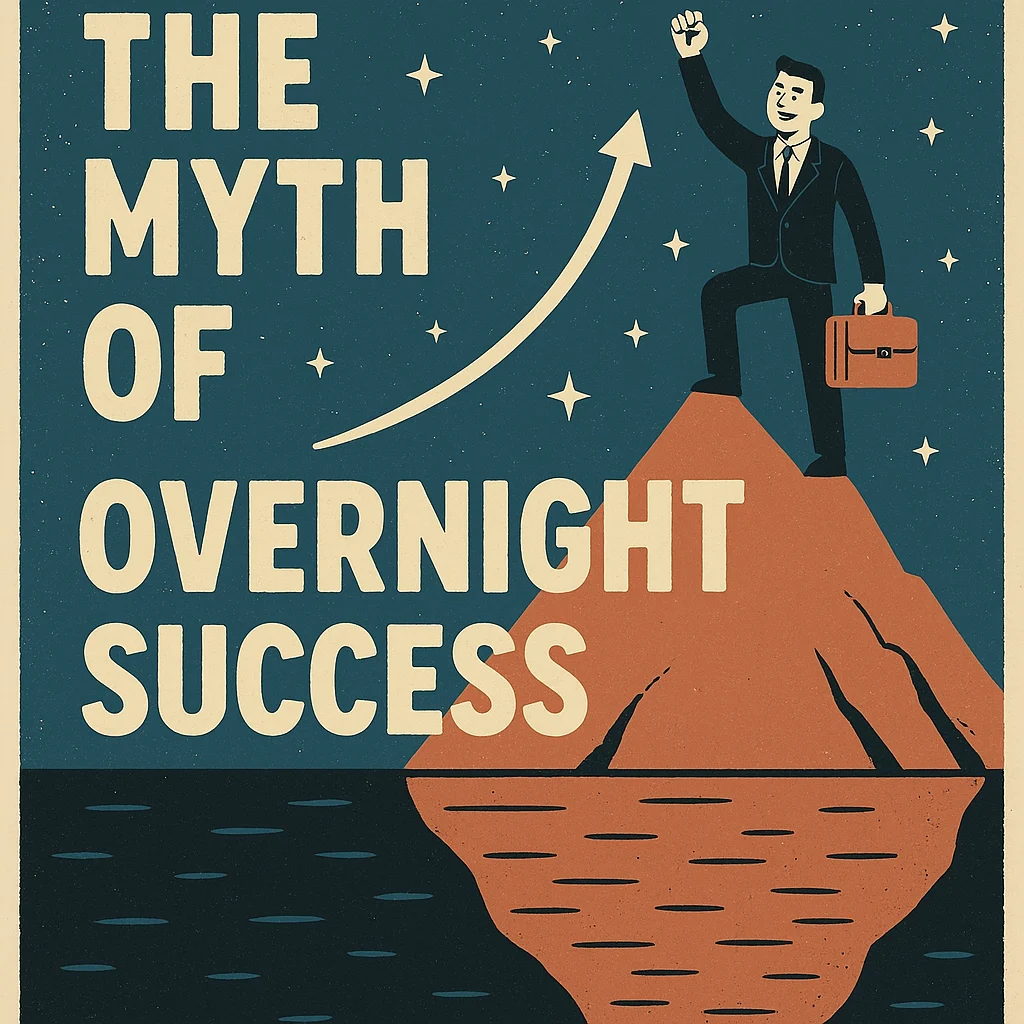
It's simple to think that success happens overnight in a society that exalts viral fame and immediate recognition. Stories of young entrepreneurs who "made it" in a year, artists who "blew up" after just one video, or startups that "exploded" after launch abound on social media.
However, behind every tale of overnight success is an unseen mountain of years of perseverance, failure, hard work, and self-doubt.
The truth? Overnight success is a myth.
It’s not lightning striking out of nowhere—it’s a storm that’s been building for years.
1. The Illusion of Sudden Achievement
Highlight reels are the norm these days. We see people at their best on sites like YouTube, Instagram, and TikTok, not their journey.
We assume someone has found a secret shortcut when we witness them rise quickly. The thousands of hours they devoted to honing their craft, the rejections they faced, and the errors that molded their mastery, however, are not visible to us.
Every “overnight” success story has a hidden backstory of struggle.
-
J.K. Rowling Before Harry Potter was accepted, the book was rejected by twelve publishers.
-
Steve Jobs was let go from Apple before coming back to turn it into a multinational behemoth.
-
Vincent van Gogh sold only one painting in his lifetime but created over 2,000 works.
Their success wasn’t sudden — it was the culmination of years of preparation meeting the right moment.
“It took me 17 years and 114 days to become an overnight success.” — Lionel Messi
The illusion of overnight success is appealing because it hides the uncomfortable truth: mastery takes time.
2. Why the Myth Persists
The myth endures because it satisfies our need for speed and ease. Patience seems out of date in a fast-paced culture that is fixated on shortcuts and quick fixes.
We would like to think that there is a quick route to success, such as a single opportunity that transforms everything, a viral post, or a fortunate break.
But the real story of success is much less glamorous: it’s repetition, failure, and endurance.
The myth endures due to media narratives as well. Marketers and journalists condense intricate journeys into brief stories. Instead of "Decade of struggle, failed startups, and slow growth leads to eventual success," "Young founder becomes millionaire" sells better.
It’s not deceit — it’s storytelling. But it creates a dangerous standard that makes steady progress look like failure.
3. The Invisible Work Behind Every Breakthrough
The foundation of any "instant success" is unseen labor, the kind of labor that takes place off-camera, in silence, and without recognition.
-
The musician practicing in empty rooms.
-
The coder debugging until dawn.
-
The writer rewriting the same paragraph for the fifth time.
This invisible labor doesn’t make headlines, but it’s the foundation of mastery.
Consistency is more important for success than intensity. It's about making small, intentional progress every day rather than making big efforts once in a while.
The visible moment of recognition, not the years of unseen preparation, is what people mean when they refer to something as a "overnight success."
4. The Danger of Chasing Instant Results
Believing in overnight success creates toxic expectations. It convinces us that if we’re not succeeding fast, we’re failing.
This kind of thinking causes self-doubt, frustration, and burnout. People quit too soon because they believe their efforts aren't yielding results, but in actuality, they're just in the invisible stage of development.
The pressure for instant gratification is everywhere:
-
New creators expect viral fame in a month.
-
Startups expect profit in their first year.
-
Professionals expect promotions in record time.
But real progress doesn’t follow viral timelines.
Loss of depth is more dangerous than disappointment. We forfeit mastery when we strive for speed. We cease to acquire profound knowledge, engage in critical reflection, and make significant progress.
“The best things in life are grown, not built.”
Patience isn’t passive — it’s powerful.
5. Success Is Built on Failure, Not Luck
Every great success story is filled with failure — not as a detour, but as the main road.
Failure teaches resilience, sharpens skill, and clarifies vision. It’s the price of experience.
But because most people only share success, we rarely see how many setbacks came before it.
-
Thomas Edison failed thousands of times before inventing the light bulb.
-
Oprah Winfrey was fired early in her career for being “unfit for television.”
-
Walt Disney went bankrupt before founding his empire.
They didn’t get lucky — they got persistent.
Each failure was a lesson disguised as pain. Each setback was a foundation stone.
The value of struggle is lost when we romanticize instant success, and greatness is the result of struggle.
6. The Compound Effect of Small Efforts
Rarely is one big leap enough to achieve true success. It involves gradually compounding small, regular actions.
Like compound interest, tiny improvements grow exponentially if sustained.
A novel can be written in a year if you write 500 words every day.
You can increase your skill level by 37 times in a year by making 1% progress every day.
Over many years, a small amount of regular savings can accumulate wealth.
The compound effect rewards patience and punishes haste.
The majority of people give up in the beginning, when the results are not visible. However, it seems that those who persevere long enough to reach the compounding phase have "succeeded overnight."
The truth is, they simply didn’t stop.
7. The Role of Timing and Opportunity
While hard work and patience are essential, timing also matters.
There are instances when a person's work perfectly fits a cultural moment, such as a new trend, social change, or technological advancement. That alignment creates rapid recognition.
But even timing rewards the prepared.
If opportunity is the spark, preparation is the fuel.
Although you cannot foresee when your time will arrive, you can make sure you are prepared. And years of unseen preparation are necessary to be ready.
“Luck is what happens when preparation meets opportunity.” — Seneca
8. The Psychological Cost of Comparison
Comparison is constant and easy with social media. We forget that we're comparing chapter one to someone else's chapter twenty when we evaluate our sluggish progress against their highlights.
This illusion creates anxiety, impatience, and even self-contempt.
We start to believe that our path is too slow, our effort too small, or our dreams too unrealistic.
However, each timeline is different. It's like comparing seeds when you compare your journey to others'; one may bloom in weeks, while another may take years. With care, both can grow into forests.
The antidote is perspective. Focus less on pace and more on direction.
Progress is about sticking to your course long enough for results to appear, not about speed.
9. Redefining Success as Mastery, Not Recognition
If you want to free yourself from the myth of overnight success, redefine what success means.
Instead of chasing recognition, chase mastery.
Mastery is the profound fulfillment that comes from knowing you're getting better—not for praise, but for a reason. It's a slower, more subdued form of success, but it's far more satisfying.
Recognition can be taken away. Mastery cannot.
You become unstoppable when you prioritize growth over glory because your motivation is no longer dependent on approval from others.
10. The Power of Persistence in a Fast World
In a culture that rewards speed, persistence is rebellion.
It’s a radical act to stay committed to something for years without guaranteed results.
But the difference between dreamers and achievers is persistence. Persistent people learn, adapt, and keep going when things get tough, while others give up.
The world celebrates outcomes but forgets endurance.
Every breakthrough is the culmination of years of silent perseverance; it's like a thousand invisible steps that all appear at once.
Persistence doesn’t promise immediate results — it promises inevitable ones.
11. The Real Secret: Love the Process
The biggest secret of those who succeed is this: they love the process more than the prize.
They find joy in the work itself — not just in the result.
You stop keeping track of hours when you are passionate about your work. You no longer require outside approval. When others give up, you continue because the journey itself keeps you going.
Finding a life where your work feels meaningful every day, regardless of recognition, is the true definition of "overnight success."
12. The Slow Path Is the Real Path
In truth, success that lasts is always built slowly.
Resilience, wisdom, and depth are developed via the slow route. It teaches you how to deal with winning as well as how to win.
Because it is based on hype rather than habit, quick success frequently fails. Because it is based on skill, humility, and perseverance, slow success endures.
The best leaders, thinkers, and creators all went the extra mile. They were mastering timeless truths rather than following trends.
Conclusion: The Beauty of the Long Game
Overnight success is a fairy tale that sells fast, but the long game is the one that builds legends.
Every long-lasting success, whether in business, science, the arts, or personal development, is the result of perseverance, patience, and time.
Don't be envious of someone who appears to succeed overnight. Because their success will last, you should be envious of the person who builds steadily through obstacles, boredom, and uncertainty.
A moment is not success. It's a way of life.
And you know you've already "made it" when you come to love the process.