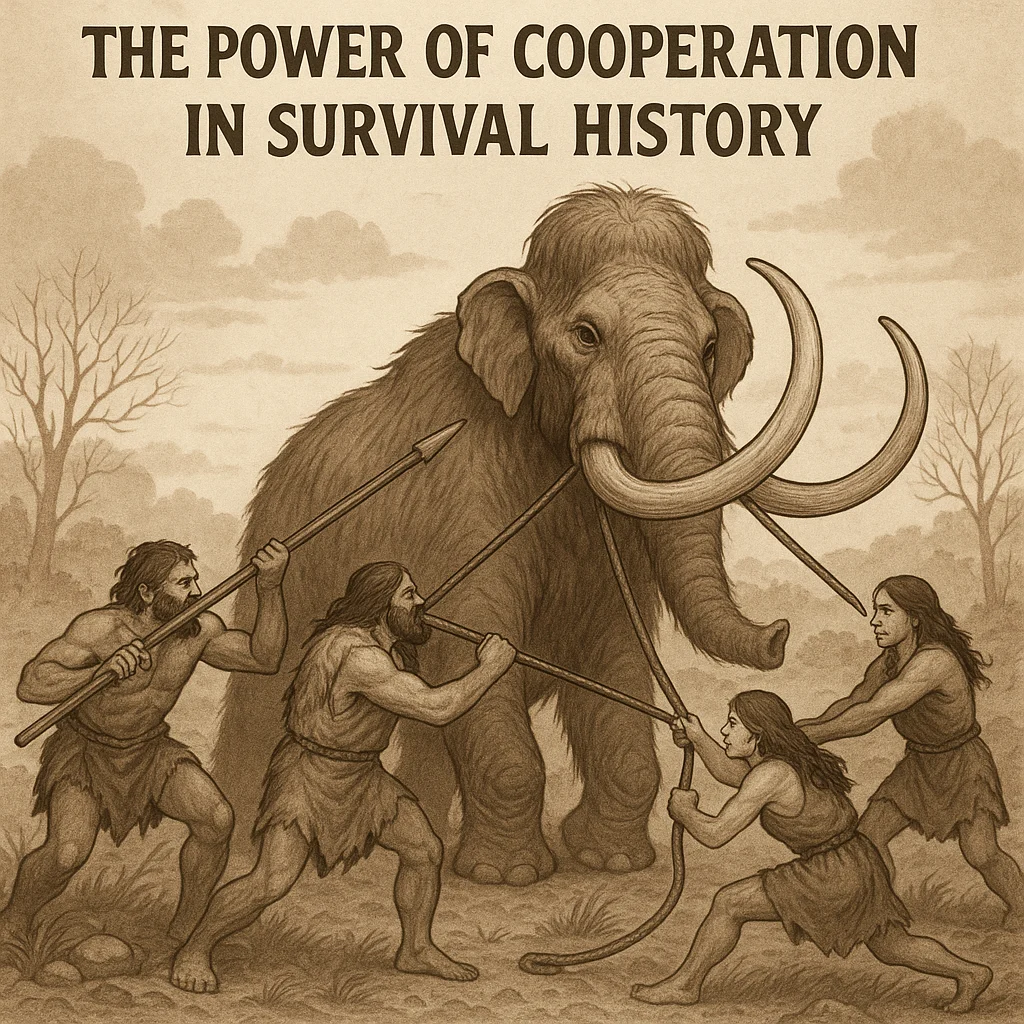
Introduction: Why Cooperation Matters More Than Strength
The first things that frequently spring to mind when we consider survival are intelligence, strength, or dominance. However, history demonstrates that human survival has depended more on cooperation than on force or even individual genius. From the earliest hunter-gatherer societies to contemporary global networks, humans have prospered due to their ability to cooperate rather than their prowess as runners or fighters.
Humans were able to outlive predators, natural disasters, and even other hominids because, in contrast to many other species, we were able to form alliances, share resources, and develop collective knowledge. Cooperation has always been our best chance of surviving, so it's not just a social grace.
From prehistoric times to the present, this blog examines how cooperation influenced human survival and explains why it is still the most potent factor in ensuring resilience.
1. Early Human Cooperation: The Foundation of Survival
Hunting and Gathering Together
In the prehistoric era, cooperation was essential to survival. It was impossible for one person to bring down large animals like aurochs, bison, or mammoths. Coordination was necessary for success; some hunters would wait to attack while others drove animals into traps.
Cooperation also helped with gathering. While one person might be an expert in identifying edible plants, another might be knowledgeable about medicinal herbs. Groups could diversify their diets and lower the chance of starvation or poisoning by working together.
Sharing Knowledge
Humans evolved the capacity to transmit knowledge from one generation to the next, unlike other animals. Instead of being invented every time, fire-making methods, tool use, and migration routes were learned, refined, and retained collectively. In an unpredictable world, this cooperative knowledge-sharing helped to make survival more predictable.
2. The Rise of Social Bonds and Trust
Beyond Blood Ties
Humans extended cooperation beyond kinship, whereas many animals only cooperate in small groups or within families. In order to create tribes and eventually entire communities, we formed alliances with unrelated people.
Greater groups were able to flourish as a result of this growth in trust. Everyone had a better chance of surviving if more people helped out with hunting, gathering, or defending territory.
Division of Labor
Efficiency was also produced by cooperation. Some made tools, cooked, or took care of children, while others hunted. Because of this division of labor, survival now relied on collective expertise rather than each person being an expert in every skill.
3. Cooperation in Competition: Outlasting Other Hominids
History demonstrates that there were other intelligent species on Earth besides Homo sapiens. The planet was once inhabited by hominids such as Neanderthals and Denisovans. However, we had the advantage because we could collaborate at a large scale.
-
Larger networks: Humans maintained larger tribes that were interconnected across geographical boundaries, whereas Neanderthals lived in small, isolated groups.
-
Trade and exchange: In order to build resilience during times of scarcity, we exchanged tools, concepts, and even food amongst groups.
-
Shared stories: Larger communities were brought together and inspired to act as a unit by myths, customs, and cultural practices.
Cooperation, not just intelligence, was the reason Homo sapiens outlasted their cousins.
4. Cooperation in Ancient Civilizations
Building Cities and Societies
Cooperation was essential to the transition from tribes to cities. Together, ancient societies in Mesopotamia, Egypt, and the Indus Valley constructed roads, irrigation systems, and colossal structures.
The Pyramids and the Great Wall of China could not have been built or organized by a single person. Thousands of people had to cooperate in order to accomplish these feats, driven by common objectives such as cultural identity, protection, or survival.
Trade Networks
Through trade, cooperation transcended national boundaries. For instance, the Silk Road served as a conduit for ideas, religions, and technologies in addition to commodities. While isolation frequently resulted in decline, civilizations that collaborated with their neighbors grew stronger.
5. Cooperation in Times of Crisis
Plagues and Pandemics
Cooperation was the difference between survival and collapse during the darkest periods in history. Communities that supported the sick, quarantined, and shared medications had a higher chance of surviving pandemics than those that broke up.
In addition to wreaking havoc on Europe in the 14th century, the Black Death spurred new kinds of collaboration, such as better public health systems and more robust urban governance.
Natural Disasters
Whether it was earthquakes, famines, or floods, survival depended on group reactions. Societies that established food-sharing networks and granaries, for instance, fared better during famines than those that relied solely on personal stockpiles.
6. War, Peace, and the Paradox of Cooperation
Ironically, the strength of cooperation is even demonstrated in conflict. In addition to having weapons, armies, coalitions, and empires were founded on people's capacity for cooperation, strategy, and selflessness.
However, long-term survival encouraged peaceful cooperation rather than ceaseless conflict. Civilizations were able to flourish far beyond what could be accomplished by conquest alone thanks to trade agreements, treaties, and cultural exchanges.
7. Cooperation in Modern Survival
The Industrial Revolution
Unprecedented levels of cooperation propelled the shift to industrial societies. Massive coordination was needed for factories, railroads, and telegraph systems, which changed not only economies but also society as a whole.
Global Cooperation Today
Survival in the twenty-first century is a worldwide issue, not limited to local tribes or nations. Global collaboration is necessary to address problems like resource scarcity, pandemics, and climate change.
This was made evident by the COVID-19 pandemic. Cross-border scientific cooperation resulted in vaccines in record time, demonstrating that teamwork is still our most effective defense against threats from around the world.
8. The Science Behind Cooperation
Evolutionary Biology
According to evolutionary theory, cooperation is not only ethical but also useful. Cooperative group members were more likely to survive and procreate than loners. Those with the ability to coordinate, trust, and share were favored by natural selection.
Psychology of Cooperation
This survival tactic is also reflected in human psychology. We perceive empathy, guilt, and justice as evolutionary mechanisms to preserve cooperation, not by chance. Selfishness or cheating frequently leads to social rejection, which lowers one's chances of surviving.
9. Lessons for the Future
Why Cooperation Is More Urgent Than Ever
The lesson of survival history is evident as humanity confronts global issues such as resource scarcity, mass migration, and climate change: no one country or person can survive on their own. Networks of cooperation and trust allowed our ancestors to prosper, and applying that lesson globally is essential to our future.
Balancing Competition with Cooperation
Innovation is fueled by competition, but competition on its own leads to collapse in the absence of cooperation. Humanity's survival in the upcoming major crises will depend on how well the two are balanced.
Conclusion: Survival Is a Team Effort
In retrospect, the tale of survival is not one of the most violent or the strongest. It is a tale of collaboration. Our greatest successes, from prehistoric hunters sharing food to international scientists rushing to halt pandemics, are the result of teamwork.
The lesson is timeless: when humans unite, we endure. When we fragment, we fall.
Collaboration is not only the key to survival throughout history, but it is also the only way for humanity to move forward.