Introduction
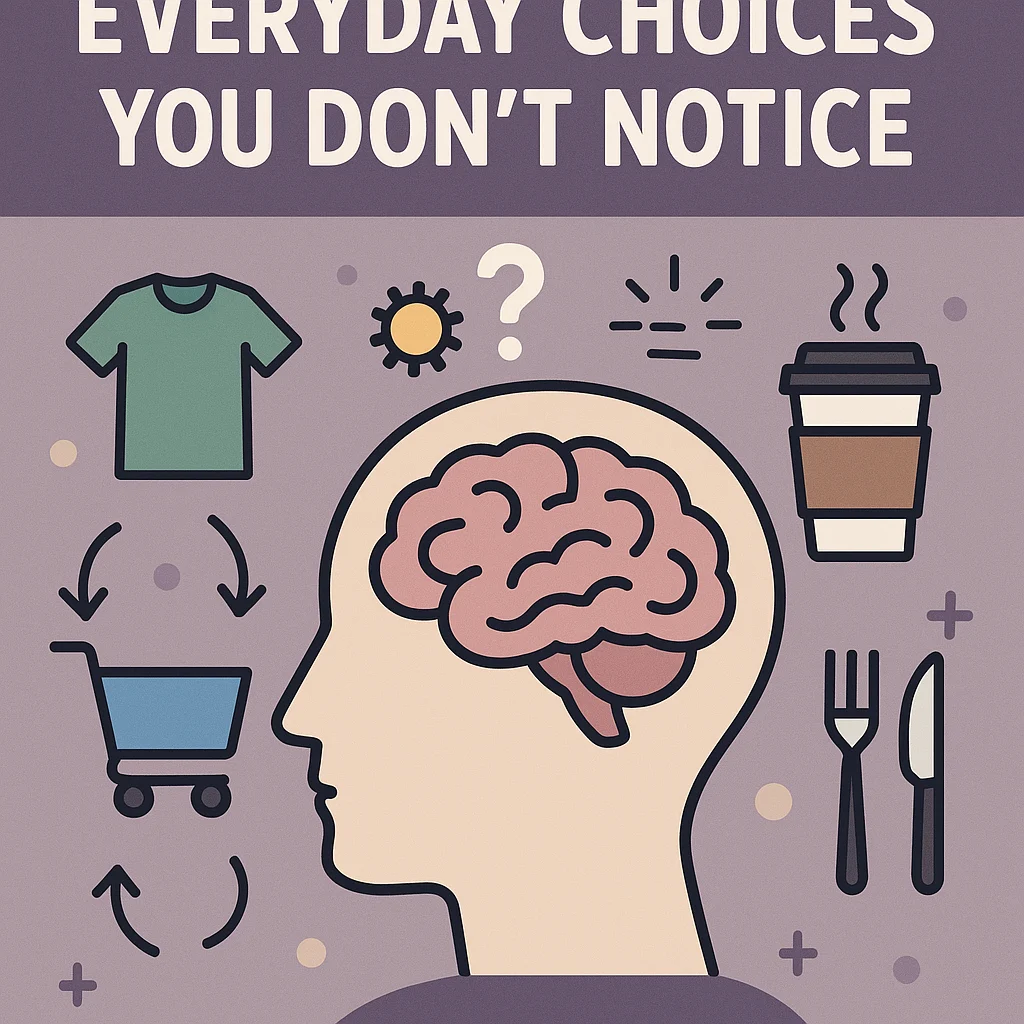
Have you ever entered a store with the intention of purchasing one item but ended up leaving with five? Or simply ordered your usual cup of coffee without giving it any thought? Although most of us believe we make deliberate choices every day, the reality is much more nuanced. Many of our decisions—what we eat, wear, click, or ignore—are influenced by subconscious psychological processes. This blog examines the unconscious psychological factors that influence your daily choices and how being aware of them can help you develop better routines and more intelligent thought processes.
1. The Power of Habit Loops
The idea of the habit loop—which consists of a cue, routine, and reward—was made popular by Charles Duhigg. The brain no longer contributes to complete decision-making once a habit is established. For this reason, you may brew coffee, check your phone, or brush your teeth mindlessly.
🧠 Why It Matters: Habits help your brain save energy. However, a habit can take precedence over conscious intention once it has developed.
Example: Because you're trained to react to the cue, you check your phone every time it vibrates, not because it's urgent.
Takeaway: Recognizing cues that trigger habits gives you the power to rewire them.
2. Cognitive Biases: The Shortcuts We Rely On
Every second, new information is added to your brain. It uses cognitive biases—mental shortcuts that facilitate speedy decision-making but frequently result in irrational outcomes—to deal with this.
Some common biases influencing everyday choices:
-
Confirmation Bias: You favor information that supports your existing beliefs.
-
Anchoring Bias: Your decisions are influenced by the first piece of information you see.
-
Availability Heuristic: You judge the likelihood of something based on how easily examples come to mind.
Example: Even though the "discounted" price is still high, you purchase a product on sale because your perception is anchored by the original price.
Takeaway: Being aware of biases reduces their power.
3. The Role of Social Proof
People are incredibly gregarious beings. Social proof is the idea that we frequently base our decisions on what other people are doing.
-
You choose a crowded restaurant over an empty one.
-
You buy a product with thousands of reviews.
-
You wear what's trending because it feels safe and accepted.
Example: Studies show people are more likely to reuse hotel towels when told “most guests do.”
🧠 Why It Matters: We feel less alone in our decisions when we see social proof. However, it can also hinder our ability to think for ourselves.
Takeaway: Ask yourself, “Would I still choose this if no one else did?”
4. Choice Overload and Decision Fatigue
There are countless options available to us in our world, from picking a Netflix series to selecting toothpaste. Due to decision fatigue brought on by this abundance of options, we either avoid making decisions or fall back on defaults.
Example: You're more likely to skip the gym or eat junk food after a long day—not because you lack willpower, but rather because you're mentally exhausted.
🧠 Why It Matters: Over time, your choices get worse the more decisions you make in a given day.
Takeaway: Minimize unimportant decisions to save mental energy for crucial ones (consider Steve Jobs' daily uniform).
5. Priming: Subtle Influences on Behavior
Priming is the process by which exposure to one stimulus, frequently unconsciously, affects how you react to another.
-
Reading words related to aging can make people walk more slowly.
-
Seeing the color red can increase alertness or urgency.
Example: Grocery stores use music to affect the speed of customers' purchases or place specific items at eye level.
🧠 Why It Matters: You are constantly being primed—by ads, environment, even color schemes.
Takeaway: Being aware of your surroundings makes it easier to fend off manipulation.
6. The Default Effect
When given multiple options, people tend to stick with the default setting—even if it's not optimal.
-
Default privacy settings
-
Default apps on your phone
-
Opting into subscriptions or services
Example: The rates of organ donation are substantially higher in "opt-out" nations than in "opt-in" nations.
🧠 Why It Matters: Defaults encourage you to make decisions without demanding all of your focus.
Takeaway: Dispute defaults. Check to see if they support your objectives.
7. Loss Aversion and Fear-Based Decisions
We are more afraid of losing than we are of gaining, according to behavioral economics. This loss aversion affects relationships and investments alike.
-
You keep a gym membership you don’t use.
-
You hoard items “just in case.”
-
You avoid quitting a job you dislike because you fear uncertainty.
🧠 Why It Matters: Fear of loss creates inertia and risk-aversion.
Takeaway: Reframe choices by considering possible gains rather than just losses.
8. The Illusion of Control
We love to believe we’re in control, even when outcomes are random.
-
Pressing the crosswalk button repeatedly
-
Blowing on dice before rolling
-
Picking “lucky” lottery numbers
This illusion of control makes us feel safe and capable in uncertain situations.
Takeaway: Realistic decision-making is enhanced and stress is decreased when uncertainty is accepted.
9. Emotions Trump Logic
Emotions have a big impact on our decisions, even when we believe we are acting rationally. Antonio Damasio, a neuropsychologist, discovered that people who had damage to the parts of their brains that process emotions had trouble making even simple decisions.
🧠 Why It Matters: Emotions serve as short cuts that facilitate speedy decision-making. However, they can also be deceptive.
Takeaway: Take a moment before acting on intense feelings. Think about the long-term effects.
10. The Influence of Identity
We often make choices that align with our self-image or the group we identify with:
-
A vegan avoids leather not just for ethics but identity.
-
A techie prefers certain brands not just for function but status.
Example: If you see yourself as a “productive person,” you’ll subconsciously choose actions that affirm that.
Takeaway: Your identity drives behavior. Redefine it consciously if needed.
Final Thoughts
Your life's path is shaped by innumerable small decisions you make every day. Even though many of these choices are made automatically, you still have some control over them. You can start making more deliberate decisions that are in line with your objectives and values by comprehending the psychology underlying them, including habits, biases, social influences, and more.
You don't need to control every choice you make. Better habits, fewer regrets, and a more satisfying life can result from even a slight increase in awareness.