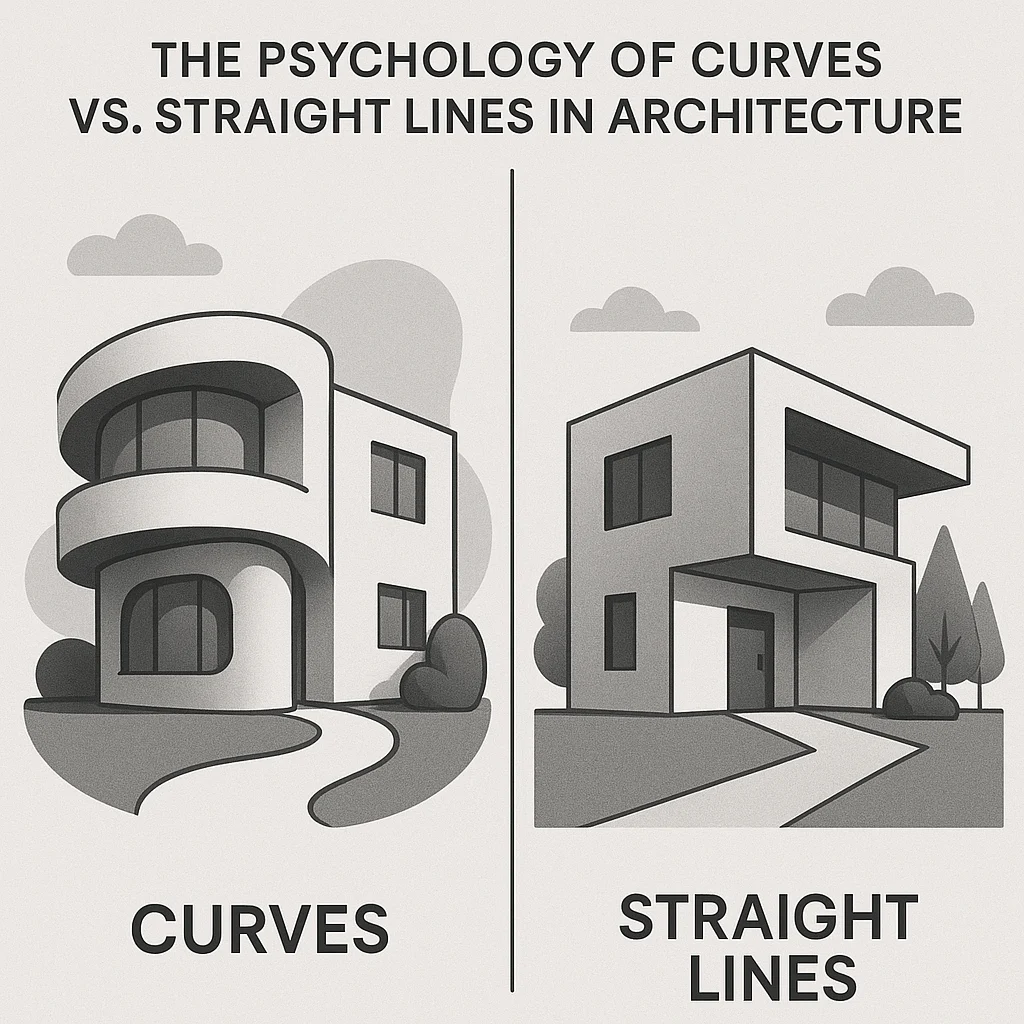
Architecture is more than just structures; it is the unspoken language that societies use to communicate their psychology, values, and goals. Each curve, angle, and line conveys a narrative. Some structures impose rigid symmetry and sharp edges, while others embrace fluidity and soft curves, evoking very different emotional reactions in their viewers.
In architecture, the argument between curves and straight lines is about more than just aesthetics. It concerns cultural meaning, human psychology, and how our behavior is influenced by our surroundings. The use of geometry in architecture, from historic temples to contemporary skyscrapers, reflects both pragmatic requirements and the form's subliminal influence on human cognition.
In this post, we'll look at how architects employ curves to affect perception, why they feel different from straight lines, and what this age-old conflict tells us about how people interact with their built environment.
Straight Lines: Order, Control, and Rationality
Straight lines dominate much of the man-made world. Roads, walls, and towers rely on geometry that maximizes efficiency and stability. Psychologically, straight lines evoke feelings of:
-
Structure and order: Predictability is reflected in rectilinear forms. A city layout that resembles a grid suggests logical control and planning.
-
Authority and dominance: Institutions and governments frequently prefer imposing, inflexible structures that bolster their authority. Think of New York's towering skyscrapers or Washington, D.C.'s neoclassical columns.
-
Simplicity and efficiency: It is simpler to measure, cut, and duplicate straight lines. They support mass production and the "form follows function" tenets of modernism.
Consider brutalist architecture, which consists of large, sharp concrete blocks with minimal ornamentation. Although these structures exude strength, they frequently come across as aloof or cold. Straight lines can give off an air of rigidity, reminding us of discipline and hierarchy instead of coziness.
Yet, they also represent humanity’s triumph over chaos—a reminder that we can bend nature to conform to our will.
Curves: Flow, Comfort, and the Organic
Curves convey a different message. There are curves everywhere in nature, including waves, hills, rivers, clouds, and even the human body, in contrast to straight lines, which are uncommon. Curves elicit psychological reactions like these because of their connection to nature.
-
Warmth and softness: Compared to sharp corners, rounded forms are more calming, friendly, and less intimidating.
-
Femininity and fluidity: Curves have been linked to fertility, mobility, and the divine feminine throughout history.
-
Creativity and imagination: Curvilinear areas evoke curiosity and playfulness because they feel more vibrant and dynamic.
Think about the flowing, nearly bone-like structures of Barcelona's Sagrada Família, designed by Antoni Gaudí. His organic architecture seems to have grown rather than been built. In a similar vein, Zaha Hadid's expansive futuristic designs favor flowing, sculptured areas over the rigid box.
Curves are soft-edged, unpredictable, and adaptive, just like life itself. Even in urban settings, they help us feel more connected to nature.
Neuroscience of Curves vs. Lines
What has been intuitively understood by architects for centuries—that people react emotionally to shapes—is supported by recent neuroscience research.
-
People overwhelmingly preferred curved objects over sharply angled ones, according to a 2013 study published in the Proceedings of the National Academy of Sciences. Participants who viewed curvilinear designs showed increased activation in the anterior cingulate cortex, a region associated with emotions and reward, according to brain scans.
-
Curves lessen a sense of danger. Perhaps because they resemble teeth, blades, or other threats from evolutionary history, sharp angles can evoke subtle feelings of caution.
-
Conversely, straight lines activate brain areas linked to control, reasoning, and problem-solving.
In other words: curves appeal to emotion, while straight lines appeal to reason.
This explains why straight lines convey professionalism or seriousness, while curved furniture frequently feels more comfortable. Architects carefully combine the two based on the mood they wish to achieve.
Historical Shifts Between Lines and Curves
Different civilizations leaned toward curves or straight lines depending on their worldview:
-
Ancient Greece & Rome: They regarded proportion, symmetry, and straight lines as representations of reason and divine order. Balance was communicated by grids, pediments, and columns.
-
Islamic Architecture: Islamic design frequently emphasized fluidity through domes, arches, and arabesques—expressing infinity and divine unity—despite its geometric precision.
-
Gothic Cathedrals: The eye was raised toward heaven by pointed arches and flowing rib vaults that combined linear discipline with upward, curving transcendence.
-
Baroque and Rococo Eras: In order to arouse emotion and overwhelm the senses, these styles reveled in curves, swirls, and ornamentation.
-
Modernism (20th Century): The straight line came back into vogue with Le Corbusier and the Bauhaus. Efficiency, function, and clarity were prioritized in minimalism.
-
Contemporary Architecture:Thanks to new materials and computational design, curves are now being embraced again. Famous buildings like the Beijing National Stadium, also known as the "Bird's Nest," combine organic flow and linear grids.
Each era’s geometry reflects its priorities: control, transcendence, emotion, or efficiency.
The Balance of Curves and Straight Lines
Although straight lines and curves are often thought of as opposites, architecture benefits greatly when they complement one another. Meaning is produced by the contrast alone.
-
Urban design: While amphitheaters, parks, and riverbanks offer softness, straight-line roads offer clarity.
-
Interiors: While curved seating areas promote relaxation and conversation, straight walls and desks suggest productivity.
-
Landmarks: The Eiffel Tower symbolizes elegance and human engineering by fusing graceful arcs with linear beams.
Humans are both logical and emotional, and the best architecture recognizes this. We want efficiency but also comfort; we want order but also beauty.
What Curves and Lines Reveal About Us
Ultimately, the preference for curves or straight lines is a mirror of cultural psychology:
-
Sharp geometry and straight lines are frequently associated with societies that are preoccupied with efficiency, control, and progress.
-
Societies that value harmony with nature, emotion, and spirituality lean into curves.
Neither is better by nature. Rather, the most prosperous settings acknowledge the dichotomy. Building functional societies requires the accuracy of lines, and curves serve as a gentle reminder of our humanity.
Conclusion: The Silent Psychology of Shape
Architecture is not neutral. Our subconscious is directly impacted by the choice of whether to use straight or curved lines when building. While soft curves soothe and inspire, sharp corners may convey authority. Collectively, they constitute the visual discourse of civilization.
Take note of the geometry surrounding you the next time you stroll through a city. How do you feel about the buildings? Do the angular skyscrapers make you feel awed but detached? Do you feel at ease under an old cathedral's arches? Do curved bridges or flowing museums spark your imagination?
A timeless truth is revealed by the psychology of curves versus straight lines: our built environment shapes minds just as much as it shapes space.