Introduction: A New Era of Museums
For a long time, museums have been thought of being peaceful, contemplative places devoted to honoring artistic legacy, conserving history, and fostering curiosity. However, immersive museums have become a new trend in recent years. These are venues for participation as well as observation. Visitors are exploring virtual worlds, engaging with VR objects, touching projections, and taking Instagram-worthy backdrops rather than standing behind velvet ropes.
Immersion places are becoming more and more popular, from Van Gogh Alive to TeamLab Planets Tokyo to the Museum of Ice Cream to Illusion Museums worldwide. Tickets are sold out fast. They attract younger audiences. Neon rooms, mirror hallways, and illuminating installations abound on social media.
But this rise brings a debate:
Do immersive museums improve cross-cultural understanding, or are they merely the next big thing in commercial entertainment?
The contemporary development of cultural places revolves around this subject.
What Exactly Are Immersive Museums?
An immersive museum changes the way visitors interact with exhibitions by combining art, technology, sound, movement, and storytelling. These areas frequently consist of:
-
AR/VR technology
-
Interactive digital screens
-
Projection mapping
-
Themed rooms and scenic installations
-
Sensor-based responsiveness to movement or sound
-
Social media–friendly environments
Certain immersive museums use digital animation and light to reimagine old works of art. Others are made only for fun and capturing pictures.
Both the general public and professionals react differently to this diversity.
Why Immersive Museums Are So Popular
Immersion museums' success is not coincidental; rather, it is a reflection of broader changes in behavior, technology, and society.
1️⃣ A Generation Driven by Experience
Experiences are more important to younger generations than material possessions, particularly Gen Z and Millennials. In response to this inclination, museums are creating spaces that are more like expeditions than lectures.
2️⃣ Social Media Amplification
Art is becoming a shareable commodity thanks to Instagram, TikTok, and Snapchat. Millions of people can see an eye-catching display in a matter of hours, creating free advertising.
These museums serve as both cultural destinations and educational opportunities for a large number of people.
3️⃣ Technology Feels Familiar
For an audience that is digitally native, interactive screens, virtual reality headsets, and projection art seem natural. In contrast to captivating multimedia storytelling, traditional museum plaques could look antiquated.
4️⃣ Accessibility and Inclusiveness
For people who are intimidated by classical art, immersive museums might be more approachable. Enjoying whirling colors, motion-sensitive displays, or whimsical illusions doesn't require a comprehensive understanding of art history.
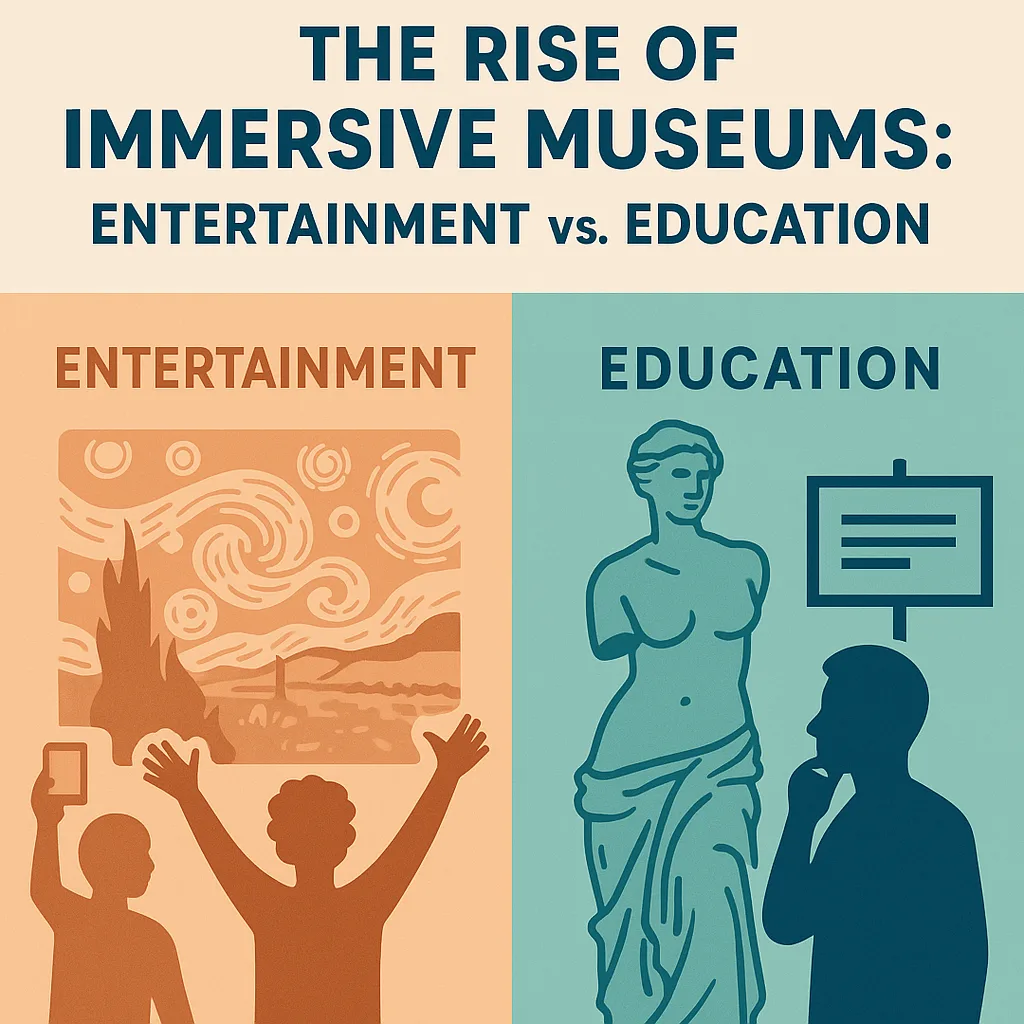
Entertainment vs. Education: The Core Debate
Cultural scholars and traditional museum curators bring up important issues:
If museums prioritize fun over learning, do they lose their cultural purpose?
Immersive museums often balance two goals:
|
Educational Purpose |
Entertainment Purpose |
|---|---|
|
Teach and preserve history, culture, and art. |
Attract visitors by making exhibits fun and visually appealing. |
|
Encourage deep reflection and curiosity. |
Provide excitement, novelty, and shareable media moments. |
|
Intellectual, informational engagement. |
Emotional, sensory engagement. |
Both are correct, but when amusement takes precedence over education, there is a contradiction.
When Immersive Museums Support Learning
Not every immersive setting is superficial. In fact, many improve education by increasing the memorability of the material. For instance:
✔ VR simulations allow visitors to walk inside ancient civilizations
✔ Projection mapping helps explain scientific concepts visually
✔ Interactive storytelling increases retention and curiosity
✔ Multisensory experiences support different learning styles
Cognitive science supports this shift:
Learning is enhanced more by active interaction with the subject than by passive observation.
Additionally, museums can reach new audiences with an immersive approach, such as kids who would be disinterested in traditional galleries.
When Immersion Becomes Just Entertainment
In particular, "Instagram museums" are the subject of criticism. These installations frequently consist of:
-
Designed primarily for photo backdrops
-
Lacking historical or cultural context
-
Focused on novelty rather than storytelling
They can feel less like cultural institutions and more like theme parks.
This trend raises concerns:
Do museums now prioritize social media appearances over educational content?
The learning opportunity—the real purpose of a museum—may be missed if an immersive exhibit doesn't offer depth or context.
The Economic Factors Behind the Shift
Immersion museums function as businesses and are frequently supported by private donations. Traditional museums mainly depend on donations and government support, but immersive environments can:
-
Charge higher ticket prices
-
Sell branded merchandise
-
Generate viral marketing for free
Immersion installations that are successful increase tourist and income, drawing business investors and local planners.
But there are concerns with this commercial model:
-
Will culture become pay-to-experience?
-
Will entertainment value come at the expense of historical context?
-
Will conventional museums find it difficult to make ends meet?
Balancing the Two: A New Hybrid Museum Culture
It's possible that the future will involve combining both sides rather than picking one.
Museums are already finding middle ground:
-
Immersion technology is being used by traditional museums to improve displays (e.g., hologram guides, AR-enhanced artifacts).
-
Immersion environments that use digital narration, guided tours, and narrative to provide instructional content
Some examples of successful hybrids include:
🖼 The Louvre’s interactive digital installations
🌌 Smithsonian VR space exploration exhibits
🎨 Interactive projection rooms in contemporary art museums
This demonstrates that learning may be improved without compromising enjoyment.
What Visitors Really Want
Research suggests museumgoers are seeking:
-
Meaningful connection to culture
-
Experiences that feel personal and participatory
-
Environments that encourage curiosity
-
A blend of fun + education
In summary, visitors seek edutainment, or education combined with entertainment.
Minimal Bullet-Point Summary
-
IImmersion museums produce participatory cultural experiences through the use of technology.
-
They increase tourism and draw in younger audiences.
-
The question of whether they put amusement before education is up for debate.
-
The best outcomes occur when immersion complements learning rather than replaces it.
-
The future of museums is being shaped by a hybrid paradigm.
Conclusion: A New Definition of Museums
Immersion museums are broadening the notion of what a museum may be, not taking the place of regular museums.
They make culture more approachable, fascinating, and applicable to the modern world. However, museums must continue to serve the dual purposes of teaching and preservation.
The solution lies in balance:
Entertainment opens the door.
Education gives the visit meaning.
Museums will continue to change themselves as technology advances, becoming dynamic cultural experiences that inspire the future while preserving history rather than stagnant archives of the past.