Introduction: A Shift in What Employers Value
A college degree was considered the key to a secure and lucrative profession for many years. Diplomas were utilized by employers as a stand-in for intelligence, discipline, and employability. However, the hiring environment is changing more quickly than before.
The degree-first mentality is becoming less prevalent in the digital age, when new technologies appear every year, abilities change quickly, and information becomes obsolete in a matter of months. Rather, skill-based recruiting is becoming more common. Employers are starting to focus more on your abilities than your educational background.
Driven by the realities of contemporary work, this change is more than just a trend; it is a reinvention of career strategy. The future belongs to people who can learn, adapt, and use talents in real time as automation, artificial intelligence, and global competitiveness transform industries.
The Old Paradigm: Degrees as Gatekeepers
Education was a direct route to work during the majority of the 20th century. A bachelor's degree was almost always a prerequisite for "good" positions and was a show of competence. Because degrees were effective filters, employers used them as stand-ins for talents, particularly in a time when digital proof of knowledge, online portfolios, and LinkedIn profiles were nonexistent.
But this system had flaws:
-
Degrees don’t guarantee practical ability. Many graduates enter the workforce without the hands-on skills needed for their roles.
-
Education costs skyrocketed. Student debt burdens soared, leaving millions trapped in financial stress without a proportional career payoff.
-
Access remained unequal. For those without the resources to attend college, many career paths were effectively closed, regardless of talent.
This dependence on formal schooling eventually led to the development of a strict and exclusive system that prioritized credentials over aptitude. However, as industries changed and new technology upended established processes, employers started to recognize the discrepancy between what was taught at colleges and what was needed for actual jobs.
The Spark of Change: The Skills Gap
The skills gap—the widening difference between what employees know and what employers require—was the driving force behind skill-based recruiting. Even though millions of job seekers are still unemployed, over 40% of companies report having trouble finding applicants with the necessary technical or soft skills, according to surveys by the World Economic Forum and McKinsey.
Why is there a discrepancy? because academic institutions are unable to keep up with the rapid evolution of the modern economy. Although ideas may be covered in a four-year degree, industries now require instant application.
For example:
-
Tech companies value coding proficiency over computer science diplomas.
-
Startups seek creative problem-solvers who can pivot quickly.
-
Marketing firms prize data literacy and storytelling, not necessarily MBAs.
Skills-first recruiting, a concept where your abilities are more important than your degree, was made possible by this rising realization.
The Rise of Skill-Based Hiring: A Global Trend
In recent years, major corporations have begun to dismantle degree requirements altogether.
-
Apple, Google, and IBM have all made it clear that a four-year degree is no longer necessary for many of their positions.
-
According to LinkedIn data, job posts that prioritize "skills" or "experience" over "degree required" are steadily increasing.
-
In 2020, the federal government of the United States formally transitioned to hiring for many civil service positions based on skills by a presidential order.
The tech industry is not the only one affected. The emphasis is shifting to competency—verified by portfolios, certifications, tests, or real-world experience—in a variety of fields, including logistics, design, and healthcare.
Learning has become more accessible because to platforms like Coursera, Udemy, Skillshare, and Google Career Certificates, which enable students to get employable skills without the need for formal degrees. The monopoly held by the gatekeepers is eroding.
Degrees vs. Experience: A False Binary
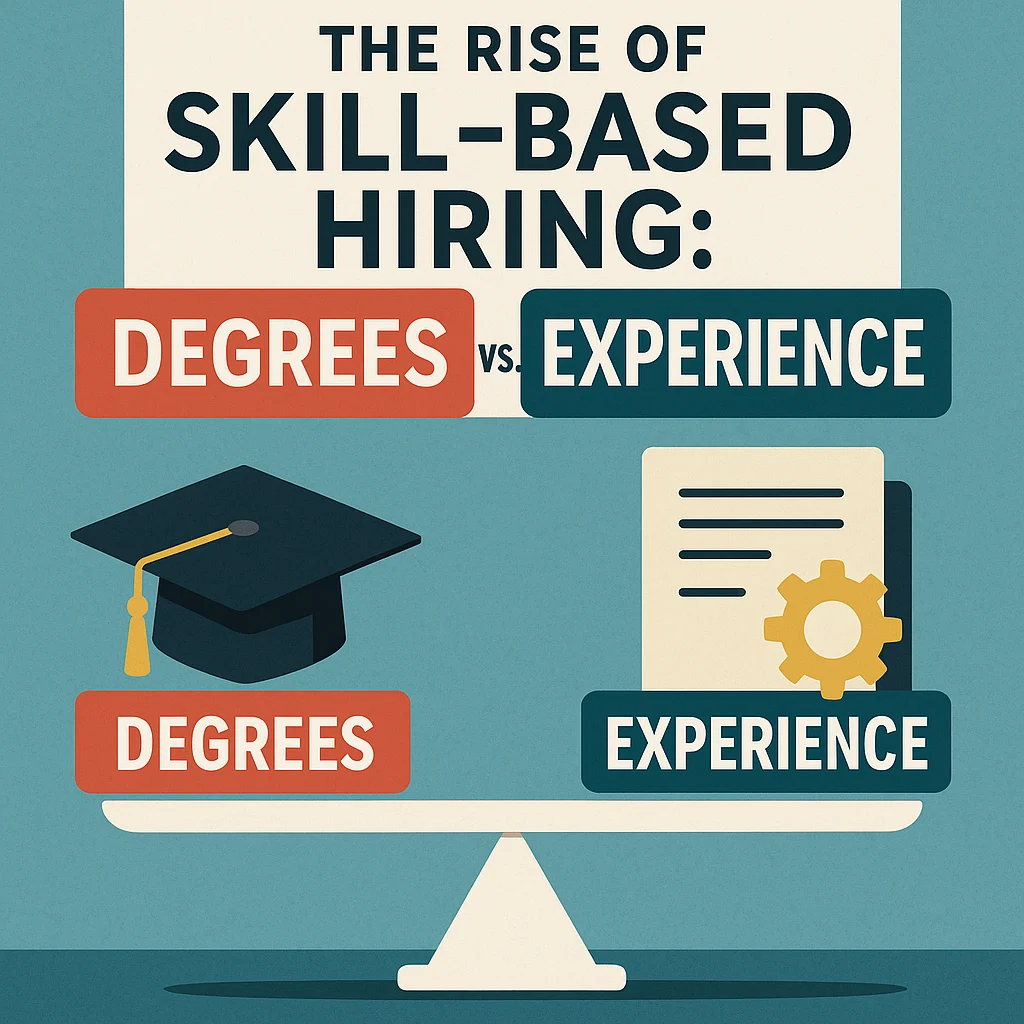
Although it would be easy to characterize the argument as a conflict between degrees and experience, the truth is more complex. Both are valuable, but the ratio is changing.
1. Degrees provide foundational knowledge and credibility.
They impart theory, discipline, and critical thinking. Because of regulations and safety concerns, formal education is still necessary in professions like engineering, medicine, and law.
2. Experience builds adaptability and applied skill.
Exposure to the real world fosters creativity, problem-solving skills, and resilience—qualities that are becoming more and more valued in fast-paced fields like technology, journalism, and entrepreneurship.
The crucial realization is that abilities serve as a link between theory and practice. The most qualified applicants combine both formal education to comprehend systems and practical experience to make them function.
However, when given the option, most companies now place a higher value on proven competence than academic background. A portfolio demonstrates proof, whereas a degree indicates potential.
The Tools of the New Hiring Era
Technology is the driving force behind skill-based recruiting. Employers may now effectively match talent and directly analyze talents thanks to tools that were previously unavailable.
Here’s how it’s happening:
-
Digital portfolios and GitHub repositories allow professionals to showcase work in real-time.
-
Online skill assessments—like those on LinkedIn or HackerRank—verify technical abilities objectively.
-
Micro-credentials and badges validate specific competencies quickly and affordably.
-
AI-driven recruitment systems can analyze candidates’ practical fit beyond traditional resumes.
This data-driven strategy lessens prejudice and offers non-traditional, self-taught professionals an equal opportunity to compete. The level of the playing field is increasing.
Why Employers Prefer Skills Over Degrees
From an employer’s perspective, skill-based hiring offers several advantages:
-
Faster onboarding: Candidates who already possess the necessary skills require less training.
-
Higher performance: Measurable competence often predicts success better than credentials.
-
Wider talent pool: Removing degree barriers opens access to millions of capable, non-traditional workers.
-
Greater diversity: It promotes inclusion by focusing on merit and ability rather than socioeconomic background.
It basically brings hiring into line with business realities. Businesses require doers, not just theorists, when the market shifts suddenly, as it did during the pandemic.
The Rise of Alternative Credentials
In place of degrees, new forms of credentialing are emerging:
-
Bootcamps like General Assembly, Flatiron School, and Le Wagon train job-ready developers in months.
-
Nanodegrees from Udacity and Google validate skills in AI, UX, or data analytics.
-
Industry certifications (AWS, Adobe, CompTIA) are becoming standard benchmarks for technical roles.
These programs are practical, lean, and in line with the needs of the industry today. More significantly, they represent a shift away from one-time degrees and toward ongoing education, where professionals will upgrade their skill sets on a regular basis.
The Employee’s Perspective: Freedom and Responsibility
For workers, skill-based hiring is both liberating and demanding.
It eliminates conventional obstacles, enabling self-taught programmers, designers, and artists to compete with those with degrees. Initiative, inquiry, and outcomes are rewarded. However, it also places more of the responsibility for learning on the individual.
Education is a lifelong process in a skill-driven economy. Workers must constantly adapt and upskill in order to stay employable. Those who don't run the danger of being outdated will prosper; those who embrace lifelong learning will.
Empowerment is the benefit. As long as they can demonstrate their worth, self-taught developers, YouTube-taught filmmakers, and certified data analysts can now command the same respect as university graduates.
The Future of Work: Hybrid Hiring Models
Hiring in the future will probably combine the two. While talents will be the universal currency of employability, degrees will still be valuable for some sectors.
We can expect to see:
-
Hybrid credentials: Combining formal education with skill-based certifications.
-
Skill passports: Portable, verifiable records of a person’s abilities across platforms.
-
AI-driven career maps: Guiding workers to learn the right skills for emerging roles.
The emphasis will shift from what you studied to what you can learn next.
Conclusion: From Credentials to Competence
An important development in the history of employment is the emergence of skill-based hiring. Redefining what it means to be qualified is more important than simply hiring differently.
Although degrees are still important, they are no longer the sole or even the greatest measure of potential. Adaptability, inventiveness, and ongoing learning are now the real indicators of success in a world that is changing quickly.
Employers can now access a more varied and extensive talent pool thanks to this evolution. For employees, it represents both a challenge to continue developing and freedom from antiquated barriers.
Those that demonstrate their value through expertise, effort, and performance rather than relying solely on credentials will have the advantage in the future.
In the new world of work, the diploma may open doors—but skills keep them open.