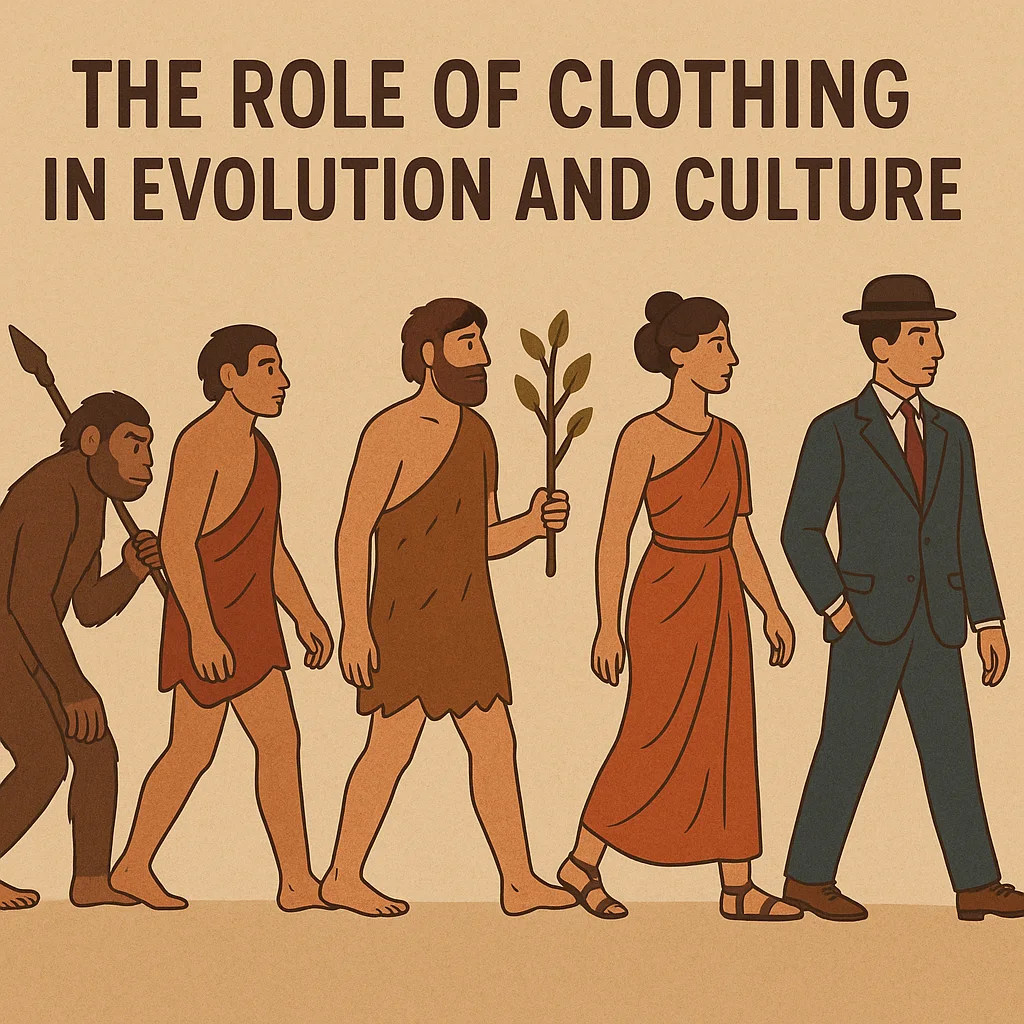
Introduction: More Than Just Fabric
Clothing may initially appear to be a superficial addition to human existence—a fashion statement or a protective layer. However, clothing is much more than just a piece of cloth worn around the body. It is a social signal, a cultural canvas that represents our identities as individuals and as societies, and a marker of evolution.
Clothes are technologically produced rather than biologically inherited, in contrast to fur or feathers in the animal kingdom. It is special because it is one of the oldest and most widely used inventions in human history. Through design and symbolism, clothing conveys tales of surviving in hostile environments, integrating into communities, and using creativity.
From the earliest animal hides to the modern global fashion industries, this blog examines the dual role that clothing has played in human evolution and culture, helping to physically, socially, and symbolically shape our species.
Clothing and Evolution: From Survival to Adaptation
1. Protection Against the Elements
The ability to survive in a variety of climates was one of clothing's most direct evolutionary functions. Humans, in contrast to most animals, are comparatively hairless and susceptible to temperature extremes. An adjustable layer of protection was offered by clothing:
-
Cold Climates: Humans were able to migrate into Siberia, ice-age Europe, and other places thanks to furs and animal skins.
-
Hot Climates: In Egypt, loose, breathable materials like linen provided protection from the sun and heat.
-
Environmental Hazards: apparel that protects against insects, thorns, and uneven ground.
Because of its adaptability, clothing allowed humans to live in almost every ecological niche on the planet.
2. The Human Body and Clothing Co-evolution
Human biology was also impacted by clothing. Natural body hair dwindled over generations as people became more dependent on clothing for warmth. Depending on where groups lived, the skin adjusted to varying degrees of sun exposure, with melanin balancing protection and vitamin D absorption.
Clothes acted as an extension of our skin, a "second skin" that changed more quickly than biology.
3. Tools, Sewing, and the Evolution of Dexterity
Making clothes required new equipment and abilities. The development of weaving techniques and bone needles promoted fine motor skills and hand-eye coordination. In addition to being useful, these advancements increased cognitive abilities and prepared the way for future human innovation.
Clothing as a Marker of Identity and Community
1. Group Belonging
Clothes have served as a symbol of belonging for both ancient tribes and contemporary nations. Members of one group were distinguished from others by their unique dress codes, patterns, or colors. This aided in strengthening mutual respect and trust within a group.
Examples include:
-
Tribal markings: Specific furs, feathers, or body coverings.
-
Military uniforms: Symbolizing unity and discipline.
-
Religious garments: From robes to turbans, signaling shared beliefs.
We have always used clothing to express who we are and are not, as well as to be both personal and communal.
2. Status and Hierarchy
Clothing soon became a status symbol. Wealth and status were conveyed through materials, colors, and designs. Laws even restricted who was allowed to wear particular textiles in many ancient societies:
-
Roman Empire: Only emperors and other elites were allowed to use purple dye.
-
Medieval Europe: Silk and other luxuries were restricted to the nobility by sumptuary laws.
-
Ancient China: The emperor was the only one to use dragon motifs.
Clothing was not just functional but political, a visible hierarchy stitched into fabric.
The Cultural Role of Clothing
1. Ritual and Spirituality
Clothes have profound symbolic meaning in all cultures. It is interwoven with the customs of marriage, birth, and death. Ceremonial robes, black funeral garments, and white wedding gowns demonstrate that clothing is a means of meaning rather than just a means of protection.
From the monk's robe to the priest's vestments, religious attire symbolizes humility and devotion. Many people believe that clothing serves as a conduit between the divine and the human.
2. Expression and Creativity
Human creativity developed along with evolution. Clothing evolved into a kind of art that expressed creativity, culture, and uniqueness.
-
Patterns and embroidery told stories of heritage.
-
Colors conveyed emotions, power, or spirituality.
-
Fashion trends reflected shifting values and aspirations.
Unlike survival-driven uses, cultural clothing highlights humanity’s capacity for symbolism and self-expression.
3. Resistance and Protest
Another way to express defiance is through clothing. Fashion frequently turns into protest, from suffragettes who wore white to symbolize purity and rights to contemporary activists who wear slogan-emblazoned T-shirts. Subtle decisions, such as defying conventional dress codes, can represent opposition to oppression or authority.
Clothing in the Evolution of Society
1. Trade and Economy
The need for textiles influenced economic development. The Silk Road, which connected Asia and Europe, was started by silk from China. Trade empires and the Industrial Revolution were powered by cotton. Textiles were frequently at the forefront of technological advancement, from mechanized looms to spinning wheels.
Clothing, therefore, was not only about survival or status—it was a central force in global exchange.
2. Colonialism and Power
In colonial interactions, clothing was important. Local identities were undermined when Western clothing was imposed by European colonists as a symbol of "civilization." Concurrently, colonists drew clothing into exploitative systems by extracting resources like cotton and indigo.
However, clothing was also reclaimed; colonized peoples blended tradition and modernity by adopting Western styles to demonstrate their independence.
3. Industrial and Modern Fashion
Clothing became mass-produced instead of handmade as a result of industrialization. Standardized sizing, low-cost textiles, and ultimately worldwide fashion were introduced by factories. Accessible clothing also became commodified, resulting in waste, consumerism, and trend cycles that continue to this day.
The Psychological Role of Clothing
1. Self-Perception
Our perception of ourselves is altered by our attire. This is referred to as "enclothed cognition" by psychologists. Formal clothing increases confidence, and lab coats make people more attentive. Clothes influence how we see ourselves and serve as more than just signals to others.
2. Social Perception
Sometimes unfairly, but always powerfully, we make snap judgments about other people based on what they wear. Before words are spoken, clothing conveys messages that shape perceptions of identity, competence, and dependability.
3. Gender and Identity
Although clothing has historically been associated with gender roles, it can also be used to redefine them. In discussions about gender fluidity today, fashion is essential because it enables individuals to express their identities outside of strict conventions.
Clothing in the Modern Age: From Necessity to Luxury
Clothes are more than just a means of survival in our world. While luxury brands transform clothing into status symbols worth thousands of dollars, fast fashion brings cheap trends to billions.
At the same time, clothing raises urgent questions:
-
Sustainability: The fashion industry is among the largest polluters.
-
Ethics: Labor conditions in garment factories spark debates about exploitation.
-
Identity: Clothing remains a battleground of tradition, modernity, and individuality.
Clothing still defines how humans adapt, connect, and express themselves—just as it did thousands of years ago.
Conclusion: Clothing as Humanity’s Second Skin
Cloth is only one aspect of clothing. It is a personal statement, cultural language, social code, and survival gear. It made it possible for people to create societies, conquer climates, and use symbols and styles to tell stories.
Clothing was the first authentic manifestation of human culture, much like fire was the first technology. It reveals our inner selves while protecting us from the elements, bridging the gap between biology and society.
Even in the era of virtual fashion and digital avatars, clothes continue to play a crucial role. In every culture on the planet, it remains the "second skin" of humanity, a testament to identity, inventiveness, and survival.