Introduction
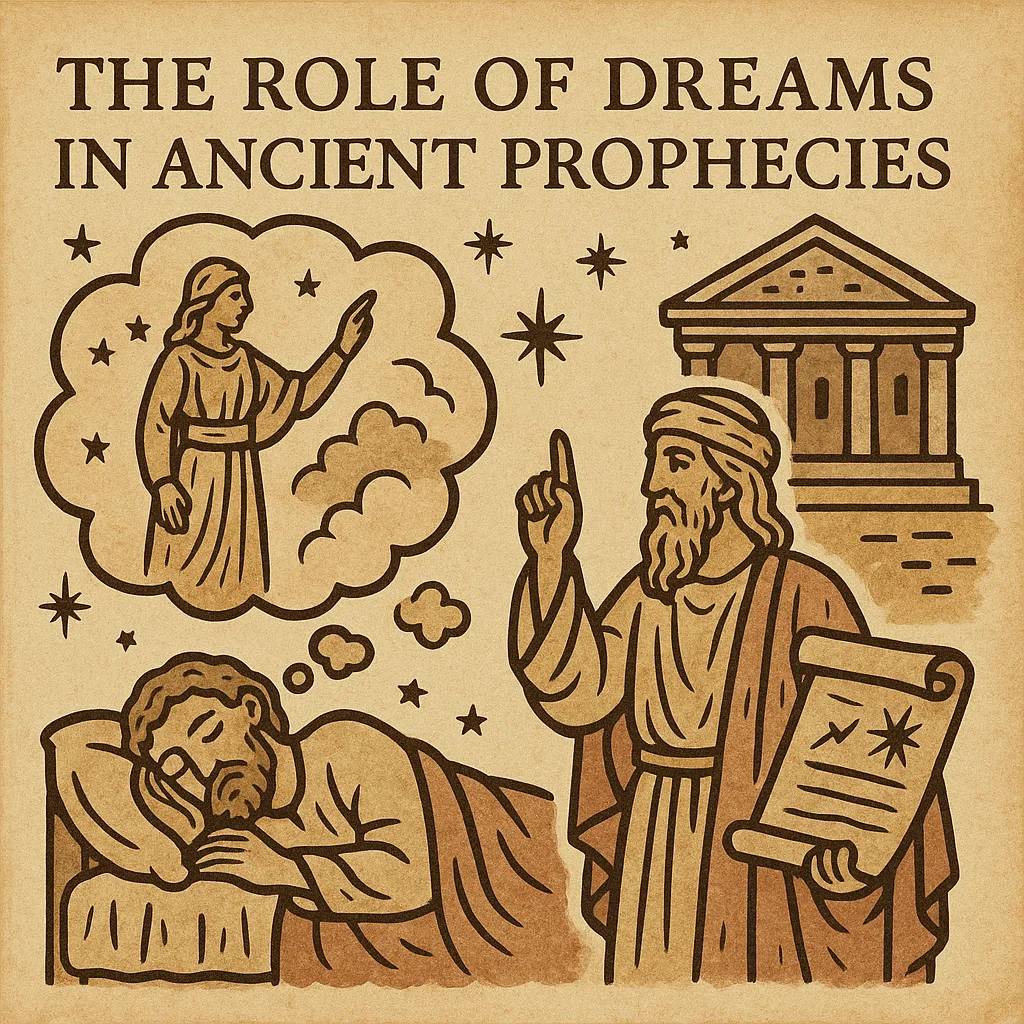
One of the oldest mysteries in human history is dreams. Dreams were seen by ancient cultures as divine messages, future glimpses, or warnings from gods and spirits long before modern psychology and neuroscience were developed. From Mesopotamia and Egypt to Greece, India, and indigenous customs, dreams influenced political, religious, and military choices throughout history.
Dreams were, in many respects, a conduit between the conscious and the invisible, between the human and the divine. Their part in ancient prophecies shows how early societies looked for meaning in the unknown as well as how they perceived reality.
Dreams as Divine Messages
Dreams were seen by ancient peoples as messages from beyond the world rather than as illusions. It was thought that supernatural forces, gods, and ancestors communicated with people through dreams, avoiding the constraints of the real world.
-
Mesopotamia
-
Mesopotamian clay tablets from 3100 BCE contain some of the earliest documented instances of dream interpretation.
-
Dream books with lists of common symbols and their meanings were frequently kept by kings and priests. For instance, seeing a lion in a dream could portend strength or peril, while seeing water could represent plenty.
-
The epic journey of the legendary king Gilgamesh is said to have been guided by prophetic dreams.
-
-
Ancient Egypt
-
Dreams, according to the Egyptians, were a means of communicating with God. Priests and commoners would rest in the "sleep chambers" of temples in the hopes of gaining divine visions.
-
Visions were classified as either "good" or "bad" in the Book of Dreams, and their interpretations were linked to the favor or disfavor of God.
-
-
Biblical Traditions
-
The Old Testament is filled with stories of prophetic dreams.
-
Joseph’s dreams of sheaves of wheat and stars foreshadowed his rise to power in Egypt.
-
State policy was guided by the pharaoh's dreams of seven fat cows and seven thin cows, which foretold years of plenty followed by famine.
-
These examples illustrate how dreams were woven into the fabric of governance, survival, and religious practice.
Dreams and Oracles in Ancient Greece
Dreams captivated the Greeks, who associated them with gods like the god of sleep, Hypnos, and the god of dreams, Morpheus. Dreams were regarded as essential hints to the future, even though oracles like Delphi were crucial to prophecy.
-
Artemidorus of Daldis, Oneirocritica, one of the most thorough books on dream interpretation, was written by a Greek author in the second century CE. He maintained that, depending on their symbols, dreams could foretell both state and personal events.
-
Dreams were frequently associated with recovery. People would sleep in hallowed places after undergoing ceremonial purification at the temples of Asclepius, the god of medicine, in the hopes of having healing dreams that priests could decipher.
For the Greeks, dreams represented both individual psychology and cosmic order, acting as windows into fate.
The Indian and Chinese Traditions
Dreams also held deep significance in Eastern civilizations.
-
India
-
In Vedic texts, dreams were divided into categories: ordinary dreams, dreams of divine origin, and prophetic dreams.
-
The Upanishads explored dreams as stages of consciousness, a state between waking and deep sleep that could reveal truths about the self and the universe.
-
Ancient kings often consulted Brahmins and astrologers to interpret dreams before making political or military decisions.
-
-
China
-
Dreams were associated with the equilibrium of the soul in traditional Chinese philosophy. Dreams were considered spiritual travels to other worlds in Daoist traditions.
-
It was claimed that Confucius himself had important dreams that shaped his philosophy.
-
Dreams containing prophetic warnings, dreams reflecting health, and dreams triggered by emotions were all categorized in some Chinese texts.
-
Both traditions reveal how dreams were considered not just mystical phenomena, but also practical tools for living wisely.
Dreams as Warnings and Guides in War
Throughout history, rulers and generals often made crucial decisions based on dreams.
-
Alexander the Great Before conquering Tyre, he supposedly had a dream about a satyr, which was seen as a sign of victory.
-
It was later believed that Emperor Augustus' dream about the goddess Cybele in Rome was a divine endorsement of his reign.
-
Warriors from Native American tribes frequently used dreams to direct their tactics in battle or to predict when to avoid conflict.
Dreams offered legitimacy in addition to reassurance. Leaders could use their prophetic visions to justify their power as divinely approved.
Archetypal Dream Symbols Across Cultures
Many dream motifs are common to all civilizations, despite cultural differences, indicating a universal human fascination with particular symbols.
-
Animals: Lions, snakes, and birds often symbolized power, transformation, or divine intervention.
-
Water: Associated with fertility, renewal, or impending catastrophe.
-
Death: Although frequently dreaded, death-related dreams were occasionally seen as symbols of transformation or rebirth.
-
Journeys: Symbolized spiritual quests or major life transitions.
These recurrent pictures demonstrate how dreams functioned as a symbolic language that cut across time and space.
Dreams as a Tool for Legitimacy
In many cases, dreams were used not just as personal revelations but as instruments of power.
-
Pharaohs and kings often claimed dreams validated their divine right to rule.
-
Prophets and shamans used dreams to influence collective decisions, from migrations to religious rituals.
-
In medieval Europe, saints’ dreams and visions became foundations for new religious movements or reforms.
By tying leadership to the divine, dreams gave authority a sacred legitimacy that was hard to challenge.
The Shift in Understanding Dreams
As societies evolved, so did interpretations of dreams.
-
Philosophers like Aristotle started to contend that dreams might originate from natural causes, such as emotional or physiological states, rather than supernatural forces as scientific thinking grew in Greece and Rome.
-
Even Aristotle, however, admitted that dreams occasionally seemed prophetic, reflecting minute sensory details the dreamer missed while awake.
-
During the Middle Ages, this conflict between natural and mystical explanations continued, and it eventually had an impact on contemporary psychology.
Dreams and Modern Echoes of Ancient Prophecy
Most people no longer consider dreams to be actual prophecies. Rather, they are interpreted via the perspectives of neuroscience and psychology. Whereas Jung saw dreams as manifestations of archetypes and the collective unconscious, Freud saw them as manifestations of the unconscious mind.
Yet echoes of ancient beliefs remain:
-
People still seek meaning in dreams of loved ones or strange symbols.
-
Entire industries—books, websites, and apps—offer dream interpretation guides, just as ancient civilizations once did.
-
Some still believe dreams can carry spiritual or prophetic messages, especially in religious communities.
The current interest in dreams demonstrates that the ancient appeal of prophetic dreaming has never completely vanished, despite advances in science.
Why Dreams Endured as Prophecies
Dreams endured as prophetic tools because they fulfilled deep human needs:
-
A Desire for Connection with the Divine
Dreams offered ordinary people a direct link to gods and ancestors. -
A Way to Make Sense of the Unknown
In times of uncertainty, dreams provided explanations and predictions when no other tools existed. -
A Source of Authority
Leaders and prophets could use dreams to strengthen legitimacy and inspire trust. -
A Universal Language of Symbols
Shared archetypes made dream interpretation meaningful across cultures.
Conclusion
Ancient prophecies' use of dreams tells us a lot about how people look for purpose in life. Dreams served as a window into the unknown and a holy conduit between the divine and the mortal long before contemporary science or psychology.
The ancient belief in dreams' prophetic power reminds us of a timeless truth: people have always looked to the unseen for guidance, whether from the stars, the gods, or the landscapes of sleep. This is true even though we now view dreams as reflections of the subconscious.
Even though dreams no longer determine conflicts or monarchies, their symbolic significance continues to influence how we view the world, connecting traditional knowledge with contemporary introspection.