The fields of agriculture, toolmaking, and language are frequently mentioned when discussing the factors that shaped humanity. However, the mastery of fire was one of the most revolutionary and underappreciated discoveries in human history. In addition to providing warmth and protection, fire had a significant influence on the development of the human brain, the organ that best describes our species.
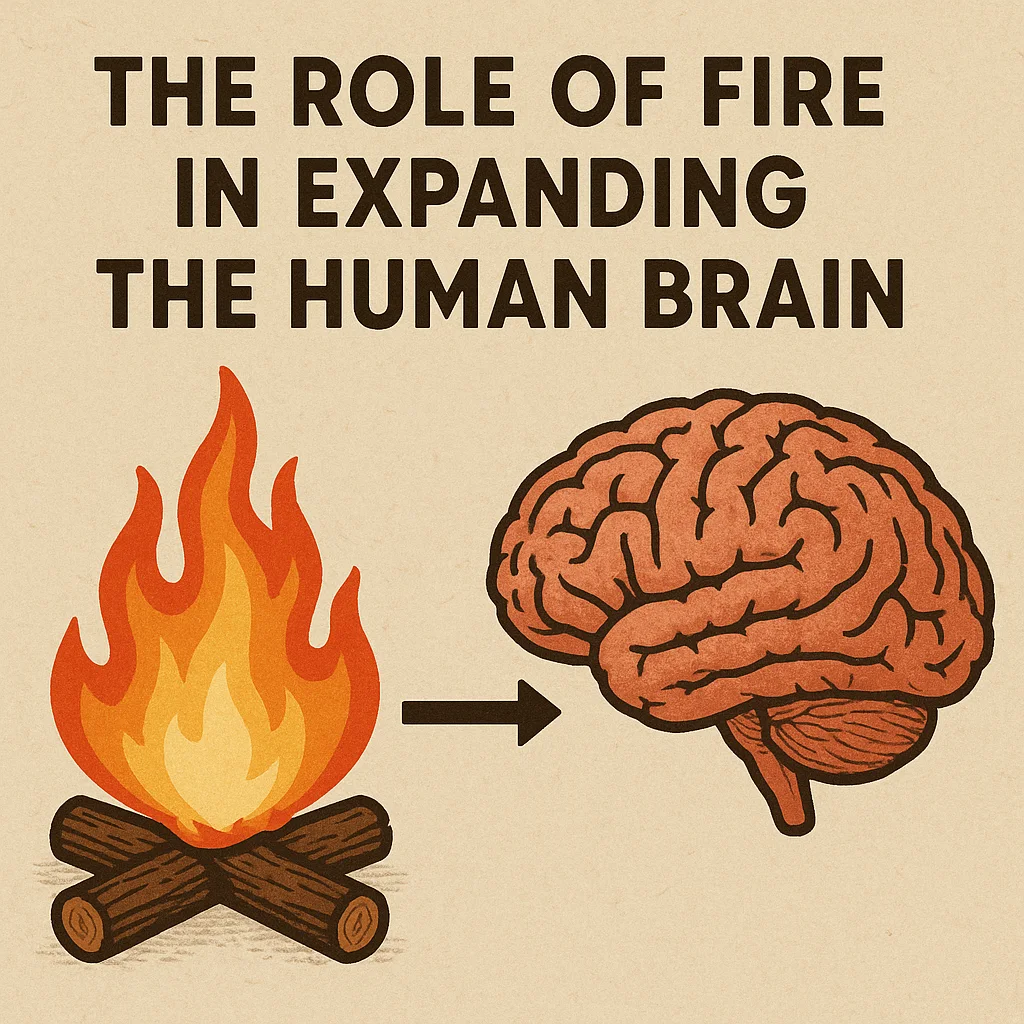
Although it only makes up around 2% of our body mass, the human brain is disproportionately large in relation to our body size, using 20% of our daily energy intake. How were our forefathers able to feed such a ravenous organ? More and more evidence points to fire as being essential to this leap because of its capacity to cook food, offer safety, and alter human routines.
This blog examines the evolutionary function of fire, how it changed our diets and ways of thinking, and why it is still the most useful and symbolic technology in human history.
Fire: Humanity’s First True Technology
Fire was the technology that set humans apart from other animals long before smartphones, wheels, or plows. Although there is evidence that suggests hominins may have experimented with controlled fire even earlier, controlled use of fire dates back at least one million years.
Fire was particularly transformative because it enabled humans to change matter at a chemical level, in contrast to toolmaking, which some primates also engage in. Darkness became day, plants became digestible, and raw meat became tender. Humans became masters of their own biology and their surroundings thanks to fire.
The Cooking Hypothesis: Fueling a Bigger Brain
The cooking hypothesis, made popular by anthropologist Richard Wrangham, is the strongest argument for the connection between fire and brain expansion. This theory holds that humans were able to consume food more efficiently and provide the calories required to support larger brains because of their mastery of fire and cooking.
Why Cooking Changed Everything
-
Higher Energy Yield
-
Cooking breaks down plant fibers and animal tissues, making nutrients more bioavailable.
-
Since the body uses less energy to digest a cooked meal than a raw one, a cooked meal has more net calories.
-
-
Dietary Expansion
-
Once toxic, tough, or indigestible foods (such as some grains and tubers) became edible when cooked.
-
This expanded the range of resources early humans could exploit.
-
-
Smaller Guts, Bigger Brains
-
Humans have smaller digestive tracts in relation to their body size than other primates. This trade-off most likely happened because eating cooked food allowed for an evolutionary investment in a larger brain by reducing the need for a large gut.
-
-
Time Efficiency
-
Chimpanzees, for instance, may chew for more than six hours every day when they eat raw food. This burden was significantly lessened by cooking, which freed up time for toolmaking, socializing, and cross-cultural interactions.
-
In summary, fire provided humans with the biological surplus required to support a brain far beyond what raw diets could provide, in addition to making food taste better.
Fire and the Social Brain
Fire influenced human social evolution in addition to nutrition. Processing relationships, teamwork, and communication were all impacted by brain expansion in addition to processing food. An important factor in this change was fire.
-
Gathering Around the Fire
-
At night, humans had a natural focal point for the first time. The campfire evolved into a space for planning, storytelling, and camaraderie.
-
This “after-dark” social time may have fueled the development of language and culture.
-
-
Safety and Cooperation
-
Fire warded off predators, allowing humans to sleep more safely in groups.
-
This safety promoted cooperation and trust, essential ingredients for complex societies.
-
-
Transmission of Knowledge
-
Elders could share myths and impart skills around fires. The fire served as a classroom in addition to providing warmth.
-
This storytelling tradition enhanced memory, creativity, and abstract thinking.
-
Fire turned nights from silent, dangerous hours into a stage for cognitive and cultural development.
Fire as a Tool for Environmental Mastery
Fire was the perfect tool for changing the environment, and the human brain thrives on challenges. In addition to learning how to cook, early humans also discovered other creative uses for fire:
-
Landscape Management: Forests were cleared, game was flushed out, and new plant growth was promoted through controlled burns.
-
Toolmaking: Fire was used to help crack rocks, harden wooden spears, and later in metallurgy.
-
Migration Aid: Humans were able to colonize new areas and adapt to a variety of ecosystems because fire provided warmth in colder climates.
Each of these uses required planning, foresight, and experimentation—further exercising the growing human brain.
The Symbolism of Fire and Human Consciousness
In addition to being useful, fire took on symbolic meaning, representing humanity's understanding of its own identity and position in the universe. Fire was considered sacred or divine in almost all ancient cultures. Fire has been viewed as the link between the material and the spiritual worlds since the time of Greek mythology's Prometheus, who stole fire from the gods, and Hinduism's Agni.
Why? Because human uniqueness was reflected in fire. No other species was so adept at controlling fire. Fire served as a living metaphor for danger, creativity, and human intelligence. It reflected the brain's inherent duality in many ways, being able to create, destroy, and transform.
Fire and Sleep: A Hidden Cognitive Boost
The way fire affected people's sleep is another underappreciated aspect of its function. Nights were times of great vulnerability prior to fire. However, fire allowed humans to sleep more safely, dream without worrying about constant predators, and stay awake longer.
According to some researchers, once fire offered protection, dreaming and REM sleep—which are critical for memory and problem-solving—became more dependable. Therefore, by improving the quality of sleep, fire may have indirectly improved cognition.
Fire vs. Other Animals: The Cognitive Divide
It has been noted that certain animals, such as chimpanzees and birds, use tools. However, the real cognitive difference between the animal kingdom and humans is marked by fire. Fire needed control and foresight in addition to opportunistic use:
-
Knowing how to start it.
-
Knowing how to sustain it.
-
Knowing how to transport it.
These are abstract tasks that call for advanced cognitive abilities like long-term planning, delayed gratification, and cause-and-effect reasoning. The ability to control fire was essentially the first test of human intelligence, and mastering it paved the way for all subsequent innovations.
Fire’s Legacy in the Modern Brain
Even though campfires have mostly been replaced by electricity and electronic gadgets, fire's legacy lives on. Cooked food, social interactions, and fire-sparked cultural transmissions have all contributed to the development of the modern human brain over many generations.
Even now, there is something primordial about seeing fire, whether it be in a fireplace or a candle flame. According to studies, viewing fire can lower blood pressure and reduce stress, possibly because it connects with our deep evolutionary history.
In addition to being the first technology invented by humans, fire also represents the intellectual fire that still burns within us.
Conclusion: Fire as the Brain’s Evolutionary Partner
The human brain did not grow in a vacuum. It developed alongside fire. Gatherings unlocked language and culture, cooking unlocked calories, and safety unlocked rest. The most significant evolutionary leap in human history was propelled by fire, an external engine.
To comprehend fire's function is to comprehend why humans evolved beyond being intelligent primates. We developed into storytellers, thinkers, and creators. And even though we now store fire in regulated furnaces and illuminated screens, its fundamental nature is still the same: it is a force that feeds the human intellect.