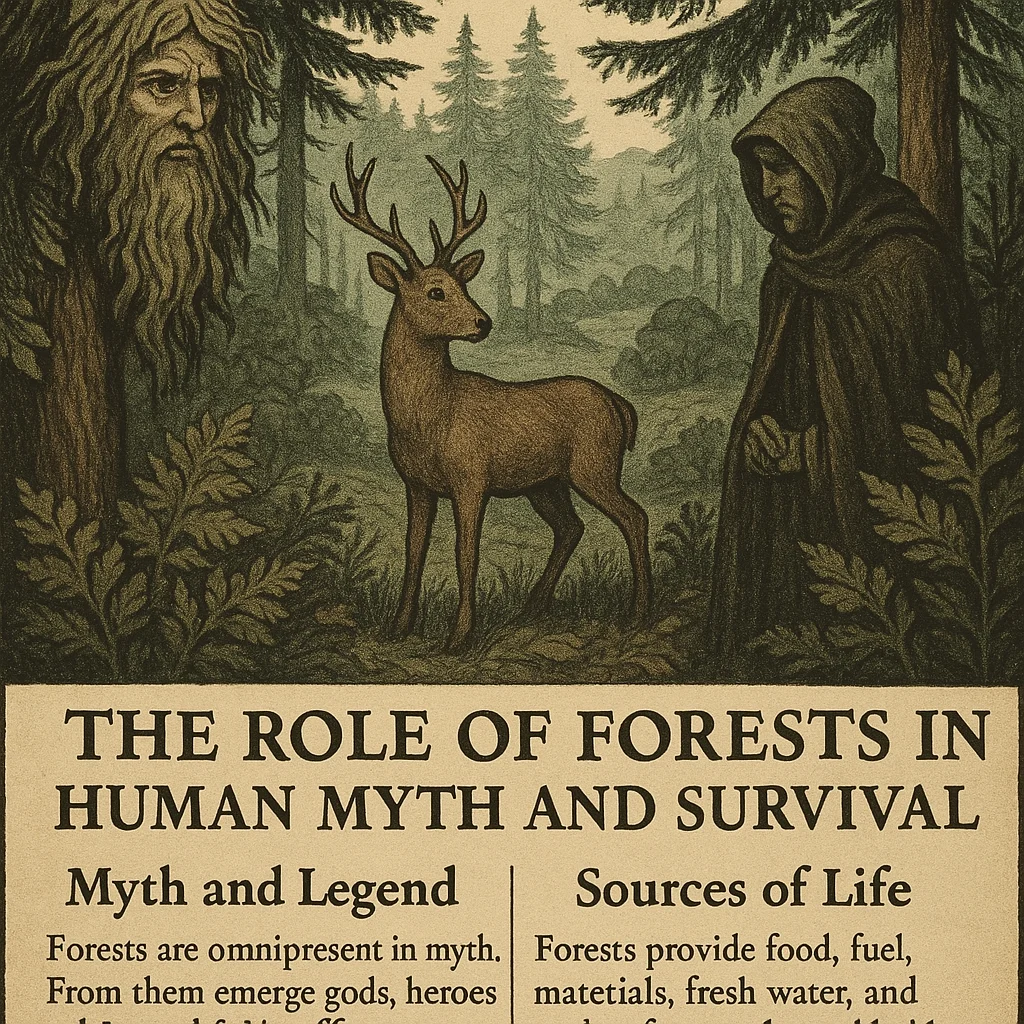
Forests have always been living worlds of mystery, peril, safety, and sustenance rather than merely being collections of trees. Forests have shaped human behavior, narratives, and the spiritual significance we ascribe to the natural world for as long as people have existed. They function in myth, folklore, and religion as both symbolic landscapes and actual sources of survival across cultural boundaries. Understanding how humans relate to forests means tracing the origins of our survival instincts and our imagination.
Forests as Providers of Survival
Humanity's first home was a forest, long before there were cities or farms. In addition to supplies for tools and fire, they offered food, water, and shelter. In this way, forests influenced the course of human existence itself:
-
Food and Medicine: Forests have long served as nature's pharmacy, producing everything from berries, nuts, and fruits to therapeutic herbs and fungi. Knowledge about which plants are harmful and which are healing was frequently transmitted by indigenous cultures.
-
Shelter and Firewood: Trees provided building materials for weapons, boats, and shelters. Families stayed warm during the long winters thanks to firewood.
-
Hunting Grounds: Communities were supported by the deer, boars, and other wildlife that could be hunted in dense woods.
More than 1.6 billion people still directly rely on forests to survive. They continue to be essential for biodiversity, oxygen production, and water cycles. Forests have always played a parallel, symbolic role in human myth and imagination, despite being vital to physical life.
Forests in Myth and Folklore
In human storytelling, forests are often portrayed as liminal spaces, where the extraordinary and everyday life collide. These are environments where transformation is possible, dangers loom, and heroes lose themselves.
-
The Dark Forest Archetype: Forests are frequently used to symbolize peril and the unknown in European fairy tales. A witch is encountered by Hansel and Gretel as they venture into the woods. Red Riding Hood encounters the wolf while making her way through the forest to her grandmother's home. In this context, forests stand in for the subconscious, which is gloomy, erratic, and instructive.
-
Sacred Groves: Forests were considered sacred places in many ancient cultures. In Celtic traditions, Druids believed that trees had spiritual power and conducted rituals in groves. Similar to this, Hinduism honors forests as the homes of sages and gods, and some trees, such as banyans, are revered as sacred.
-
Forests as Portals: In mythologies ranging from Native American tales to Norse Yggdrasil (the World Tree), forests act as spiritual bridges that connect people to the divine and open doors to other worlds.
-
Transformation in the Forest: Forests are frequently portrayed in myths as places where people go through experiences that transform them. In Arthurian legend, the knight goes into the forest in search of the Holy Grail. Consider the danger and revelations found in Harry Potter's Forbidden Forest in contemporary storytelling.
Therefore, forests are more than just actual places; they are also metaphorical landscapes of growth, testing, and spiritual connection.
Forests as Spaces of Fear
Forests have always had two sides: they conceal danger while also offering life. The silence can be unnerving, the thick undergrowth conceals predators, and the dense canopy blocks light.
-
Predators and Perils: Bears, tigers, and wolves were among the wild creatures that lived there in premodern times. People were cautious when they entered forests.
-
Exile and Punishment: Banishment to the forest, which exposed a person to wilderness dangers and removed them from the safety of their community, was a form of punishment in some cultures.
-
Psychological Fear: Getting lost in the woods still evokes a basic fear. The forest becomes a metaphor for bewilderment and uncertainty in the absence of trails or landmarks.
This blend of awe and fear is what makes forests such powerful symbols across cultures.
Forests and Human Identity
Forests reflect human identity and are more than just metaphors or resources. Numerous societies have used forests to define themselves.
-
Nomadic Tribes: In order to survive without destroying the ecosystem, hunter-gatherer communities coexisted peacefully with forests.
-
Settled Communities: Forests served as both a source of lumber and a barrier to farmland for agricultural societies. Forest clearing was frequently associated with the advancement of civilization, albeit at the expense of the environment.
-
Modern Nations: Countries still take pride in their forests today, whether it's the Amazon as the "lungs of the Earth," Germany's Black Forest as a cultural icon, or Russia's dense Siberian taiga as a testament to its size.
Cities and forests are frequently contrasted in philosophy and literature. The forest stands for chaos, mystery, and the primordial, while the city symbolizes order and advancement. Human civilization is defined by the balance they produce when combined.
The Forest as a Place of Retreat
Forests have served as havens beyond myth and survival. In order to avoid distractions and communicate with the divine, many spiritual seekers withdrew into forests.
-
Buddha’s Enlightenment: Siddhartha Gautama achieved enlightenment while meditating in a forest beneath a Bodhi tree.
-
Christian Hermits: In order to find solitude for prayer and spiritual development, early Christian monks frequently withdrew into deserts and forests.
-
Romanticism: Poets and philosophers such as Wordsworth and Thoreau praised forests in the 18th and 19th centuries as places of purity in contrast to the filth of industrial cities.
To enter a forest was to leave behind the noise of society and reconnect with something timeless and eternal.
Forests in the Modern Age
Forests today are torn between being valued and being used for profit. Large tracts of forest have been lost due to logging, urbanization, and agricultural deforestation. However, forests are also hailed as ecological gems that are essential to the fight against climate change.
-
Conservation Efforts: The importance of forests to human survival is acknowledged by national parks and international efforts to protect the Amazon.
-
Ecotourism: Millions of tourists visit forests each year because they provide chances for recreation and reconnection with the natural world.
-
Cultural Relevance: Forests are still used in modern storytelling; consider the use of forests as the backdrop for mysteries and quests in video games, fantasy novels, and movies.
Forests remain as relevant to our cultural identity as they were thousands of years ago.
Why Forests Will Always Matter
Simply put, forests represent the duality of human existence, which is why they evoke such a potent blend of survival instincts, myths, and emotions. They are commonplace yet holy, energizing yet enigmatic, and life-giving yet perilous.
They serve as a reminder that we were once creatures that lived only in their depths. They demonstrate how meaning and survival are frequently linked. Additionally, they still act as settings for human imaginations in which transcendence and danger coexist.
Forests continue to serve as a reminder of slower rhythms, patience, cycles, and the interconnectedness of all life in a world that is becoming faster by the day. They are not only a part of nature, but also of us, which may be why they persist in both myth and necessity.
Conclusion
Our cultural mirrors and the homes of our ancestors are both found in forests. They provided a haven for spiritual development, taught us how to survive, and sparked transformational myths. The provider and the destroyer, the sacred and the feared, the known and the unknown—they represent the paradox of life itself.
Throughout history, forests have served as a constant reminder to humanity that we are inextricably linked to nature rather than existing outside of it. To respect forests, whether in conservation, myth, or reverence, is to respect ourselves.