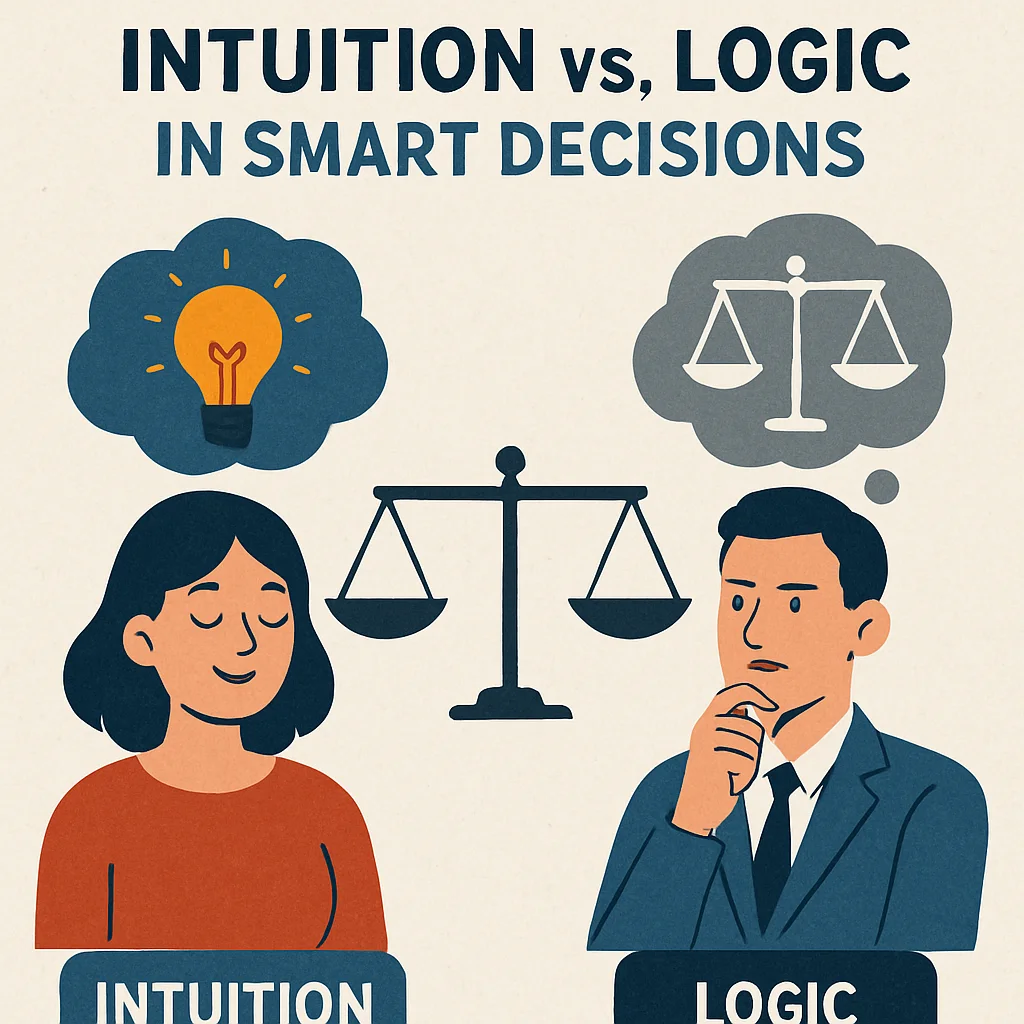
There is frequently a mental conflict between intuition and logic when it comes to making wise decisions. Is it wise to follow your instincts? Or should you examine every aspect and make a decision based on facts?
Whether in business, science, or the arts, some of the most significant discoveries in history have been attributed to an epiphany. However, disregarding unambiguous evidence has also led to some of the worst decisions. Which one, then, should we trust?
The fact is that making wise decisions frequently calls for both intuition and reasoning. Whether you're choosing a partner, investing money, changing careers, or what to eat for dinner, knowing when and how to use each can greatly enhance the quality of your decisions.
Understanding the Basics: Intuition vs. Logic
What is Intuition?
The capacity to comprehend something instantly without using conscious thought is known as intuition. It is quick, instinctive, and frequently experience-based. Some refer to it as an instinct or a "gut feeling."
Examples:
-
A doctor diagnosing a patient the moment they walk in.
-
A chess grandmaster spotting a weak move in a second.
-
You suddenly feeling uneasy about a person you just met.
Intuition operates in the subconscious mind, drawing from patterns we've absorbed over time.
What is Logic?
Logic is a methodical approach to reasoning. It is methodical, analytical, and grounded in data, facts, and regulations. What are the benefits and drawbacks, logic asks? What proof do I possess? What are the probable results?
Examples:
-
An engineer calculating the load-bearing capacity of a bridge.
-
A student comparing universities by tuition cost, curriculum, and location.
-
You listing pros and cons before taking a new job.
Logic uses the conscious mind to evaluate, compare, and conclude.
The Strengths and Weaknesses of Each
Strengths of Intuition:
-
Fast, efficient in high-pressure situations.
-
Draws from deep experience.
-
Helps in creative problem-solving.
-
Useful when information is incomplete.
Weaknesses of Intuition:
-
Can be biased or emotionally driven.
-
Hard to explain or justify to others.
-
May lead to impulsive or irrational decisions.
-
Relies on past patterns that may not apply.
Strengths of Logic:
-
Objective and consistent.
-
Defensible and explainable.
-
Minimizes emotional interference.
-
Ideal for solving complex, unfamiliar problems.
Weaknesses of Logic:
-
Slow and mentally exhausting.
-
Can get paralyzed by overanalysis ("analysis paralysis").
-
May ignore human or emotional dimensions.
-
Doesn’t always capture the full picture.
How the Brain Uses Both: Dual-System Thinking
In his book Thinking, Fast and Slow, psychologist Daniel Kahneman described how humans function using two different mental systems:
-
System 1 (Fast Thinking): This is intuitive, emotional, and automatic. It's useful for everyday decisions and quick reactions.
-
System 2 (Slow Thinking): This is logical, deliberate, and analytical. It kicks in when you solve a math problem or make a long-term plan.
Making wise decisions frequently requires understanding when to combine System 1 and System 2 or when to switch between them.
When to Trust Intuition
Intuition is powerful—but only in the right context. Here's when it's usually safe to trust your gut:
1. When You’re Experienced
Your intuition gets more accurate the more you have experience in a particular field. Given that they have witnessed hundreds of fires, firefighters may have an innate sense of when a building is about to collapse.
Tip: Ask yourself, “Have I been in a similar situation before, and did I learn from it?”
2. When You Don’t Have Much Time
There is frequently no time for in-depth analysis in situations that move quickly, such as sports, emergencies, or negotiations. You can make the best decision right away by following your instincts.
Tip: Practice beforehand. Professionals rehearse under pressure so their intuition is more accurate when it matters.
3. When the Decision is Personal or Emotional
Not all decisions are based solely on data, such as selecting a life partner or pursuing an artistic vision. Unlike logic, your gut can tell you what "feels right."
Tip: Check that your emotions aren’t just reactions to fear, insecurity, or past trauma.
When to Rely on Logic
Logic shines when complexity and consequences are high. Here's when to lead with your analytical brain:
1. When the Stakes Are High
Logic should be the primary factor in decisions pertaining to finances, health, or long-term effects (such as purchasing a home, making investments, or leaving your job).
Tip: Use decision-making frameworks like pros/cons lists, cost-benefit analysis, or mental models.
2. When You’re Biased
Whether it's optimism bias, confirmation bias, or something else entirely, we're all biased. We can slow down and examine the facts more objectively when we use logic.
Tip: Write down your reasons, and challenge them. Ask, “Would I give this advice to someone else?”
3. When You Need to Justify the Decision
In teams or organizations, you often need to explain your choices. Logic builds credibility and trust.
Tip: Use data and evidence. If your gut tells you something, try to find logic to support it.
The Best Decisions Use Both
The most effective decision-makers combine reasoning and intuition. They follow their instincts, but they also use logic to confirm them. Or they begin with data, but they also feel their feelings about the result.
Example 1: Hiring an Employee
-
Your gut tells you the person has great energy.
-
But you check their resume, references, and test results.
-
Both intuition and logic align: you make the hire confidently.
Example 2: Choosing a Business Idea
-
Data says there’s demand for a certain product.
-
However, your gut tells you that neither you nor your customers will be thrilled with it.
-
You pass, trusting both your head and your heart.
Exercises to Develop Both Skills
Sharpen Intuition:
-
Reflect on past decisions: What gut feelings were right or wrong?
-
Practice mindfulness: Helps you hear your inner signals better.
-
Expose yourself to patterns: More experience = sharper intuition.
Strengthen Logic:
-
Read and write regularly: Improves reasoning.
-
Use mental models: Learn tools like inversion, opportunity cost, etc.
-
Challenge your beliefs: Engage in debates or play devil’s advocate.
Warning Signs: When You’re Out of Balance
-
Too intuitive: Making impulsive decisions, ignoring facts, driven by emotions.
-
Too logical: Overanalyzing, acting slowly, and failing to consider the human element in decisions.
Aim for harmony, not dominance. Think of logic and intuition like the two wings of a bird—both are needed to soar.
Famous Thinkers on Intuition and Logic
-
Albert Einstein: “The intuitive mind is a sacred gift and the rational mind is a faithful servant.”
-
Steve Jobs: At Apple, product vision is frequently attributed to intuition.
-
Daniel Kahneman: cautioned against relying on instinct in uncharted territory.
Conclusion: Head and Heart Working Together
Logic and intuition are not mutually exclusive. Actually, the best choices are made when you combine the two—have faith in your gut but double-check it with research. Don't ignore your inner voice, but pay attention to your reasoning.
Those who are adept at both systems—reason and intuition—are the ones who lead, innovate, and prosper in our fast-paced, complex world.