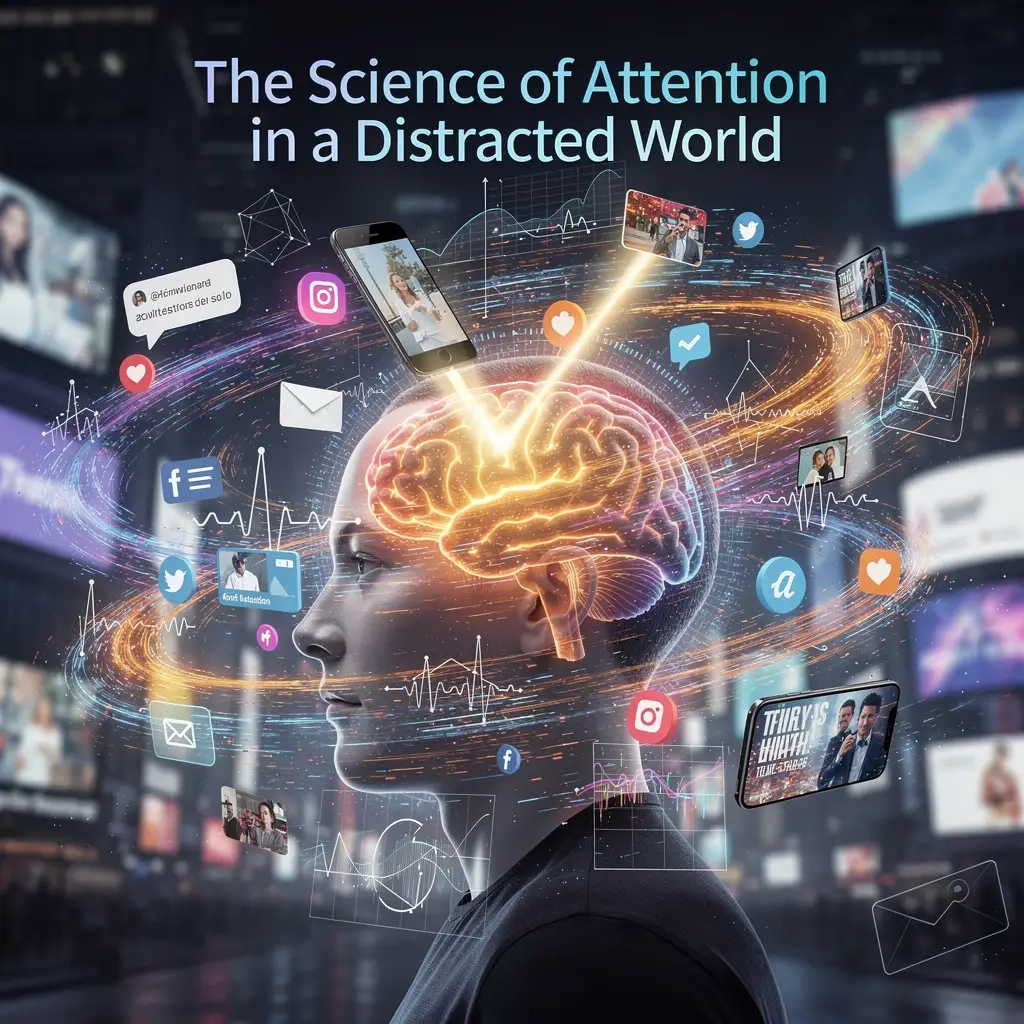
The doorway to experience is attention. Everything we observe shapes our reality, influencing our memories, feelings, and lessons. However, one of the most brittle and disputed mental resources in the modern society is attention. Sustained focus becomes more challenging as devices, notifications, multitasking, and continuous stimuli vie for our attention.
Knowing the physics of attention makes it easier to understand why distraction seems so strong and why it now takes more than just willpower to stay focused. A complex system influenced by biology, psychology, emotion, and environment, attention is not a single skill. Reclaiming attention in a distracted world begins with understanding how it functions.
What Attention Really Is
Concentrating is only one aspect of attention. It is the process by which the brain chooses which information is filtered out and which is brought into conscious awareness. Attention serves as a gatekeeper because the senses receive significantly more information than the brain can comprehend at any given time.
The brain's numerous networks are how this system functions. Certain areas are in charge of maintaining concentration over time, while others are in charge of choosing objectives and awareness. There are two types of attention: automatic and voluntary. While certain stimuli are easy to focus on, others need intentional management.
This system is overloaded by the contemporary surroundings. Mental exhaustion and diminished focus result from the brain's continual evaluation of what merits attention. This gradually impairs the brain's capacity to maintain focus, not because the brain is malfunctioning but rather because it is adjusting to its surroundings.
How the Brain Handles Focus
Attention is restricted, according to neuroscience. The quantity of information that the brain can store in working memory at once is limited. When there are conflicting demands, performance deteriorates and attention becomes fragmented.
The brain must withdraw from one task and re-engage with another whenever attention moves. In addition to using energy, this shift impairs accuracy, creativity, and emotional control. Rapid task switching, which has a cognitive cost, is what appears to be multitasking.
✔️ The brain focuses best on one thing at a time.
✔️ Frequent switching weakens sustained attention.
✔️ Mental fatigue reduces the brain’s filtering ability.
The brain's capacity to withstand distraction and preserve internal coherence is equally as important for sustained attention as effort. This ability is stretched in a constantly cue-filled environment.
The Role of Dopamine in Distraction
Dopamine is essential for motivation and attentiveness. Although it is sometimes referred to as the brain's "reward chemical," it actually indicates learning, novelty, and anticipation. Dopamine stimulates the brain to look for new opportunities and information.
Digital platforms take advantage of this structure in the current world. Little dopamine releases are triggered by notifications, likes, texts, and endless scrolling, resulting in reward and anticipation loops. This teaches the brain to look for novelty instead of depth.
The brain grows increasingly reliant on continuous stimulation and less receptive to sustained concentration over time. Focus becomes tedious and distraction becomes alluring as a result. The focus becomes externally driven instead of internally led.
✔️ Novelty becomes more rewarding than meaning.
✔️ Depth feels harder than stimulation.
✔️ Stillness feels uncomfortable rather than calming.
This neurological conditioning does not mean attention is permanently damaged, but it does mean it must be retrained.
Emotional Attention and Threat Detection
It is not neutral to pay attention. Emotion, particularly fear, stress, and uncertainty, shapes it. As it scans the surroundings for danger, the brain has evolved to prioritize dangers. Even in situations where threats are psychological rather than physical, this survival function still functions.
The brain's alert system is triggered by stress, which focuses attention on perceived threats. This causes the mind to become too preoccupied with issues, concerns, and potential outcomes, diverting attention from the here and now.
This pattern is reinforced by ongoing stress. Attention shifts from exploration, inquiry, and presence to control, prediction, and prevention when the nervous system is still active.
✔️ Stress narrows attention.
✔️ Anxiety amplifies threat perception.
✔️ Safety allows attention to relax and expand.
The brain seldom feels comfortable enough to focus deeply in a world where social comparison, news, and performance pressure are commonplace.
The Fragmentation of Conscious Experience
In addition to influencing what we see, attention also affects how we perceive time, memory, and identity. Experience fragments with attention as it breaks. Moments seem hurried, unfinished, and detached.
The brain's capacity to encode memories is diminished by fragmented attention. Because of this, time frequently seems to go by swiftly while leaving little in its wake. Experiences that are continuously interrupted are not fully registered by the brain.
Additionally, emotional awareness is weakened by this fragmentation. Emotions are felt but not processed when attention shifts too quickly. Emotional disorientation, irritation, and a feeling of alienation might result from this.
On the other hand, prolonged focus enables experience to become more profound. Memory improves, meaning grows, and time slows. Time is not what separates a distracted moment from a present moment; attentiveness is.
The Social Dimension of Attention
Attention is societal as well as personal. Our relationships with people are shaped by the things we focus on. Relationships grow thinner, less emotionally rich, and more transactional when attention is split.
Being present in a relationship demands paying close attention to the words, feelings, and nonverbal clues of the other person. This bond is broken by distraction, which results in miscommunication, emotional detachment, and less empathy.
✔️ Attention strengthens emotional bonds.
✔️ Distraction weakens relational trust.
✔️ Presence deepens communication.
In a distracted world, the science of attention becomes the science of connection. How we attend determines how we relate.
The Impact of Technology on Attentional Development
Over time, regular usage shapes attention. Attention gets stronger with practice, just like muscles get stronger with training. However, rather than focusing on depth, patience, and inward awareness, modern technology trains attention toward speed, novelty, and external stimuli.
Compared to earlier generations, children raised in high-stimulation environments may exhibit distinct attentional tendencies. They might be very good at digesting information quickly, but they might have trouble focusing for extended periods of time, reflecting, and controlling their emotions.
This does not imply that technology is intrinsically dangerous, but it does require deliberate cultivation of attention in conjunction with technology use. The brain adjusts to stimulation rather than stability when there is an imbalance.
The Difference Between Focus and Presence
Although they are connected, focus and presence are not the same. Sustained attention to a certain task or object is referred to as focus. Being aware of the present moment as it is, including both internal and exterior experiences, is referred to as being present.
When working mechanically or compulsively, for example, a person can be concentrated without being present. When viewing nature or experiencing an emotion, for example, one can be present without being narrowly focused.
The science of attention demonstrates that the capacity to control attention rather than be controlled by it is necessary for both presence and focus. Environmental design, emotional safety, and awareness all play a role in this control.
✔️ Focus directs attention.
✔️ Presence opens attention.
✔️ Regulation stabilizes both.
In a distracted world, learning to regulate attention becomes essential for mental health, creativity, and well-being.
The Neuroplasticity of Attention
The idea that attention is malleable is among the most encouraging discoveries in neuroscience. Practice, experience, and deliberate training can alter the brain. Attention is trainable and not fixed.
The brain's attentional networks are strengthened by techniques like mindfulness, deep reading, introspection, and single-tasking. The brain improves with time at maintaining focus, avoiding distractions, and coming back to the present.
Instead of stifling distractions, this method gently reroutes attention when it strays. Like a mental exercise, each redirection improves attentional control.
The science is clear: attention improves through use, not force.
Attention and Meaning
Meaning is determined by attention. What matters is what we focus on. Meaning frequently becomes superficial, disjointed, and externally determined in a distracted environment.
Meaning can develop with sustained attention. It facilitates introspection, emotional integration, and self-awareness. Experience remains superficial without focus. Experience becomes transforming with focus.
Meaning is not found by searching harder—it is found by attending more fully.
Reclaiming Attention in a Distracted World
It is not necessary to retreat from contemporary life in order to regain focus. It necessitates comprehending how attention functions and creating settings, routines, and internal reactions that facilitate it.
This involves:
-
Reducing unnecessary stimulation.
-
Creating spaces for silence and reflection.
-
Practicing sustained engagement with tasks and relationships.
-
Allowing emotions to be felt rather than avoided.
-
Rebuilding trust in stillness.
✔️ Attention grows where awareness is welcomed.
✔️ Focus strengthens where distraction is softened.
✔️ Presence deepens where safety is restored.
Attention returns not through control, but through care.
Conclusion
According to the science of attention, distraction is a systemic issue influenced by environment, emotion, biology, and culture rather than a human shortcoming. Attentional systems are overloaded by the modern world, which trains the brain to prioritize novelty, speed, and external control over depth, continuity, and presence.
However, attentiveness can still be trained. People can restore their ability to concentrate, be present, and find meaning via comprehension, awareness, and deliberate practice.
Paying attention turns into a sort of independence and resistance in a world where people are easily distracted. Who we become is shaped by the things we focus on. Reclaiming attention also allows us to take back our inner life, relationships, and experiences.