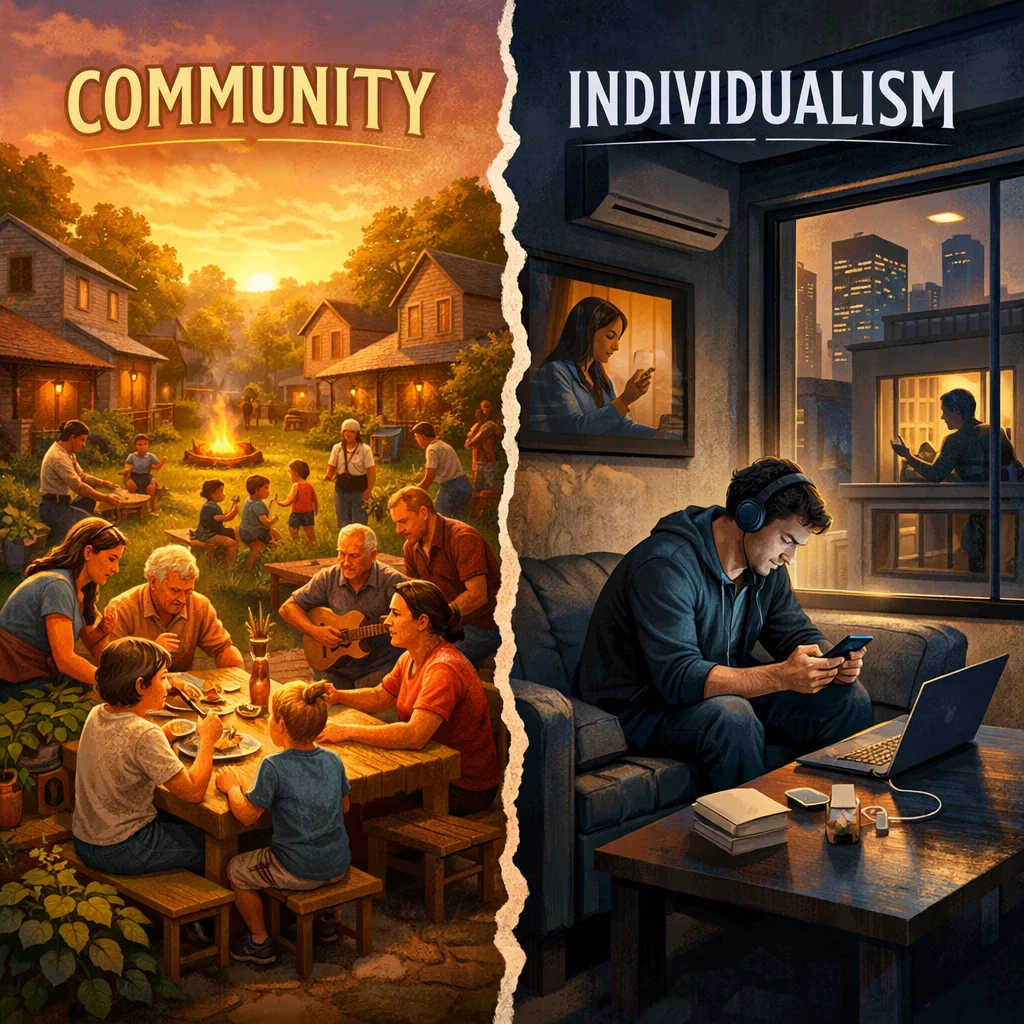
Living in a community was a need for the most of human history. Cooperation was essential for survival in the tribes, villages, joint families, and close-knit communities where people lived. Food was shared, duties were split up, and belonging was the foundation of identity. However, the tale of modern life today is rather different. While community living is frequently viewed as constrictive or antiquated, individual freedom, independence, and self-reliance are cherished. The gradual but significant transition from communal living to individuality has changed how we relate to one another, measure success, and comprehend ourselves.
This change took time to occur. It is the outcome of altering psychological demands, cultural evolution, technology breakthroughs, and economic shifts. Individualism has undeniably benefited society, but it has also brought forth new problems, such as social disintegration, loneliness, and a diminished sense of belonging. Knowing this change enables us to consider what we might be gaining and what we might be losing.
Understanding Community Living
The term "community living" describes a social structure in which people are closely related to one another and depend on one another for practical, social, and emotional assistance. Traditional societies placed a strong emphasis on group responsibility. Neighbors participated in day-to-day activities, families were extended, and personal difficulties were rarely encountered alone.
Key Characteristics of Community Living
✔ Shared resources and responsibilities
✔ Strong social bonds and mutual dependence
✔ Collective decision-making
✔ A deep sense of belonging and identity
Although it wasn't always perfect, living in a community provided a safety net. Others intervened while one person was having difficulties. The group frequently handled childcare, elder care, emotional support, and conflict resolution. Rather than personal success, identity was strongly associated with family, clan, or community.
The Rise of Individualism
Individualism places a strong emphasis on self-expression, independence, and autonomy. Success in individualistic societies is determined more by individual accomplishment, autonomy, and self-sufficiency than by harmony within the community. This kind of thinking pushes people to put their own objectives, aspirations, and morals first—even if they go against what society expects.
✔ Personal choice and independence
✔ Self-reliance and autonomy
✔ Individual achievement over collective success
✔ Personal identity over group identity
People's perspectives on relationships, employment, family structures, and even mental health have been profoundly altered by this transition. It has decreased dependence on—and connection to—others while empowering people to overcome restrictive customs.
Economic Forces Driving the Shift
Economic transformation is one of the main forces behind individuality. People relocated from rural areas to urban areas as a result of industrialization, when employment was no longer dependent on local cooperation or family land. Individual contracts replaced teamwork in the workplace.
Urbanization and Mobility
People started living with strangers instead of long-term neighbors as cities grew. Generational ties to place and community were broken when moving for work became commonplace. Individual abilities and flexibility were now more important for economic survival than social ties.
Capitalism and Competition
Individual success, personal output, and competition are rewarded in modern economies. Individuals, not organizations, are usually given promotions, pay, and recognition. The idea that success is a personal, rather than a social, responsibility is eventually strengthened by this economic system.
Technology and the Illusion of Connection
In a strange way, technology has both connected and alienated us. Instant communication is made possible by social media, messaging applications, and digital platforms, but they frequently take the place of more in-depth, in-person contacts.
Digital Independence
Nowadays, people may work, shop, study, and have fun all from the comfort of their own homes. Although this ease of use encourages self-reliance, it lessens regular social interaction that used to naturally take place in public areas.
✔ Online connections replace physical presence
✔ Convenience reduces dependence on others
✔ Community identity loses significance in favor of digital identification.
Although it frequently lacks emotional depth, technology creates the illusion of connection. Despite ongoing connectivity, virtual contacts never provide the same level of support as real-world communities, which can result in feelings of loneliness.
Cultural Shifts and Changing Values
Individualism is significantly shaped by cultural myths. The self-made person—the lone achiever who triumphs via hard work—is frequently celebrated in films, novels, and social media. Reliance on the community is sometimes depicted as weakness or dependence.
Nuclear families and single living are gradually replacing joint families and multigenerational households. From an early age, independence is frequently promoted, and depending on family or community support could be viewed as a sign of weakness rather than strength.
Personal freedom is frequently given precedence above social duty in modern culture. Although this enables people to break free from repressive customs, it also erodes collective accountability. When individual choice is prioritized over all else, the concept of "looking out for one another" gradually wanes.
Psychological Impact of Individualism
Both society and the human psyche are shaped by individualism. On the one hand, it fosters autonomy, self-awareness, and personal development. However, it puts more strain on people to handle things by themselves.
The Burden of Self-Reliance
People may internalize difficulties as personal shortcomings rather than common difficulties when success and failure are perceived as exclusively personal. Emotional burdens increase in the absence of robust communal support.
✔ Increased loneliness and isolation
✔ Higher stress and anxiety levels
✔ Reduced sense of belonging
Instead of using community-based support networks, mental health concerns are frequently treated on an individual basis through therapy or self-help. Even while expert assistance is beneficial, emotional gaps may result from a lack of group care.
What We’ve Gained from Individualism
It's critical to recognize that individualism has resulted in significant advancements. It has given people the freedom to create their own life, challenged inflexible hierarchies, and permitted personal expression.
Positive Outcomes
✔ Greater personal freedom
✔ Empowerment of marginalized voices
✔ Ability to break away from harmful traditions
✔ Increased innovation and creativity
People have been able to challenge conventions, follow their hobbies, and develop identities outside of inherited roles thanks to individualism. Although there are trade-offs, these benefits shouldn't be disregarded.
What We’ve Lost Along the Way
Many people feel a silent feeling of loss as ties to the community deteriorate. It is more difficult to find everyday human connection, shared rituals, and group problem-solving.
Erosion of Social Safety Nets
Without robust communities, people deal with life's obstacles—such as disease, sadness, and failure—mostly by themselves. Social support is no longer certain but rather contingent.
✔ Fewer shared responsibilities
✔ Reduced emotional support
✔ Decline in communal trust
The loss is not always evident, but it frequently itself as persistent loneliness, social anxiety, and an unfulfilled desire for connection.
Finding Balance Between Community and Individualism
The intention is not to romanticize the past or completely reject individualism. Finding a balance between individual freedom and group care is more difficult.
Reimagining Modern Community
Even though modern communities may not have the same appearance as ancient villages, they might nevertheless have significance. Rebuilding connections without compromising autonomy is possible through intentional communities, shared workspaces, local initiatives, and support groups.
✔ Choosing connection rather than isolation
✔ Valuing interdependence alongside independence
✔ Creating spaces for shared experiences
Understanding that independence and community are complimentary demands rather than antagonistic ones may lead to real progress.
The Future of Social Living
Reconnecting is becoming more popular as communities deal with growing loneliness, mental health issues, and societal disintegration. A gentle return to unity is suggested by movements that support community housing, unhurried living, and local involvement.
People are starting to understand that independence does not equate to isolation. No amount of personal achievement can completely replace the feeling of belonging because humans are social creatures by nature.
Conclusion
The transition from communal life to individualism is a reflection of broader shifts in how society functions, defines identity, and values achievement. Individualism has greatly empowered people, but it has also undermined communal ties that formerly offered security and purpose.
Learning to respect both community and individualism is more difficult in today's world than making a decision between the two. We may develop a future in which human connection is not sacrificed for independence by reestablishing deliberate connections and reframing success to include collective well-being.
Progress might ultimately involve choosing to stand together, freely, and deliberately rather than standing alone.