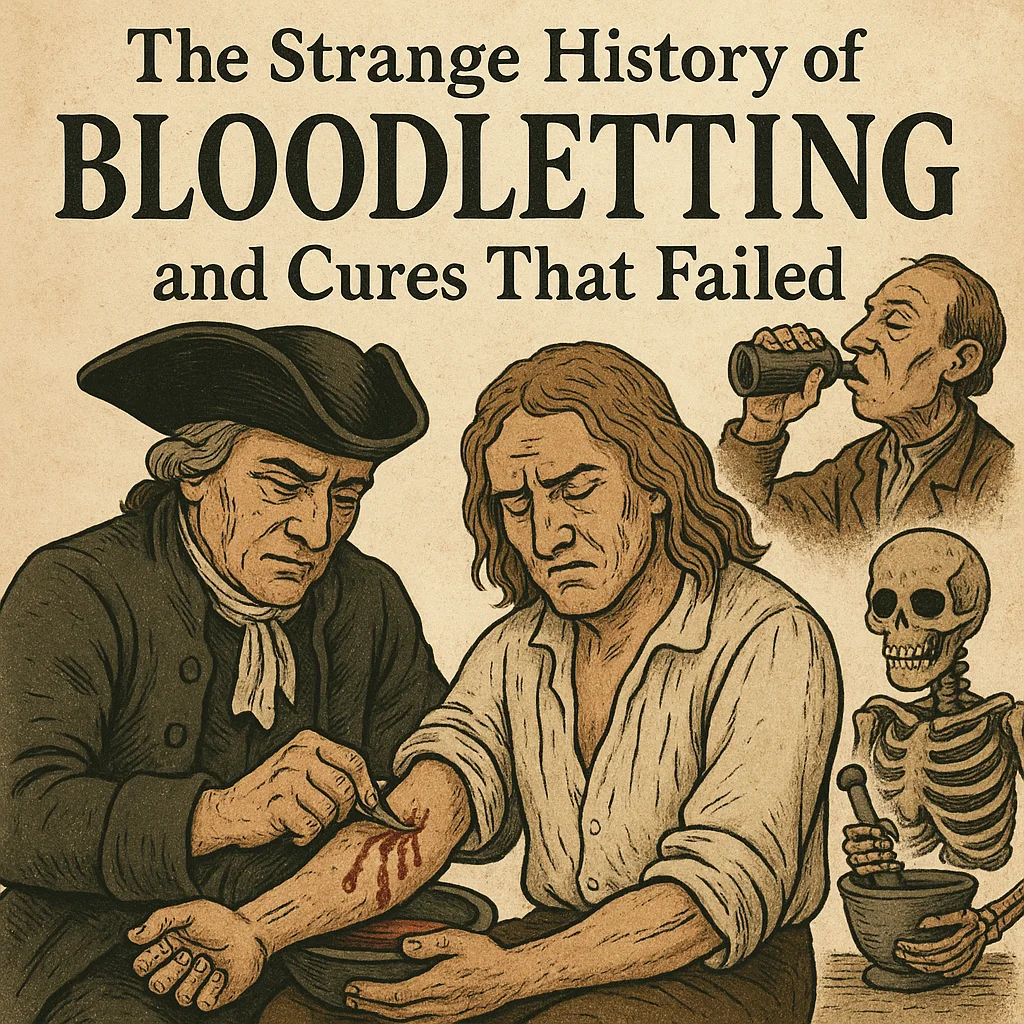
Medicine has always involved a combination of trial and error, discovery, and occasionally downright strange methods. Bloodletting, an ancient medical practice based on the idea that illness was brought on by an imbalance of bodily fluids, is one of the most bizarre and enduring of these. In an attempt to restore health, physicians, barbers, and healers have been drawing blood from patients for centuries. Although bloodletting was once thought to be a fundamental component of medicine, it now appears to be almost barbaric. There were numerous other "cures" that went along with it, ranging from ineffectual to downright dangerous, serving as a reminder that the road to contemporary healthcare has been paved with mistakes.
This article examines the peculiar origins of bloodletting, the reasons behind its longevity, and some of the other unsuccessful treatments that influenced the development of medicine.
The Origins of Bloodletting
Bloodletting is a custom that dates back over 3,000 years. It was practiced by the ancient Egyptians, Greeks, and Romans, who held that the balance of the four "humors"—blood, phlegm, yellow bile, and black bile—was essential to the body's health. For centuries, this theory—first put forth by Hippocrates and then developed by Galen—dominated Western medicine.
An excess of blood was frequently blamed for a person's fever, headache, or infection. The answer? Take some of it off. Doctors thought they could release "toxins," lower fever, or restore balance by lowering blood volume.
Bloodletting took many forms:
-
Venesection: Cutting open a vein and letting blood flow out.
-
Cupping: Using heated cups to draw blood to the surface of the skin.
-
Leeching: Applying leeches to slowly suck blood out of the body.
As a reminder of the time when barbers also served as medical professionals, the barber's pole, a red and white spiraling symbol that is still used today, is said to symbolize blood and bandages.
Bloodletting in the Middle Ages
Bloodletting was one of the most common medical practices in both Europe and the Islamic world by the Middle Ages. It was prescribed by doctors to treat everything from epilepsy to headaches, fevers, and plague. Bloodletting was frequently used to "treat" even mental illness because it was thought that too much blood would make people agitated or insane.
Charts, frequently based on astrology, were maintained by hospitals and monasteries to determine when and where to bleed patients. According to the theory, bloodletting would only be most successful during specific times because the moon and stars' positions affected the humors.
The practice was not limited to the impoverished. Bloodletting was accepted by popes, kings, and queens who saw it as a sign of superior medical practice. Paradoxically, the therapy frequently made patients weaker and occasionally accelerated their demise.
Famous Victims of Bloodletting
One of the most striking aspects of bloodletting’s history is how many famous people it harmed—or possibly killed.
-
George Washington: In 1799, the first American president became ill due to a throat infection. Over the course of two days, his doctors extracted almost 40% of his blood. Historians concluded that the "cure" was more deadly than the illness because Washington passed away soon after.
-
Charles II of England: After suffering a seizure in 1685, he was subjected to repeated bloodletting, purging, and blistering treatments. His decline was rapid, and he died shortly after.
-
Countless unnamed patients across centuries endured similar fates, their illnesses worsened rather than healed by the loss of vital fluids.
Why Did Bloodletting Last So Long?
Looking back, it seems baffling that such an ineffective treatment persisted for nearly two millennia. Several reasons explain its longevity:
-
The Authority of Tradition: Ancient philosophers like Hippocrates and Galen had a strong influence on medical theory. For centuries, it was deemed heretical to challenge them.
-
The Illusion of Effectiveness: Following bloodletting, some patients did experience brief relief; this was probably due to placebo effects or decreased blood pressure. This strengthened the physicians' faith in the therapy.
-
Lack of Alternatives: Doctors had limited resources because there were no antibiotics, germ theory, or contemporary diagnostics. At least bloodletting gave the impression that something was being done.
-
Social Status: Those who were wealthy frequently demanded dramatic, visible treatments. In accordance with social norms, bloodletting offered a theatrical kind of treatment.
Other Strange Cures That Failed
Bloodletting was not the only bizarre cure in medical history. Across cultures, people experimented with remedies that now seem shocking, ineffective, or outright dangerous.
1. Trepanation – Drilling Holes in the Skull
Drilling holes into the skull to relieve pressure or release evil spirits was one of the earliest known medical practices. Rarely, it might have lessened brain edema, but most patients died or contracted an infection.
2. Mercury Treatments
Mercury has been used for centuries to treat syphilis and other illnesses. Patients were instructed to apply it to their skin, swallow it, or breathe in vapors. Sadly, mercury is extremely toxic and frequently causes death, organ failure, and insanity.
3. Snake Oil and “Miracle Elixirs”
Vendors of "snake oil" and other tonics in the 19th century claimed that they could treat anything from baldness to arthritis. The majority contained opium, alcohol, or nothing of value.
4. Radioactive “Cures”
Both uranium and radium were promoted as health products at the beginning of the 20th century. Before widespread radiation poisoning put an end to the craze, radium water, radioactive toothpaste, and even "radium underwear" were touted as energy boosters.
5. Lobotomies
Misguided cures were still a problem in medicine even in the 20th century. In order to treat mental illness, lobotomies—the surgical cutting of brain connections—were frequently carried out. Although they occasionally helped patients relax, they frequently left people permanently injured or incapacitated.
The Turning Point: Modern Medicine Emerges
The reputation of bloodletting was too damaged by the 19th century to be disregarded. Centuries-old theories regarding humors were called into question by developments in anatomy, physiology, and the discovery of germs.
Using statistical techniques, physicians such as Pierre Charles Alexandre Louis demonstrated that bloodletting had no positive effects on patient outcomes. By the late 1800s, scientifically supported treatments had supplanted the practice in mainstream medicine.
Bloodletting hasn't completely vanished, though. These days, it's used in very specific cases, like polycythemia vera (an overproduction of red blood cells) or hemochromatosis (a condition where the body has too much iron). Although the reasoning behind it is completely different from the ancient humoral theory, it does in fact benefit patients in these uncommon situations.
Lessons from Failed Cures
The history of bloodletting and other strange cures is not just a curiosity—it carries important lessons:
-
Medical Authority Can Be Wrong – A practice is not necessarily right just because it is common or supported by experts. It is crucial to conduct critical testing.
-
Placebo and Perception Matter – Because they seemed to be effective, many "cures" continued. One should not undervalue the role that belief plays in healing.
-
Science Is Self-Correcting – Science changes, as evidenced by the eventual abandonment of unsuccessful treatments. Even though errors occur, progress eventually advances.
-
Humility Is Necessary – Examining past unsuccessful treatments serves as a reminder that modern medicine may also appear antiquated or misguided in the future.
Conclusion: A Strange but Necessary Journey
The history of bloodletting and other unsuccessful treatments demonstrates both human resiliency and frailty. Using the best knowledge available at the time, people underwent risky treatments for centuries in the hopes of surviving. These approaches opened the door for more in-depth research, skepticism, and scientific discoveries, even though they frequently failed or caused more harm than good.
Every unsuccessful treatment was, in a way, a part of the lengthy medical apprenticeship. We might not have achieved the level of medical sophistication we do now if it weren't for the errors made by bloodletting, mercury treatments, and radioactive tonics.
Strange as it may seem, the rivers of blood that were shed in barbershops and hospitals during the Middle Ages were a part of the cost humanity had to pay in order to finally discover the secrets of health. And perhaps in centuries to come, people will look back on some of our current treatments with the same astonishment, reminding us that medicine is a constantly evolving field.