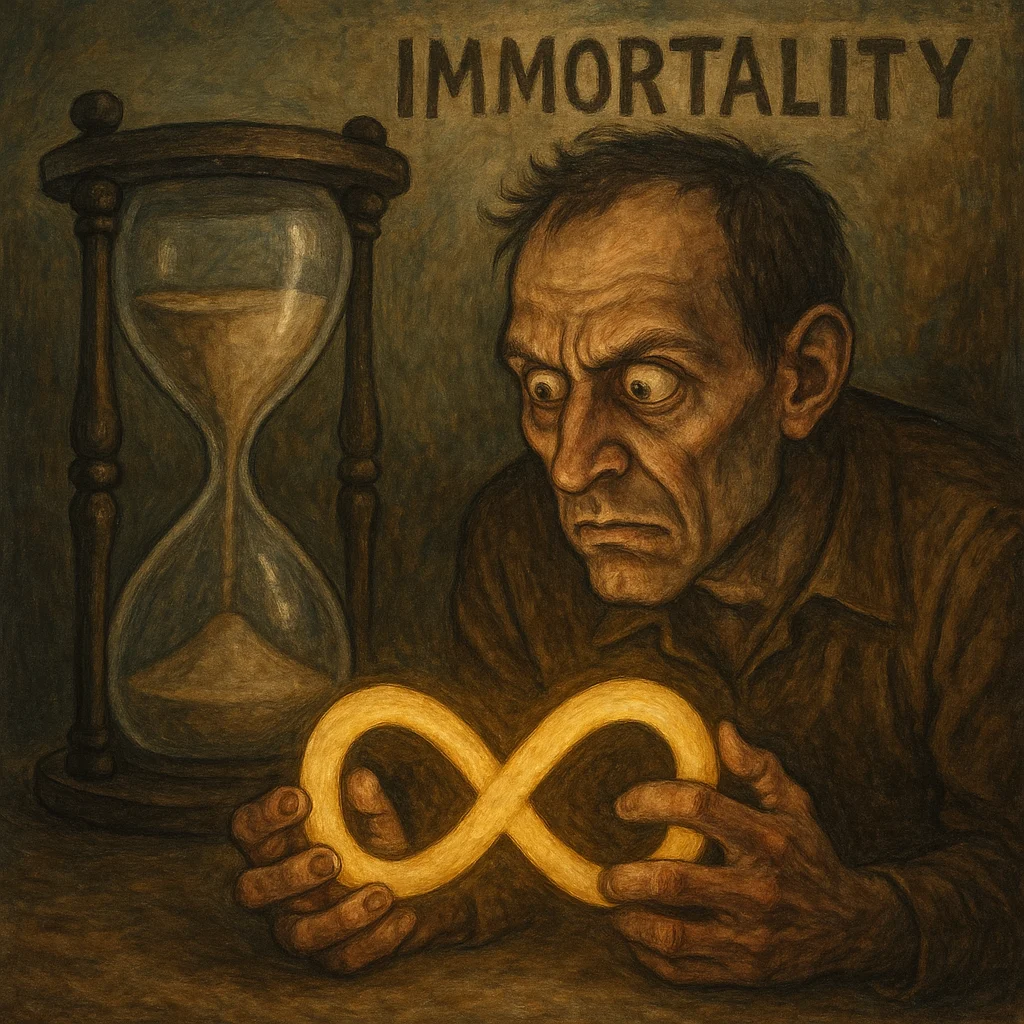
Death has always been a source of conflict for humans. Despite being the only thing that is certain in life, it is also the biggest mystery. There has been a profound and persistent fascination with immortality—the wish to live forever beyond the confines of the body—across cultures, religions, philosophies, and even science. The desire to live forever has influenced human imagination and aspirations for thousands of years, from ancient myths of perpetual youth to state-of-the-art biotechnology that seeks to reverse aging.
However, why does immortality have such a lasting appeal? Is it the human urge to hold on to life, a fear of nonexistence, or a desire for control? And would it really be a blessing—or a curse—if immortality were possible?
We'll examine the origins of humanity's fixation with immortality in this blog, as well as how it has influenced culture and advancement and what it means for the contemporary world.
1. Ancient Myths and the Origins of Immortality
The goal of immortality was a spiritual or mythical one long before technology or medicine offered any chance of prolonging life. Stories of gods, heroes, and seekers seeking eternal life were created by every great civilization.
-
Greek Mythology: The gods gave the mortal Tithonus eternal life, but he neglected to request eternal youth. His unending, deteriorating old age turned into a warning about the drawbacks of immortality.
-
Chinese Daoism: Alchemists mixed minerals and herbs to make concoctions that promised eternal life in an attempt to find the elixirs of life.
-
Gilgamesh’s Quest: The Epic of Gilgamesh, one of the oldest stories ever written, describes the hero's fervent quest for immortality following the passing of his friend Enkidu. His failure served as an example of a basic reality: everyone dies.
-
Christianity and Islam: These religions reinterpret immortality as spiritual continuation rather than physical preservation by promising eternal life in heaven in place of bodily immortality.
The first indications of humanity's resistance to accepting death as the end can be seen in these myths. The desire persisted despite tales warning of the curse of immortality.
2. Philosophy and the Meaning of Death
Philosophers have long debated whether the desire for immortality is rational—or even desirable.
-
Socrates and Plato: According to Plato, the soul transcended the body and was eternal. Therefore, death was a transition rather than an end.
-
The Stoics: According to philosophers like Marcus Aurelius, fearing death is illogical since it is a normal aspect of life. According to their philosophy, freedom results from accepting mortality.
-
Modern Existentialists: According to Martin Heidegger and Jean-Paul Sartre, death is essential to human meaning. Life becomes more urgent because of mortality, which compels us to make decisions and define who we are.
There is a clear philosophical thread: our discomfort with meaninglessness is revealed by our obsession with immortality. Would life still be as intense if it were endless? If our moments lasted forever, would we cherish them?
3. Science and the Modern Pursuit of Immortality
Myths and philosophy provided symbolic responses, but science has adopted a more literal stance. Technological developments over the past century have rekindled the idea that immortality—not in heaven, but on Earth—is possible.
-
Medicine and Longevity: Human longevity has already doubled since the invention of antibiotics, vaccines, and surgery. Recent studies on genetic editing, stem cells, and telomeres indicate that aging itself may be slowed or even reversed.
-
Cryonics: In the hopes that future research will bring them back to life, some businesses offer to preserve bodies in frozen suspension.
-
Mind Uploading: Ray Kurzweil and other futurists envision digital immortality through the transfer of consciousness into machines.
-
Transhumanism:a movement that promotes the use of technology to improve human minds and bodies in order to eventually surpass death itself.
The fact that billionaires, scientists, and entrepreneurs are making significant investments in this endeavor demonstrates how alive the obsession is, even though none of these routes promise immortality.
4. Why Are Humans So Obsessed With Living Forever?
The reasons behind humanity’s fixation on immortality are complex:
-
Fear of the Unknown – The great unknown is death. The mystery of nonexistence is unnerving, regardless of one's level of reason or spirituality.
-
Attachment to Loved Ones – Many people wish they lived longer because they would have to leave behind friends and family.
-
Legacy and Achievement – Infinite time to achieve goals, create, and make a difference in the world is promised by immortality.
-
Biological Instinct – We are hardwired to survive. Humans are naturally rebellious against the finality of death because evolution has prepared us to fight for life.
-
Illusion of Control – The ultimate control over nature and the last obstacle to be surmounted is immortality.
Yet, beneath all these reasons lies a paradox: immortality may not give us the satisfaction we imagine.
5. The Dark Side of Immortality
Though stories and thought experiments usually suggest immortality could be a nightmare, it is often depicted as the ultimate dream.
-
Boredom and Stagnation: Would objectives become less urgent if life never ended? Meaning could be diluted by endless time.
-
Overpopulation: There would be problems with sustainability, space, and resources in a world without deaths.
-
Psychological Weight: Living forever could cause irreversible grief from losing loved ones for generations.
-
Inequality: Only the wealthy could afford immortality if it were costly, further dividing society.
Immortals are frequently portrayed in science fiction as aloof, icy, or even hopeless. Perhaps mortality adds richness to life rather than being a flaw.
6. Accepting Mortality Without Fear
Modern psychologists, Buddhist monks, and stoic philosophers frequently argue that changing our relationship with death—rather than avoiding it—is the key.
-
Memento Mori (Remember Death): The Stoics promoted daily contemplation of mortality to foster thankfulness and concentration rather than to arouse fear.
-
Living Fully in the Present: Instead of chasing endless tomorrows, mindfulness practices emphasize living in the present.
-
Redefining Legacy: True immortality might not be found in eternal life, but rather in the influence we have on other people, the thoughts we share, and the love we give.
Death, rather than robbing life of meaning, may actually be the very thing that makes it precious.
7. The Future of the Immortality Quest
Will people ever be able to live forever? The truthful response is ambiguous. Research on aging is speeding up, and discoveries could significantly increase lifespans this century. It's unclear, though, if that results in actual immortality or merely healthier aging.
The pursuit of immortality will undoubtedly continue. It is ingrained in our deepest psychology, our myths, and our sciences. The dream persists whether we look for eternal life in silicon, the heavens, or our genes.
Perhaps the better course of action is to live life to the fullest so that we are prepared for death, rather than to conquer it. "To practice death is to practice freedom," as philosopher Michel de Montaigne once stated. A man has unlearned how to be a slave after learning how to die.
Conclusion
Humans have been obsessed with immortality for as long as civilization has existed; it is a combination of ambition, hope, and fear. The deeper question is still whether immortality would genuinely make us happy or if it would deprive life of its purpose and urgency, even though technology may help us live longer.
Perhaps accepting death as the boundary that defines our existence—rather than trying to avoid it—is the solution. Rather than being afraid of death, we can use it as inspiration to live clearly, love passionately, and focus on the things that really matter.
Ultimately, immortality might not be about having an endless lifespan, but rather about making the years we do have count.