Change is frequently hailed as the ultimate symbol of progress in the fast-paced world of today. We are instructed to "never stay still," "keep evolving," and "reinvent yourself constantly." Motion has come to be associated with progress; the faster, the better.
However, many of us have begun to experience a subtle weariness along the way. Something feels strange even though the goals, habits, cities, and jobs have changed. We're always changing, but we don't always feel satisfied.
That’s because not all change is progress.
Change can occasionally turn into a cycle of escape, a means of avoiding discomfort, stifling boredom, or seeking approval. And the change we once desired starts to lose significance when that occurs.
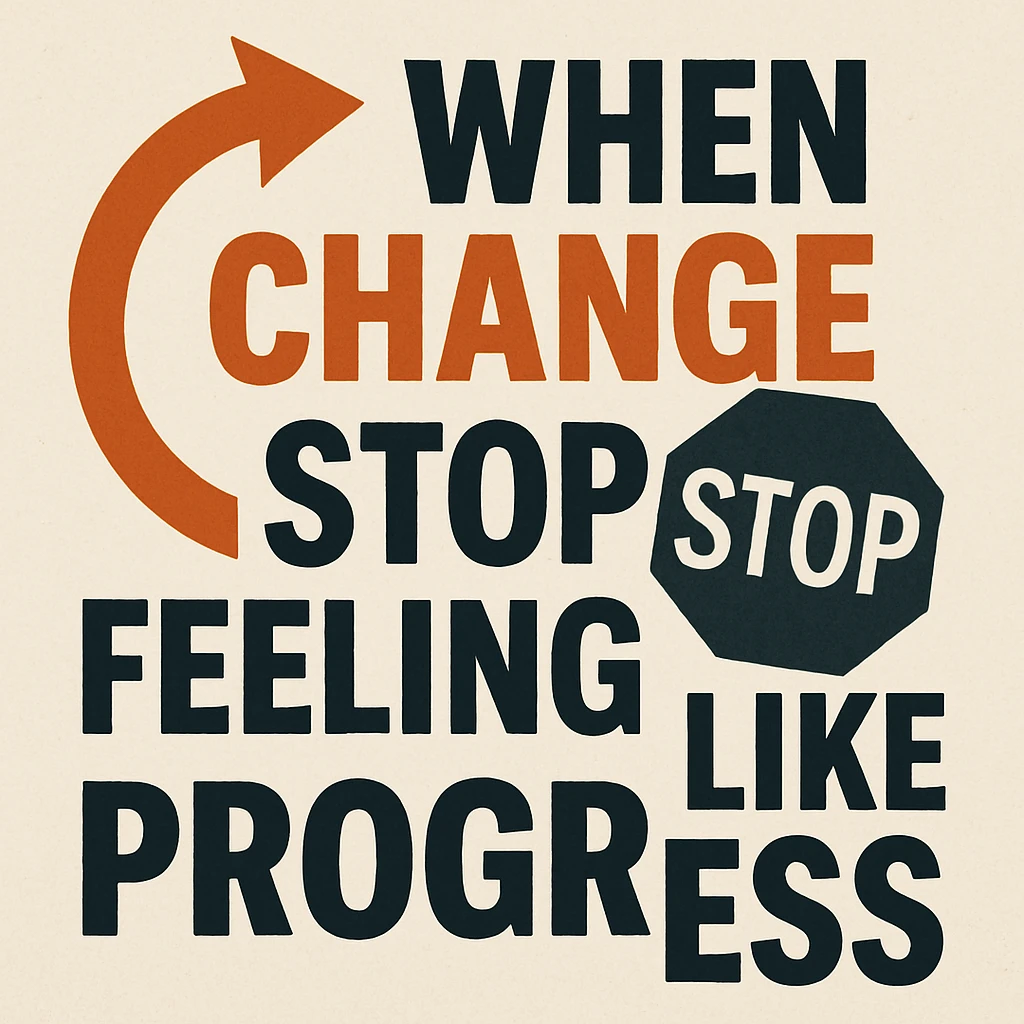
At this point, motion takes the place of direction, evolution turns into exhaustion, and change ceases to feel like progress.
The Illusion of Constant Motion
Speed is praised in our culture. Reinvention, creativity, and productivity are now regarded as virtues. The world assumes you're lagging behind if you're not making any progress.
You're encouraged to keep going—upgrade your phone, pick up new skills, change careers, streamline your daily routine, and keep getting better. The message is straightforward: more growth equates to more change.
But here’s the paradox — endless motion can mask stagnation.
We can run faster without really getting anywhere, like a hamster on a wheel. We get caught in a cycle of perpetual reinvention without true transformation when we confuse change for advancement.
By definition, progress is movement in the direction of a goal, a value, or a vision. On the other hand, change is just movement, any movement. Change that isn't intentional turns into noise rather than music.
Why We Keep Changing Without Growing
Why do we continue to change if it doesn't always result in advancement? Modern psychology and culture hold the key to the solution.
1. The Fear of Standing Still
We've been taught to be afraid of silence. Being satisfied can feel like a failure in a society that is fixated on progress. We believe that we are regressing if we are not actively changing. The most radical act of self-awareness, however, can occasionally be standing motionless—the pause that enables direction to resurface.
2. The Addiction to Novelty
Novelty is adored by the human brain. Dopamine, the feel-good hormone, is released with every new encounter, connection, or concept. However, the high quickly wears off, leaving us wanting more. This cycle causes us to mistake excitement for progress and keep searching for the next big thing.
3. The External Validation Loop
The appearance of progress is heightened by social media. We use the internet to display our changes—new careers, new cities, new objectives—often as a sign of accomplishment. Change turns into a performance. It is more important to consider how we are viewed than who we are becoming.
4. The Avoidance of Depth
Another strategy for avoiding emotional depth is constant change. It can feel like control to reinvent ourselves when life is uncertain or painful. However, without introspection, we might just be changing masks.
When Change Becomes Exhaustion
There comes a point when even positive change begins to drain us. You might notice:
-
You’re constantly “starting over” but never feeling settled.
-
You chase new goals before celebrating old ones.
-
You feel anxious when life is calm or predictable.
-
You no longer feel connected to your choices — only obligated to keep making them.
This is change fatigue — a state where the pursuit of transformation becomes emotionally unsustainable.
When your motivation changes from curiosity to compulsion, you can tell. You're running away, not exploring anymore.
Real growth adds depth and meaning to life. Endless change, on the other hand, eventually hollows it out.
Progress Is Directional — Change Is Neutral
It’s easy to mistake activity for advancement. But progress is not about how much we change — it’s about why we change.
To see the difference, imagine two people climbing a mountain:
-
The first person keeps moving up one trail with patience, adapting to obstacles, learning from each step.
-
The second keeps switching trails whenever one gets difficult, never reaching the summit.
Both are moving — but only one is progressing.
Real progress in life necessitates having a sense of direction, which includes values, objectives, and a purpose that direct our actions. We are merely aimlessly reinventing ourselves in their absence.
Change becomes meaningful only when it serves something greater than itself.
The Emotional Cost of Unanchored Change
When we live in constant motion, we lose more than energy — we lose grounding.
We start to lose our sense of self. We never stay in one place long enough to discover what it is that truly fulfills us, so we stop knowing.
This causes a kind of existential drift, a subtle ache. You may look back on your life and see that everything has changed on the outside, but on the inside, you still feel the same confusion and desire.
Change turns into a revolving door without emotional grounding; new plans, new goals, and new faces all lead to the same emptiness.
The Difference Between Growth and Escape
To tell whether your changes are helping you grow or keeping you stuck, ask yourself:
-
Am I changing toward something, or away from something?
-
Does this change align with my deeper values, or just my fears?
-
Is this transformation rooted in curiosity or avoidance?
Expanding entails facing discomfort, enduring uncertainty, and gaining a deeper understanding.
Evasion, or the desire to replace discomfort with novelty, is a component of escape.
Genuine advancement might not always appear glamorous. It frequently entails learning to be patient, enduring uncertain times without hastily reinventing, and enduring difficult emotions.
How to Reconnect With Real Progress
You just need to find meaning again if change is starting to feel meaningless. You don't have to stop changing. Here's how:
1. Revisit Your “Why”
There should be a deeper meaning behind every change than just success on the outside. Ask yourself: What am I actually looking for here? Calm? Why? Development? Having a place?
Slow down if you are unable to respond clearly. Wait until the "why" is clear before taking any action.
2. Embrace Stability as a Form of Strength
Consistency can sometimes be a sign of progress—attending the same activity, connection, or objective each day. Stasis is not the same as stability. In disguise, it's mastery.
3. Learn the Art of Staying
It makes sense to remain motionless and to let things develop before uprooting them. It takes time for habits, careers, and relationships to pay off. Deep roots cannot form if you keep replanting.
4. Redefine Growth
Not all growth is evident. Learning to relax, forgive, and listen more intently can be quiet at times. To evolve, you don't always have to alter your life; sometimes you just need to shift your viewpoint.
5. Build a Personal Compass
Your core values—truth, compassion, curiosity, courage, and authenticity—make up a compass. Make decisions based on these. Progress is always the result of change that is in line with values.
The Wisdom of Stillness
In a world that glorifies movement, stillness becomes revolutionary.
Being still does not imply doing nothing; rather, it refers to being sufficiently present to comprehend your direction before proceeding.
Rather than during chaos, great change frequently follows silence. Clarity returns during these quiet times, and we rediscover the goal we were pursuing all along.
When we slow down, we start to differentiate between what’s truly changing us and what’s merely distracting us.
The Paradox of True Progress
Sometimes, real progress feels like stagnation, failure, or even reversal. because external milestones aren't always indicative of true growth.
It occurs when depth is prioritized over speed. when you begin to respect your truth and quit seeking approval. when you let yourself grow not only upward into accomplishments but also downward into roots.
Change that feels empty teaches us something vital: progress is not about movement — it’s about meaning.
Conclusion: When Change Becomes Wisdom
Every human eventually experiences a time when change ceases to excite them; continuous change becomes exhausting rather than liberating.
It's a signal, not a failure. It indicates that you're prepared for more profound development, the kind that is independent of novelty or movement.
Because the real goal isn’t to keep changing endlessly.
It’s to change wisely.
To know which transformations lead you closer to yourself — and which simply pull you further away.
So if change has stopped feeling like progress, don’t force more motion. Sit in the stillness. Listen. Reflect.
The next phase of your life may not start with a significant shift; rather, it may start with realizing the change that has already occurred.
The quiet understanding that you are already changing, even when you are at a standstill, is where true progress starts, not the next move.