Between what we know and what we do, there is an imperceptible pause that is rife with uncertainty, hesitancy, and hypothetical thoughts. The majority of us have been there, torn between two choices, not knowing which path to choose. We convince ourselves that we are "waiting," "thinking," or "not ready yet." But something else is going on in the background.
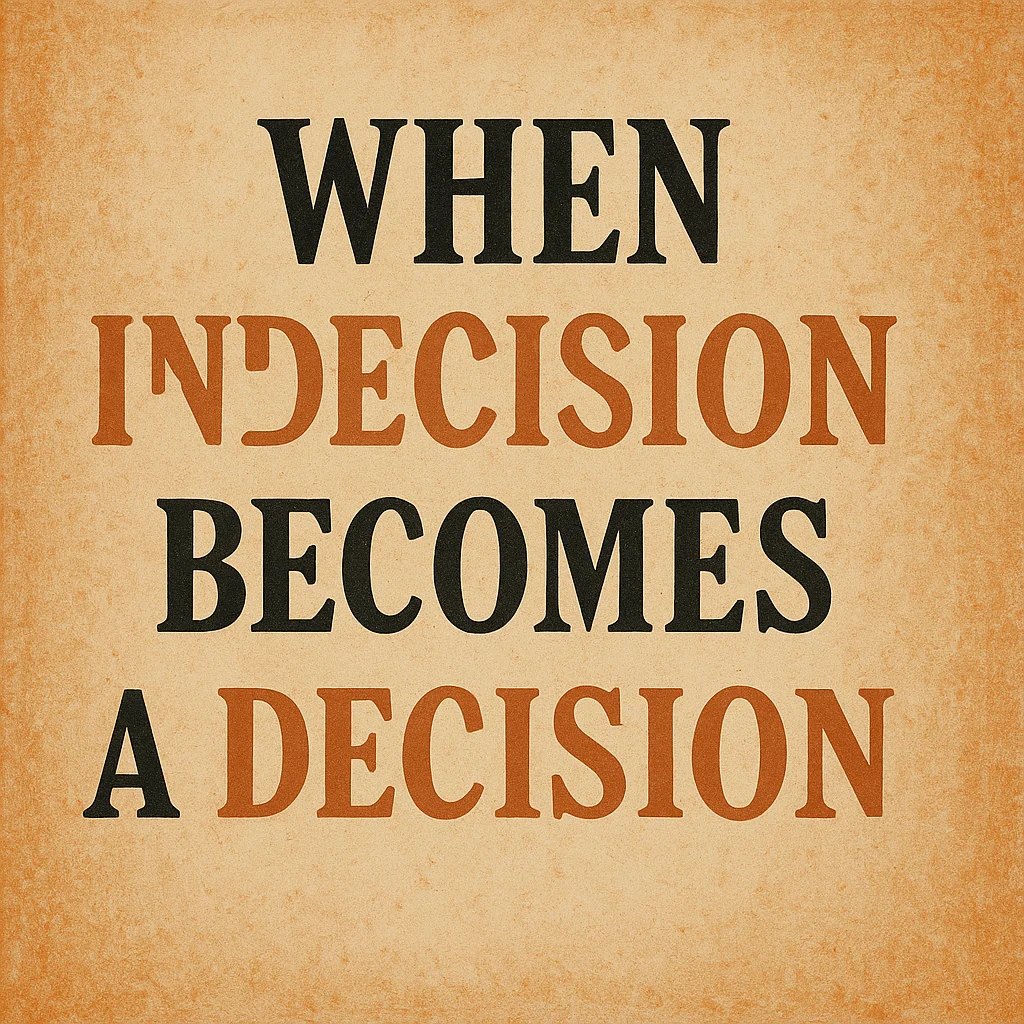
That pause—if it stretches too long—becomes a decision in itself.
Although we don't often consider it to be action, indecision is. It's the silent decision to let other people, time, or chance make the decision for us. We also forfeit our autonomy, our sense of purpose, and occasionally our aspirations in the process.
Let’s explore how indecision quietly rules our lives, why it happens, and how we can break free from it.
1. The Illusion of Waiting for the “Right” Time
Our minds seek certainty when confronted with difficult decisions, such as changing careers, ending a relationship, or beginning a new chapter. We promise ourselves that we'll take action once we're "certain." However, certainty is a myth.
Rarely is there an ideal time to jump. The right moment doesn't show up with a big sign; rather, it comes when you decide it is.
Often, indecision passes for wisdom or patience. More often, though, it's a mask of fear. We decide not to move at all because we are afraid of making the wrong move. The irony? That silence is its own guide. Whether we are involved or not, life goes on.
The world isn't waiting for us to be certain. Chances pass. Relationships change over time. Energy wanes. We are still making the decision to remain in our current location by not making a choice.
2. Why We Fear Decisions
Indecision thrives in fear. At its root, the inability to choose often comes down to one of three things:
1. Fear of failure:
We fear that making the "wrong" decision will result in loss or regret. However, every choice has some risk. Avoiding the option merely converts the risk into lost time; it does not remove it.
2. Fear of judgment:
We are hesitant because of the opinions of others about our decisions. We forget that no one else must bear the consequences of our choices when we delegate decision-making to hypothetical viewpoints.
3. Fear of change:
The familiar feels safer than the unfamiliar, even when it causes us pain. Instead of progress, our brains are programmed for predictability. As a result, we continue in our routines, jobs, and relationships well after they should end—not out of reason, but out of comfort.
These fears create mental fog. But clarity isn’t something that arrives before a decision—it’s something that follows one.
3. The Hidden Cost of Indecision
Not being sure is not neutral. It is in operation. It takes up more time, effort, and focus than the repercussions of making the wrong decision ever could.
Every day spent wavering is a day not spent moving. And movement, even imperfect, is what life demands.
Here’s what indecision costs you over time:
-
Mental exhaustion: Overthinking drains willpower. The longer you delay, the heavier the decision becomes.
-
Lost opportunities: While you wait, doors quietly close. Some never open again.
-
Erosion of confidence: Each postponed decision reinforces self-doubt, making the next one harder.
-
Emotional limbo: You feel restless but stuck, anxious but inert—a painful contradiction.
The cost of inaction is frequently greater than the cost of making a mistake. Because at least mistakes can teach us. Growth is merely delayed by indecision.
4. The Psychology of Avoidance
Why do we get stuck? Psychology offers an answer: the paradox of choice.
We feel overwhelmed when presented with an excessive number of options. We freeze because our brains can't handle the possible outcomes. The more options we have, the more difficult it is to choose one.
But there’s also a deeper, more emotional reason—we don’t trust ourselves.
We question our judgment, our intuition, and our capacity to deal with the fallout. We thus wait for outside confirmation or assurance, which never materializes.
In truth, confidence doesn’t come from always being right—it comes from trusting that you can handle being wrong.
When you accept that no decision guarantees comfort, only direction, you begin to move again.
5. Indecision as a Silent Choice
Here’s the paradox: when you don’t decide, the world decides for you.
Comfort is what you choose if you don't follow your dreams.
You choose to stay in a toxic environment if you don't want to leave it.
You choose silence—and its repercussions—if you don't speak up.
Like a river, life is. Being motionless does not imply remaining motionless. Whether you paddle or not, the current flows around you and carries you downstream.
Every choice left undone is a silent ceding of power. And more often than not, that surrender determines your fate more than any conscious decision ever could.
6. The Freedom of Choosing Imperfectly
One of the greatest truths about decision-making is this: you don’t need to be certain—you just need to be willing.
Willing to risk.
Willing to learn.
Willing to move forward without knowing everything.
There is no such thing as a "perfect" decision. There are trade-offs on every path. There are unknowns in every outcome. Making deliberate decisions and making adjustments along the way is more important than avoiding errors.
You regain your freedom when you give yourself permission to make bad decisions. You begin to live with curiosity instead of being paralyzed by the need for control.
And often, the act of choosing—of committing to a direction—creates clarity you couldn’t have found by thinking alone.
7. Decision as a Form of Power
Choice is power. The ability to say, “This is what I will do” defines your relationship with life itself.
Every decision is a statement of identity. When you choose, you’re saying, “This is who I am and what I stand for.”
Momentum is created by people who regularly make decisions, no matter how small. They become more deliberate and less reactive. That decision-making process gradually strengthens one's inner fortitude and self-confidence.
By contrast, chronic indecision erodes both. It leaves you drifting—reacting to circumstances rather than shaping them.
So, every decision, no matter how small, becomes a declaration: “I am the author of my own story.”
8. How to Break the Cycle of Indecision
If indecision has become a habit, there are ways to reverse it and reclaim your clarity:
1. Simplify your choices.
Too many options paralyze. Narrow it down to two or three. Eliminate what clearly doesn’t align with your values.
2. Use time as a tool, not a trap.
Set a deadline. Give yourself a window to think—and then decide. Endless reflection is procrastination disguised as care.
3. Practice small decisions daily.
Decisiveness is a muscle. Build it through everyday choices—what to eat, where to focus, how to spend an hour.
4. Ask: What would I choose if I weren’t afraid?
Often, beneath hesitation lies truth. That question reveals what your intuition already knows.
5. Accept imperfect outcomes.
Even if things don’t go as planned, action creates momentum. Mistakes can be fixed. Stagnation can’t.
9. The Courage to Decide
Courage isn’t the absence of fear—it’s moving forward despite it.
Making a choice means venturing into the unknown, which is where growth occurs. Instead of waiting for life to happen to you, you take control of it. You take back control of your own story.
In actuality, every choice, whether positive or negative, imparts knowledge. Nothing can be learned from indecision. It keeps you going through the same ambiguity in the hopes of finding clarity only after taking action.
The moment you choose, life begins to move again.
10. Conclusion: The Decision to Decide
Although indecision is the slowest form of surrender, it feels safe. Although it shields you from discomfort right away, it steals your time, energy, and autonomy in a covert manner.
Everything changes when you understand that not making a decision is the same as making one. You begin making decisions actively rather than inadvertently. Rather than waiting for assurances, you begin to trust yourself.
Remember this straightforward fact the next time you're faced with a choice dilemma: You just need to start, not be certain.
Because in the end, the only wrong choice is the one you never make.